US Dollar erases gains after White House labels Amazon as hostile and political
- The US Dollar goes nowhere, paring back earlier gains after Bessent's comments at the White House.
- The Trump administration labels Amazon as hostile after the company decided to communicate tariff impact on its products.
- The US Dollar Index is still capped below the 100.00 round level, trading near 99.40 on Tuesday.

The US Dollar Index (DXY), which tracks the performance of the US Dollar (USD) against six major currencies, is having a knee jerk reaction on the back of comments from United States (US) Treasury Secretary Scott Bessent and White House Press Secretary Karoline Leavitt. During a Q&A at the White House Leavitt stepped in to take over from Bessent on a question around Amazon, that will publish the tariff impact on prices from goods it is selling on its website. Representative Leavitt said she just got off the phone with President Donald Trump and that this move by Amazon is considered hostile and is political motivated, Bloomberg Television reported. Meanwhile markets already got disappointed by Secretary Bessent as apparently no trade deals are to be announced, and will take several more weeks before done.
On the economic calendar front, there is some lighter data ahead on Tuesday, with the central theme on the JOLTS Job Openings report for March. Although this is backward-looking, before US tariffs were implemented, it could already give a sentiment if US companies were preparing for an impact and reduced their job hiring activity. Besides that, the preliminary US Goods Trade Balance for March saw a further deterioration of its deficit.
Daily digest market movers: JOLTS miss, Confidence dips
- Sentiment tanked during the White House press conference where both Bessent and Leavitt spoke to reports. The main shocker came after Leavitt said that she just got off the phone with President Trump and that off now, the White House labels Amazon as hostile and that showing tariffs on each product is a hostile and political act.
- The preliminary US Goods Trade Balance for March saw a wider deficit, at $162 billion, coming from the previous deficit at $147 billion.
- Preliminary Wholesale Inventories for March came in at 0.5%, below the expected 0.7% and matching the 0.5% revised number from February.
- The February House Price Index fell to only a monthly 0.1% increase, missing the 0.3% estimate and from a revised 0.3% in February.
- The JOLTS Job Openings report for March fell to 7.192 million openings, missing the7.5 million expected and coming from 7.568 million previously. The Consumer Confidence for April is fell to 86.0 for April, coming from 93.9 in March.
- US equity are seeing whipsaw moves on the back of the White House comments on Amazon, while rate cut bets are gaining in momentum with US data starting to roll over further.
- The CME FedWatch tool shows the chance of an interest rate cut by the Federal Reserve in the May’s meeting stands at 8.9% against a 91.1% probability of no change. The June meeting sees a 62.6% chance of a rate cut.
- The US 10-year yields trade around 4.19%, ticking a bit lower with traders slowly but surely buying back into US bonds.
US Dollar Index Technical Analysis: If it is one thing, it's messy
The US Dollar Index (DXY) is not going anywhere as traders keep their powder dry for the US key economic data later this week. Meanwhile some geopolitical headlines on easing tariffs are off-setted by headlines from China or other countries in response to the Trump administration. When looking at US data, the Dallas Fed Manufacturing survey could be the first real sign that the US economic performance will start to deteriorate, calling for quick interest rate cuts from the Fed, and a weaker US Dollar before US economic numbers recover again.
On the upside, the DXY’s first resistance comes in at 100.22, which supported the DXY back in September 2024, with a break back above the 100.00 round level as a bullish signal. A firm recovery would be a return to 101.90, which acted as a pivotal level throughout December 2023 and again as a base for the inverted head-and-shoulders formation during the summer of 2024.
On the other hand, the 97.73 support could quickly be tested on any substantial bearish headline. Further below, a relatively thin technical support comes in at 96.94 before looking at the lower levels of this new price range. These would be at 95.25 and 94.56, meaning fresh lows not seen since 2022.
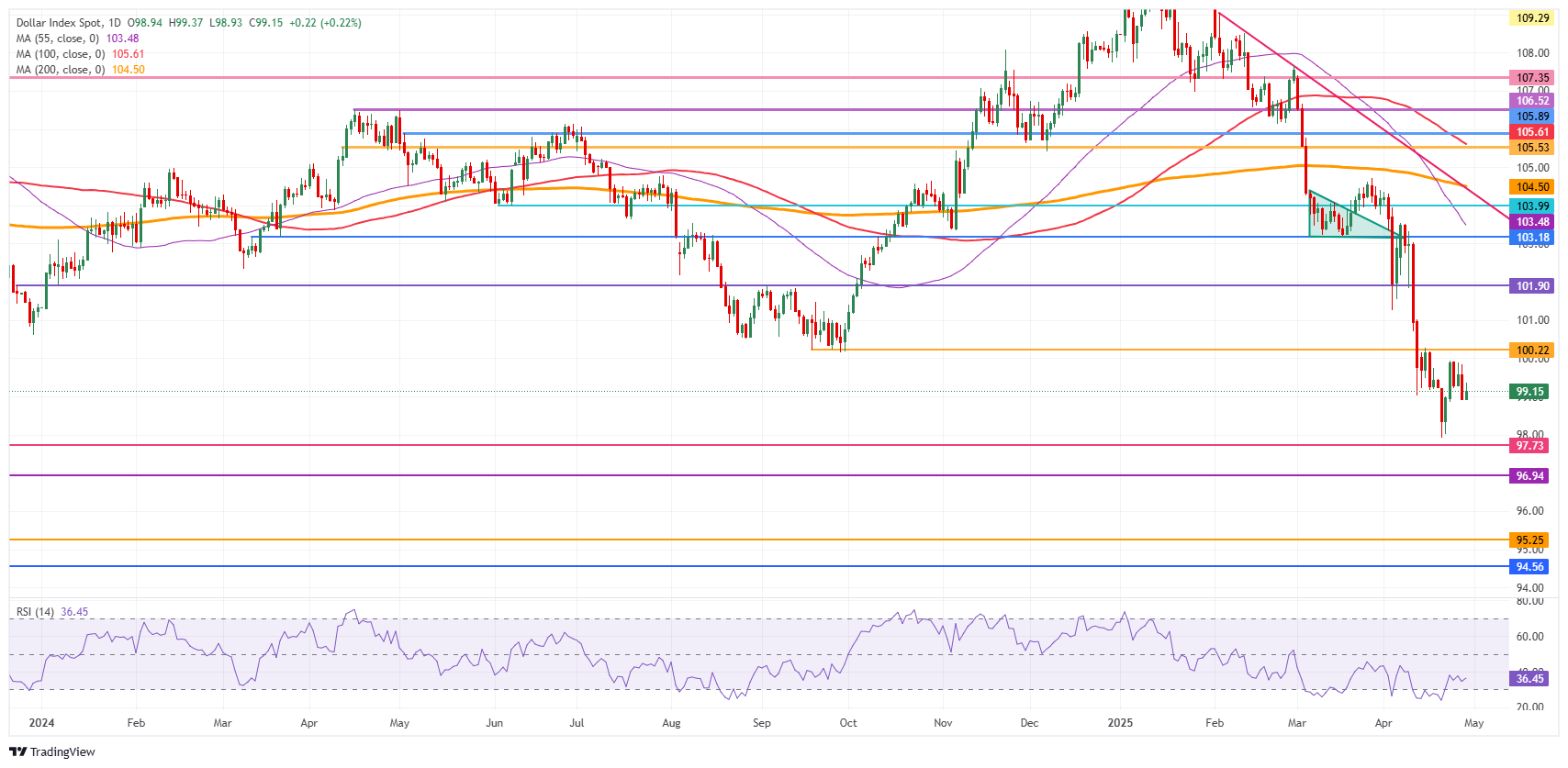
US Dollar Index: Daily Chart
Employment FAQs
Labor market conditions are a key element to assess the health of an economy and thus a key driver for currency valuation. High employment, or low unemployment, has positive implications for consumer spending and thus economic growth, boosting the value of the local currency. Moreover, a very tight labor market – a situation in which there is a shortage of workers to fill open positions – can also have implications on inflation levels and thus monetary policy as low labor supply and high demand leads to higher wages.
The pace at which salaries are growing in an economy is key for policymakers. High wage growth means that households have more money to spend, usually leading to price increases in consumer goods. In contrast to more volatile sources of inflation such as energy prices, wage growth is seen as a key component of underlying and persisting inflation as salary increases are unlikely to be undone. Central banks around the world pay close attention to wage growth data when deciding on monetary policy.
The weight that each central bank assigns to labor market conditions depends on its objectives. Some central banks explicitly have mandates related to the labor market beyond controlling inflation levels. The US Federal Reserve (Fed), for example, has the dual mandate of promoting maximum employment and stable prices. Meanwhile, the European Central Bank’s (ECB) sole mandate is to keep inflation under control. Still, and despite whatever mandates they have, labor market conditions are an important factor for policymakers given its significance as a gauge of the health of the economy and their direct relationship to inflation.
Author

Filip Lagaart
FXStreet
Filip Lagaart is a former sales/trader with over 15 years of financial markets expertise under its belt.















