US Dollar sticks to tight Friday ranger after softer Michigan reading
- The US Dollar trades a touch higher after PPI data comes in stronger.
- Traders are keeping US interest rates elevated in the assumption less rate cuts from Fed.
- The US Dollar Index trades above 102.50 and struggles to break above 103.00.

The US Dollar (USD) ticks a touch higher on Friday after a very solid rally this week, with the rate differential becoming the main driver. The question going forward for next week will be if this upward move in US Treasury rates was a bit overdone, seeing the US Consumer Price Index (CPI) only marginally ticked up in September compared to the previous month. This contradicts what several Federal Reserve (Fed) officials have said this week, that US rates will go lower with more interest rate cuts from the Fed confirmed.
The economic calendar is facing this week's last pieces of the puzzle. The US Producer Price Index (PPI) release for September wa already an upbeat surprise as with the US CPI release on Thursday. The last data point was the preliminary reading from the University of Michigan on Consumer Sentiment and inflation expectations for October, which came in below expectations.
Daily digest market movers: PPI hot, Michigan soft
- At 12:30 GMT, the US Producer Price Index numbers for September were released:
- The monthly headline PPI fell to 0.0.% from 0.2% in the previous month, with core PPI falling in line of expecationas, down to 0.2% from 0.3% previous.
- The yearly headline PPI inflation went to 1.8% with the previous figure revised up from 1.7% yo 1.9%. The core PPI came in higher at 2.8%, coming from 2.4% which got revised up as well to 2.6%.
- At 14:00 GMT, the University of Michigan preliminary reading for October was released:
- Consumer Sentiment fell to 68.9, coming from 70.1.
- 5-year consumer inflation expectations came in at 3.0% in September.
- There are a few Fed speakers to look out for on Friday:
- At 13:45 GMT, Austan D. Goolsbee, head of the Federal Reserve Bank of Chicago, gives opening remarks at the Community Bankers Symposium.
- At 17:10 GMT, Federal Reserve Governor Michelle Bowman (2024 FOMC voting member) delivers a virtual speech about community banking at the Federal Reserve Bank of Chicago Community Bankers Symposium.
- Equities soared after the US opening bell with the Michigan numbers as catalyst to drive equities higher.
- The CME Fedwatch Tool shows an 84.0% chance of a 25 bps interest rate cut at the next Fed meeting on November 7, while 16.0% is pricing in no rate cut. Chances for a 50 bps rate cut have been fully priced out now.
- The US 10-year benchmark rate trades at 4.10, afloat above 4%.
US Dollar Index Technical Analysis: Michigan as devil in the detail
The US Dollar Index (DXY) has had a quick sprint higher this week, with markets repositioning in the idea that interest rate cuts might be a certainty for the remainder of 2024. Although Fed officials are still very vocal on more rate cuts to come, the current move in US Treasury rates does not match with that message from the Fed. Either markets completely price out any rate cuts for 2024, which would mean the DXY break above 103.00, or it fades from here with US rates falling lower.
The psychological 103.00 is the first level to tackle on the upside. Further up, the chart identifies 103.18 as the very final resistance level for this week. Once above there, a very choppy area emerges, with the 100-day Simple Moving Average (SMA) at 103.26, the 200-day SMA at 103.77, and the pivotal 103.99-104.00 levels in play.
On the downside, the 55-day SMA at 101.91 is the first line of defence, backed by the 102.00 round level and the pivotal 101.90 as support to catch any bearish pressure and trigger a bounce. If that level does not work out, 100.62 also acts as support. Further down, a test of the year-to-date low of 100.16 should take place before more downside. Finally, and that means giving up the big 100.00 level, the July 14, 2023, low at 99.58 comes into play.
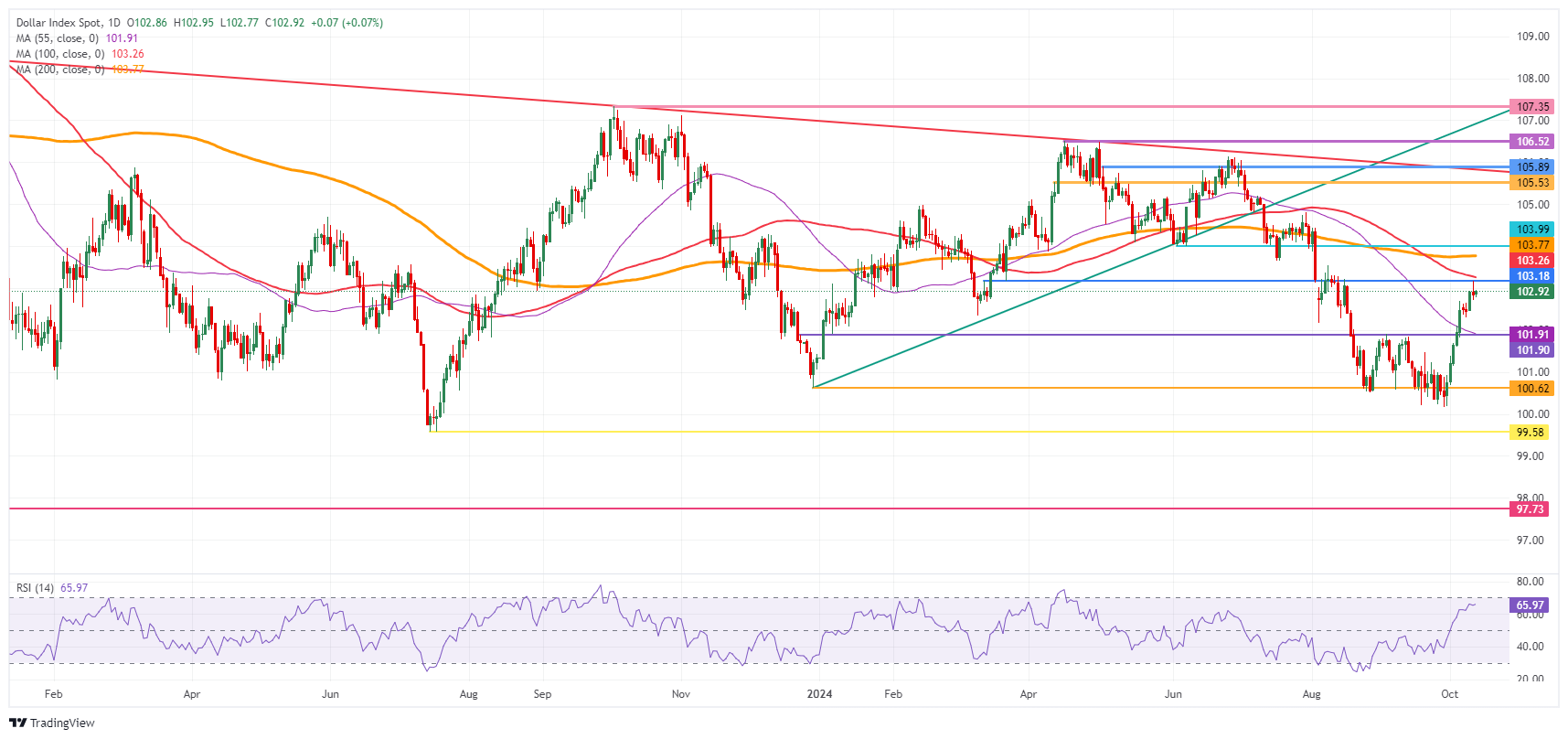
US Dollar Index: Daily Chart
Fed FAQs
Monetary policy in the US is shaped by the Federal Reserve (Fed). The Fed has two mandates: to achieve price stability and foster full employment. Its primary tool to achieve these goals is by adjusting interest rates. When prices are rising too quickly and inflation is above the Fed’s 2% target, it raises interest rates, increasing borrowing costs throughout the economy. This results in a stronger US Dollar (USD) as it makes the US a more attractive place for international investors to park their money. When inflation falls below 2% or the Unemployment Rate is too high, the Fed may lower interest rates to encourage borrowing, which weighs on the Greenback.
The Federal Reserve (Fed) holds eight policy meetings a year, where the Federal Open Market Committee (FOMC) assesses economic conditions and makes monetary policy decisions. The FOMC is attended by twelve Fed officials – the seven members of the Board of Governors, the president of the Federal Reserve Bank of New York, and four of the remaining eleven regional Reserve Bank presidents, who serve one-year terms on a rotating basis.
In extreme situations, the Federal Reserve may resort to a policy named Quantitative Easing (QE). QE is the process by which the Fed substantially increases the flow of credit in a stuck financial system. It is a non-standard policy measure used during crises or when inflation is extremely low. It was the Fed’s weapon of choice during the Great Financial Crisis in 2008. It involves the Fed printing more Dollars and using them to buy high grade bonds from financial institutions. QE usually weakens the US Dollar.
Quantitative tightening (QT) is the reverse process of QE, whereby the Federal Reserve stops buying bonds from financial institutions and does not reinvest the principal from the bonds it holds maturing, to purchase new bonds. It is usually positive for the value of the US Dollar.
Author

Filip Lagaart
FXStreet
Filip Lagaart is a former sales/trader with over 15 years of financial markets expertise under its belt.