US Dollar sees some gains on a quiet start of the week
- DXY stalls around 103.95 as market sentiment remains fragile.
- Traders eye Wednesday’s US CPI data for fresh market direction.
- Nasdaq slides 3.3%, dragging broader equities lower.

The US Dollar (USD) remains under pressure on Monday, with DXY hovering around 103.95, struggling to find traction after last week's steep decline. Federal Reserve (Fed) Chair Jerome Powell’s latest remarks on Friday reassured markets that the central bank sees no urgent need to adjust policy at the moment, though economic uncertainties are growing. Meanwhile, the Nasdaq is facing heavy market losses, down 3.3%, as investors remain cautious ahead of key United States (US) inflation data due midweek.
Daily digest market movers: Fed in focus as CPI looms
- Market participants are bracing for the release of February’s Consumer Price Index (CPI) on Wednesday, expected to provide key insights into inflation trends.
- The Federal Reserve enters its blackout period ahead of the March 19 meeting, limiting central bank commentary for the week.
- Fed Chair Jerome Powell reiterated on Friday that the Fed remains patient and does not see an urgent need to act, preferring to wait for additional economic data before making any policy changes.
- US equities face a sharp correction, with the Nasdaq leading losses, down 3.3%.
- CME FedWatch Tool indicates a majority expectation for rates to remain at current levels in May, while June rate cut expectations have risen significantly.
- Ahead of the blackout media period, the Fed’s sentiment index on the daily chart has fallen towards neutral ground, which could also explain the USD’s decline.
DXY technical outlook: Testing support near 103.50
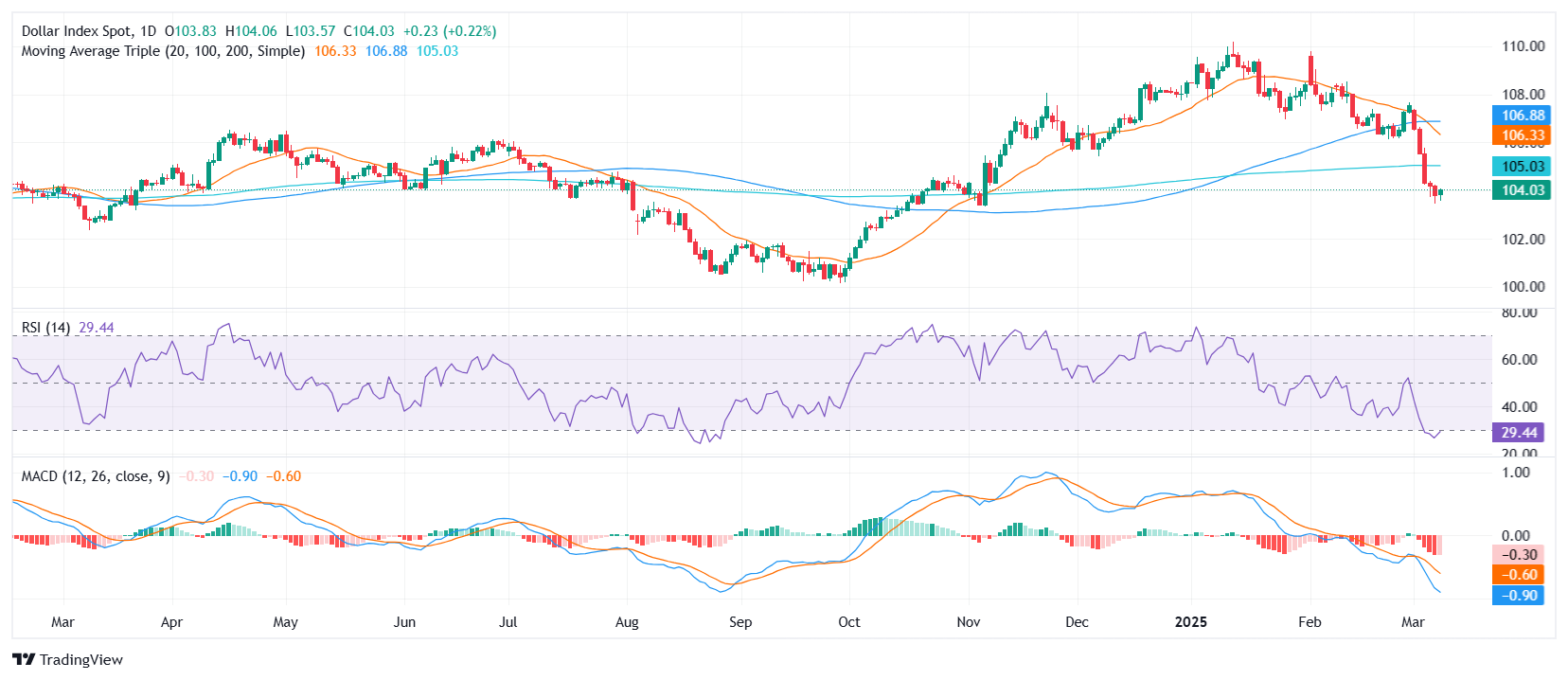
The US Dollar Index (DXY) stabilizes below 104.00, consolidating after last week’s steep drop. The 20-day and 100-day Simple Moving Averages (SMA) confirmed a bearish crossover near 107.00, reinforcing the negative trend. The Relative Strength Index (RSI) remains near oversold territory, signaling potential for a short-term rebound. Meanwhile, the Moving Average Convergence Divergence (MACD) remains bearish, suggesting further downside risk unless buyers step in near support levels. If DXY fails to reclaim 104.50, the next support is seen near 103.30, which could determine whether a deeper decline unfolds.
Fed FAQs
Monetary policy in the US is shaped by the Federal Reserve (Fed). The Fed has two mandates: to achieve price stability and foster full employment. Its primary tool to achieve these goals is by adjusting interest rates. When prices are rising too quickly and inflation is above the Fed’s 2% target, it raises interest rates, increasing borrowing costs throughout the economy. This results in a stronger US Dollar (USD) as it makes the US a more attractive place for international investors to park their money. When inflation falls below 2% or the Unemployment Rate is too high, the Fed may lower interest rates to encourage borrowing, which weighs on the Greenback.
The Federal Reserve (Fed) holds eight policy meetings a year, where the Federal Open Market Committee (FOMC) assesses economic conditions and makes monetary policy decisions. The FOMC is attended by twelve Fed officials – the seven members of the Board of Governors, the president of the Federal Reserve Bank of New York, and four of the remaining eleven regional Reserve Bank presidents, who serve one-year terms on a rotating basis.
In extreme situations, the Federal Reserve may resort to a policy named Quantitative Easing (QE). QE is the process by which the Fed substantially increases the flow of credit in a stuck financial system. It is a non-standard policy measure used during crises or when inflation is extremely low. It was the Fed’s weapon of choice during the Great Financial Crisis in 2008. It involves the Fed printing more Dollars and using them to buy high grade bonds from financial institutions. QE usually weakens the US Dollar.
Quantitative tightening (QT) is the reverse process of QE, whereby the Federal Reserve stops buying bonds from financial institutions and does not reinvest the principal from the bonds it holds maturing, to purchase new bonds. It is usually positive for the value of the US Dollar.
Author

Patricio Martín
FXStreet
Patricio is an economist from Argentina passionate about global finance and understanding the daily movements of the markets.