|

US Dollar Index under pressure as US-China tension ease

  • Tensions between the US and China over trade war is easing. 
  • The US Dollar index is under pressure as the week starts. 

The US Dollar Index is trading at around 89.09 down 0.46% on the day so far as tensions of a trade war between the US and China seem to somewhat cool off.

The US and China are negotiating trade agreements so that the US can have access to Chinese markets. China is willing to buy more semiconductors from the US in addition to opening up the financial services sector to foreign investment, according to the Financial Times.

The China retaliation to US tariffs should have minimal impact as only a “relatively small part of trade is being impacted and the retaliatory steps seem symbolic”. According to BBH analysts.

New York Federal Reserve Bank President William Dudley has a speech scheduled at 17:30 GMT about regulatory reform at the US Chamber of Commerce while Cleveland Federal Reserve Bank President Loretta Mester will speak about monetary policy at 20:30 GMT.

Earlier the Chicago Fed National Activity came in at 0.88 vs 0.19 expected while the Dallas Fed Manufacturing Index in March came in at 21.4 vs 33.4. 

US Dollar Index weekly chart
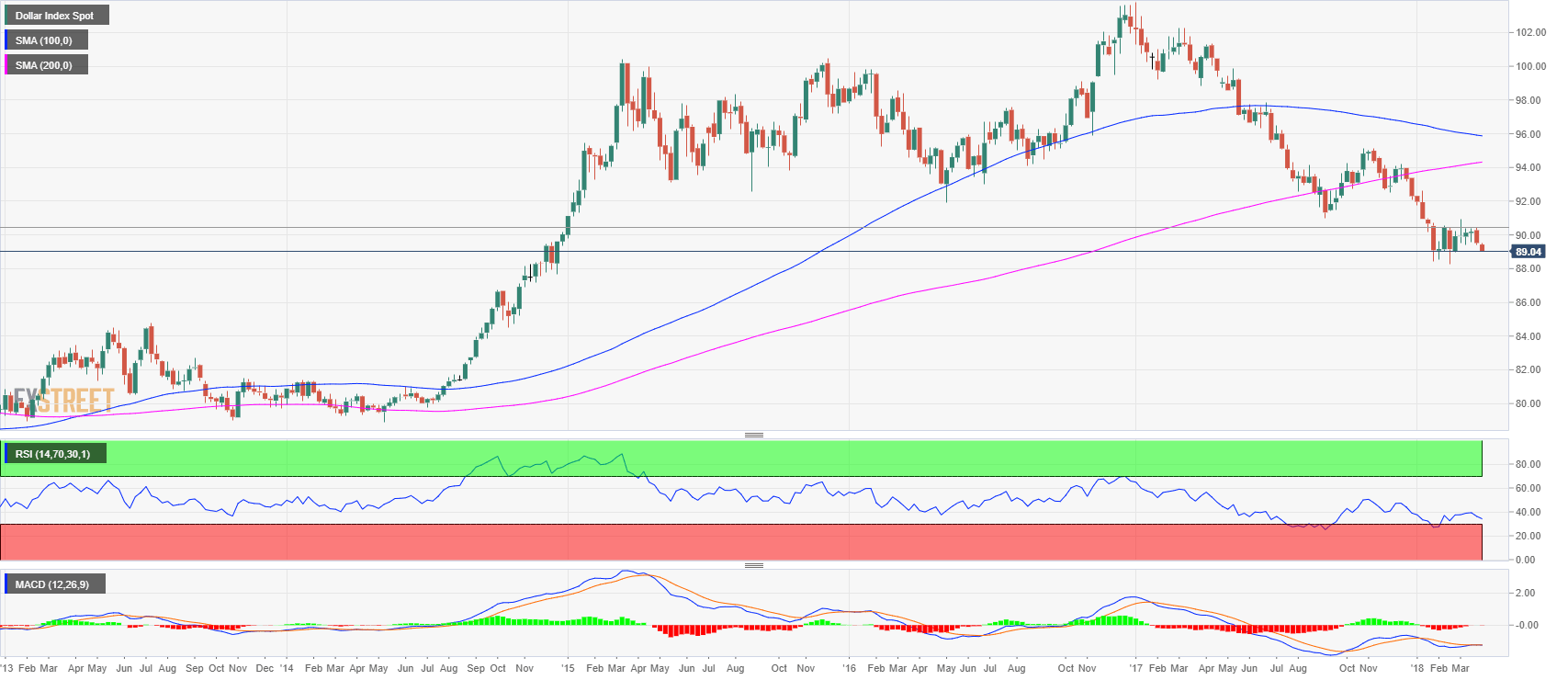
Weekly support is seen at 89.00 supply/demand level; followed by 88.25 last cyclical low. On the other hand, weekly resistance is seen at the 90.00 psychological mark, followed by 90.96 last cyclical high. 

US Dollar daily chart
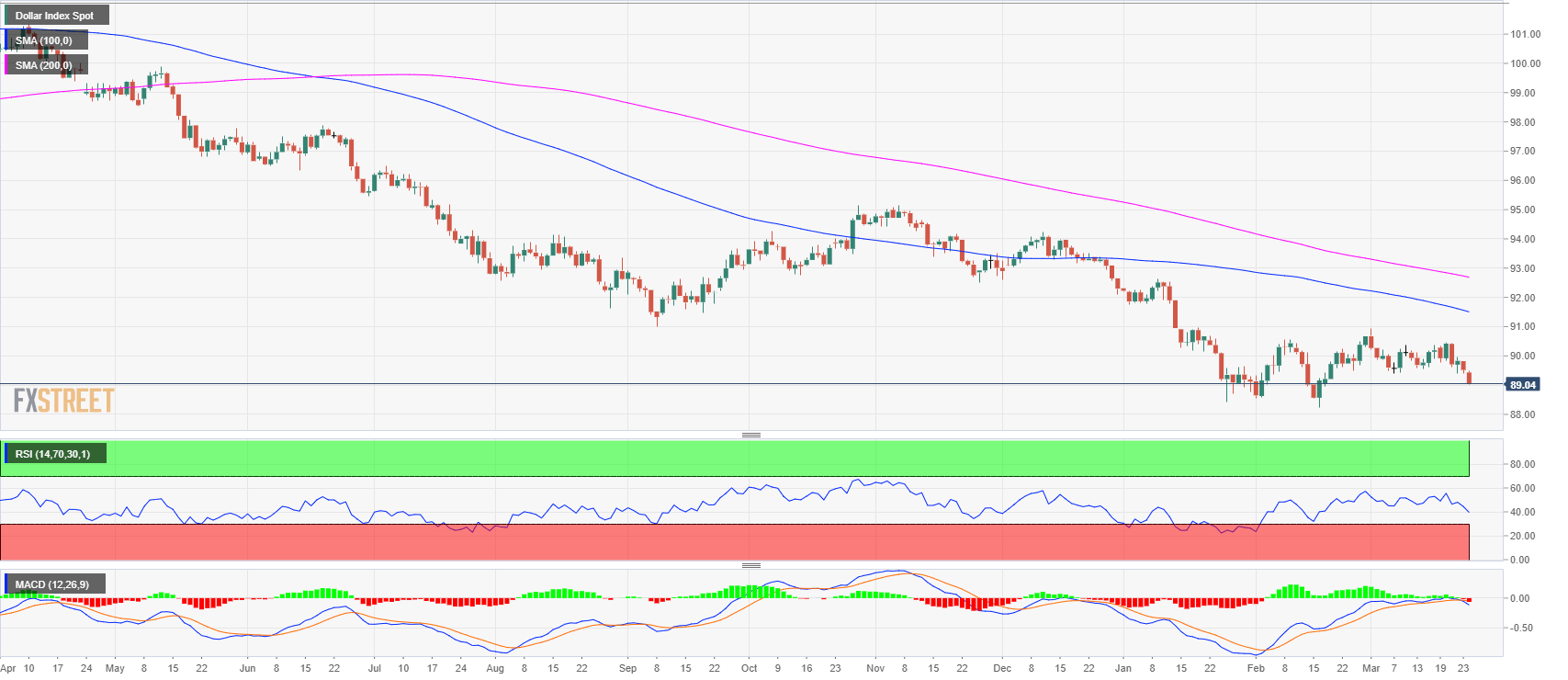
Support is seen at 88.50, previous demand level; followed by 88.25 cyclical low. Resistance is seen at 89.45 supply level and the 90.00 psychological mark. Both Relative Strength Index (RSI) and Movcing Average Convergence/Divergence (MACD) are bearishly configured. 

Author

Flavio Tosti

Flavio Tosti

Independent Analyst

 

More from Flavio Tosti
Share:

Markets move fast. We move first.

Orange Juice Newsletter brings you expert driven insights - not headlines. Every day on your inbox.

By subscribing you agree to our Terms and conditions.

Editor's Picks

EUR/USD falls to near 1.1700 due to safe-haven demand

EUR/USD extends its losses, trading around 1.1710 during the Asian hours on Monday. The pair loses ground as the US Dollar strengthens on safe-haven demand, driven by a renewed rise in geopolitical risks following the United States’ capture of Venezuelan President Nicolas Maduro.

GBP/USD trades with modest losses below mid-1.3400s as geopolitical tensions lift USD

The GBP/USD pair opens with a modest bearish gap at the start of a new week and trades just below mid-1.3400s during the Asian session, down 0.10% for the day. Spot prices, however, lack follow-through selling and manage to hold above last week's swing low amid mixed fundamental cues.

Gold jumps over 1.5% to near $4,400 on US-Venezuela tensions

Gold holds sizeable gains near $4,400 in the Asian trading hours on Monday. The traditional safe-haven metal capitalizes on escalating geopolitical risks after the United States' capture of Venezuelan President Nicolas Maduro. Traders will closely monitor developments surrounding the US seizure of Maduro and await the US ISM Manufacturing Purchasing Managers' Index data later on Monday. 

Powerful guide to ISM, building permits, NFP and Silver technicals

Next week is important for U.S. markets. We get key economic data that can move stocks, bonds, and the dollar. The main reports are ISM Manufacturing, ISM Services, Building Permits, and Non-Farm Payrolls. Traders will watch these closely.

Economic outlook 2026-2027 in advanced countries: Solidity test

After a year marked by global economic resilience and ending on a note of optimism, 2026 looks promising and could be a year of solid economic performance. In our baseline scenario, we expect most of the supportive factors at work in 2025 to continue to play a role in 2026.

Crypto market outlook for 2026

Year 2025 was volatile, as crypto often is.  Among positive catalysts were favourable regulatory changes in the U.S., rise of Digital Asset Treasuries (DAT), adoption of AI and tokenization of Real-World-Assets (RWA).
















