US Dollar Index: DXY retreats as United States recession woes contradict Federal Reserve talks
- US Dollar Index fades bounce off 7.5-month low marked the previous day.
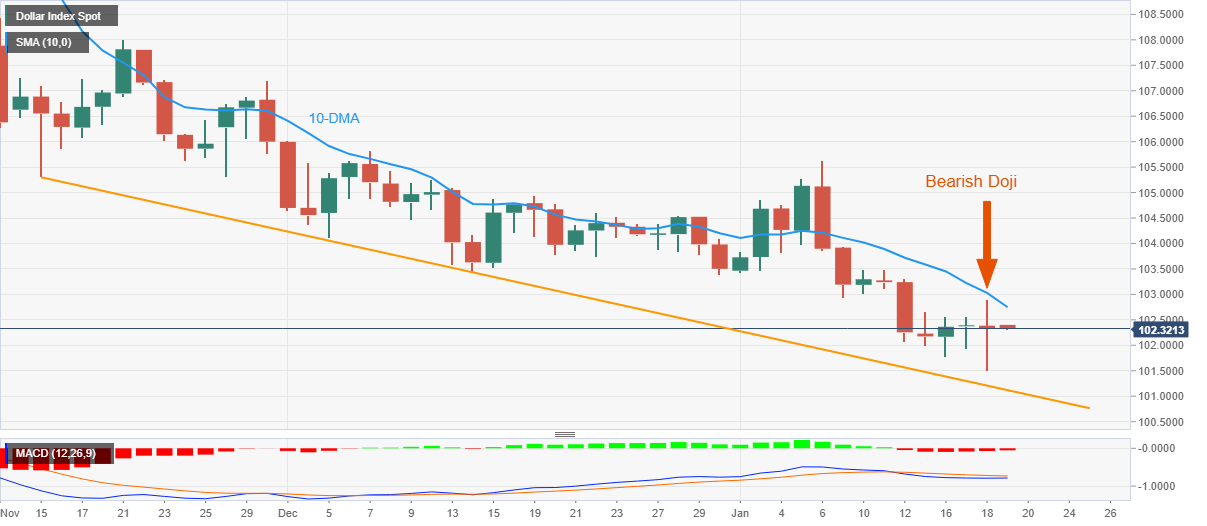
- Doji candlestick challenges early-week DXY rebound from multi-day low.
- United States data fails to challenge the Federal Reserve’s hawkish bias but the US Dollar struggles.
- Fewer important catalysts to track; qualitative factors are the key to clear directions.


US Dollar Index (DXY) remains pressured around 102.30 after failing to recover from the lowest levels since May 31, 2022. In doing so, the US Dollar gauge versus the six major currencies struggles for clear directions as fears of the United States recession contradict the recent Federal Reserve (Fed) talks.
Fears of United States recession defend US Dollar Index bulls
After witnessing downbeat US data recently, disappointment from the US economic calendar highlighted the economic recession woes inside the world’s biggest economy, which in turn weigh on the hawkish Fedspeak and challenge the US Dollar Index bulls.
That said, US Retail Sales marked the biggest slump in a year while posting a 1.1% MoM contraction for December, versus -0.8% market forecasts and -1.0% prior (revised). On the same line, Producer Price Index dropped to the lowest level in six months with a -0.5% MoM figure compared to -0.1% expected and 0.2% prior (revised).
Mixed Federal Reserve speech, China concerns probe DXY traders
Federal Reserve (Fed) policymakers remained hawkish as St. Louis Federal Reserve's President James Bullard said US interest rates have to rise further to ensure inflationary pressures recede. On the same line, President of the Federal Reserve Bank of Cleveland Loretta Mester praised the Fed’s actions for taming inflation.
Further, Kansas City Fed President Esther George mentioned that the central bank must restore price stability, "that means returning to 2% inflation." Recently, Dallas Federal Reserve President Lorie Logan supported a slower rate hike pace but also mentioned possibly a higher stopping point.
Besides the Fed talks, China-related headlines also put a floor under the US Dollar Index (DXY). That said, Analysts at Goldman Sachs expected more robust China growth and favored hopes of more energy demand from the dragon nation. However, fears of the US-China tension outweigh the optimism of late. US Treasury Secretary Janet Yellen and Chinese China’s Vice Premier Liu He met in Germany on Wednesday and initially boosted the risk appetite, together with the BOJ’s inaction. However, the diplomats’ mentioning of the areas of disagreement raised market fears of another round of US-China tension. Previously, the South China Morning Post (SCMP) previously mentioned that Beijing ‘should be wary’ as the US and Taiwan seek closer economic ties.
Downbeat United States Treasury bond yields probe DXY buyers
Not only the Bank of Japan’s (BOJ) surprise inaction but the receding fears of the Federal Reserve’s (Fed) aggressive monetary policy actions also drowned the United States Treasury bond yields on Wednesday. That said, the BOJ left monetary policy and the interest rates unchanged, but the US 10-year Treasury bond yields dropped the most in 10 weeks, pressured around the four-month low near 3.37% by the press time. As a result, the US Dollar Index traces the US Treasury bond yields amid the mixed signals from the Fed.
Nothing major on the calendar
Given the light calendar ahead, US Dollar Index (DXY) may take clues from the risk catalysts, mainly the headlines from China and the Federal Reserve talks for clear directions, not to forget the Treasury bond yields. Should cautious optimism prevails, the DXY may refresh the multi-day low.
US Dollar Index technical analysis
US Dollar Index justifies the previous day’s bearish Doji candlestick as it retreats toward the lowest levels marked during late May 2022. Also adding strength to the bearish bias could be the downbeat signals from the Moving Average Convergence and Divergence (MACD) indicator.
As a result, the DXY is well-set to probe the mid-2022 bottom surrounding 101.30 while citing the 102.00 round figure as the immediate support.
It’s worth noting that a downward-sloping support line from mid-November 2022, around 101.10 by the press time, could challenge the US Dollar Index weakness past 101.30.
Alternatively, the 10-Day Moving Average (DMA) level near 102.75 guards the DXY recovery moves, a break of which highlights the previous monthly low surrounding 103.40 as the key hurdle.
If the US Dollar Index remains firmer past 103.40, the odds of its run-up to the monthly peak near 105.65 can’t be ruled out.
DXY Price: Daily chart
Trend: Further weakness expected
Author
Anil Panchal
FXStreet
Anil Panchal has nearly 15 years of experience in tracking financial markets. With a keen interest in macroeconomics, Anil aptly tracks global news/updates and stays well-informed about the global financial moves and their implications.

















