The British Pound goes into PMI week paying for softer inflation and slower pay
- GBP/USD falls to a 12-month low under 1.3100 as bets on a BoE hike fade.
- UK inflation at 3.6% and pay growth at 3.5% both came in under forecast.
- UK PMIs and BoE Chief Economist Pill on Monday, then US core PCE on Wednesday.


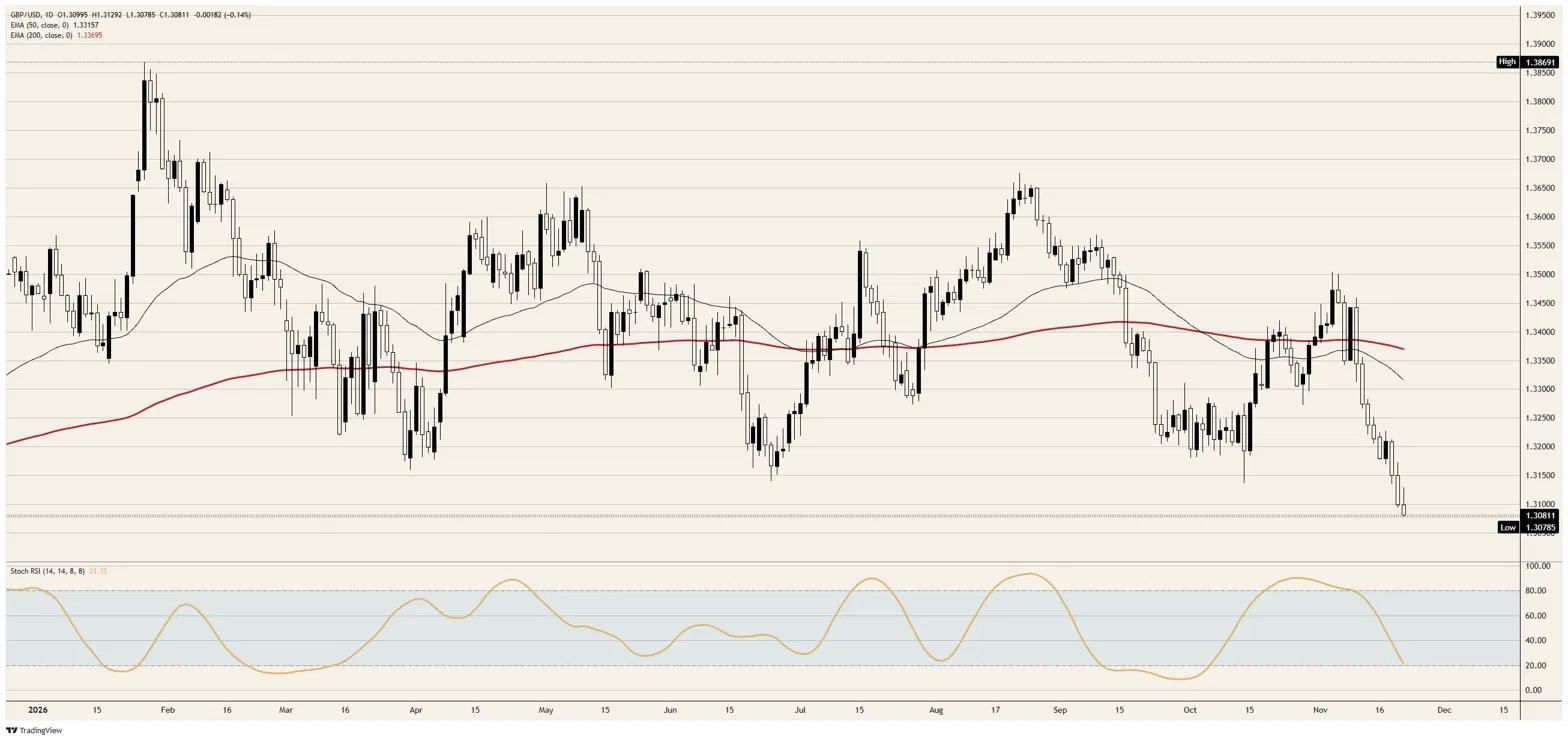
UK inflation and pay growth both came in under forecast, which is good news for British households and was the reason the Pound fell. Each miss took something off the odds of a second Bank of England (BoE) hike on December 17, while Fed officials used the same five days to argue over the size of theirs. GBP/USD trades just under 1.3100, its lowest in 12 months, after falling in eight of the past nine sessions.
Good news for households, bad news for the Pound
Tuesday's labour figures showed pay excluding bonuses growing 3.5% in the three months to September, under the 3.6% forecast and down from 3.7%, while the claimant count rose 33.2K against a 28.1K forecast. Unemployment fell to 4.6% where 4.7% was expected, so the slower pay isn't coming from job losses. Wednesday's Consumer Price Index (CPI) rose 3.6% YoY against a 3.7% forecast, with the core rate unchanged at 2.8%.
For the economy, that's a pay round and an inflation rate both running a tenth cooler than expected. For the Pound, it's a reason for the BoE to wait, and traders cut the odds of a December hike to about 80% from 90% after the inflation release. The BoE's November report, which made the case for the hike on November 5, had inflation reaching about 5% by mid-2027, and BoE Governor Bailey said on Wednesday it would likely peak below that.
Friday's retail sales were the one release that beat, rising 0.7% in October where the forecast had them flat. The bounce they produced stopped short of 1.3150, and the pair is back at its low.
A rate advantage with a date on it
The UK's Bank Rate is 4% and the Fed's rate is 3.75%-4.00%, so the Pound still holds a small yield edge over the Dollar. The Fed meets on December 9, before the BoE, and its October minutes showed almost all officials expecting further hikes, with Fed Governor Waller asking for a half-point on Wednesday. BoE Deputy Governor Lombardelli has said she wouldn't rule December or February in or out.
On Friday a US stock market rout led traders to stop fully pricing the Fed's December hike, and the Pound made a 12-month low regardless. It fell when UK data cooled the BoE's case and fell again when the Fed's hike came into doubt, which leaves very little for the bulls to wait for.
Monday's PMIs come first, America's inflation gauge counts for more
Monday opens with S&P Global's November Purchasing Managers Index (PMI) surveys for the UK at 09:30 GMT, following October readings of 52.9 for the composite and 52.8 for services. At 13:00 GMT it's the turn of BoE Chief Economist Pill. His November 14 interview with the Financial Times argued the BoE waited too long and would need to raise rates again in 2027, which makes him the official with the firmest public case for December.
Wednesday at 13:30 GMT brings October core Personal Consumption Expenditures (PCE) inflation in the US, forecast at 0.3% MoM and 3.2% YoY after 3.1%. A number at or above forecast would put the Fed's December hike back to fully priced and could carry the pair toward 1.3000. A softer one would let the Pound trade on its own PMIs for a session or two.
The BoE's Financial Stability Report follows on Thursday at 10:30 GMT, when US markets are shut for Thanksgiving and a good share of the people who would trade it are not at their desks. Before any of it, the Finance Bill carrying the October 28 budget gets its second reading in the Commons on Monday, a budget the gilt market took calmly and the Pound has ignored since.
Technical levels
Resistance: 1.3150 was October's low and the floor the pair broke on Thursday, and Friday's bounce stopped short of it. Above that, 1.3200 is the area where Tuesday's rally ran out.
Support: Friday's low sits just under 1.3100 and is the lowest trade in 12 months. Under it, the daily chart has nothing until November 2025's low just above 1.3000.
Bias: The lean stays short under 1.3150, with 1.3050 the first objective and 1.3000 the second. The daily Stochastic Relative Strength Index (Stoch RSI) is near 20 and still falling, so a bounce toward 1.3150 can happen without changing the call. A daily close above 1.3200 would mean the break of October's low has failed, and the short lean goes with it.
GBP/USD daily chart
Pound Sterling FAQs
The Pound Sterling (GBP) is the oldest currency in the world (886 AD) and the official currency of the United Kingdom. It is the fourth most traded unit for foreign exchange (FX) in the world, accounting for 12% of all transactions, averaging $630 billion a day, according to 2022 data. Its key trading pairs are GBP/USD, also known as ‘Cable’, which accounts for 11% of FX, GBP/JPY, or the ‘Dragon’ as it is known by traders (3%), and EUR/GBP (2%). The Pound Sterling is issued by the Bank of England (BoE).
The single most important factor influencing the value of the Pound Sterling is monetary policy decided by the Bank of England. The BoE bases its decisions on whether it has achieved its primary goal of “price stability” – a steady inflation rate of around 2%. Its primary tool for achieving this is the adjustment of interest rates. When inflation is too high, the BoE will try to rein it in by raising interest rates, making it more expensive for people and businesses to access credit. This is generally positive for GBP, as higher interest rates make the UK a more attractive place for global investors to park their money. When inflation falls too low it is a sign economic growth is slowing. In this scenario, the BoE will consider lowering interest rates to cheapen credit so businesses will borrow more to invest in growth-generating projects.
Data releases gauge the health of the economy and can impact the value of the Pound Sterling. Indicators such as GDP, Manufacturing and Services PMIs, and employment can all influence the direction of the GBP. A strong economy is good for Sterling. Not only does it attract more foreign investment but it may encourage the BoE to put up interest rates, which will directly strengthen GBP. Otherwise, if economic data is weak, the Pound Sterling is likely to fall.
Another significant data release for the Pound Sterling is the Trade Balance. This indicator measures the difference between what a country earns from its exports and what it spends on imports over a given period. If a country produces highly sought-after exports, its currency will benefit purely from the extra demand created from foreign buyers seeking to purchase these goods. Therefore, a positive net Trade Balance strengthens a currency and vice versa for a negative balance.
Author
Joshua Gibson
FXStreet
Joshua joins the FXStreet team as an Economics and Finance double major from Vancouver Island University with twelve years' experience as an independent trader focusing on technical analysis.

















