|

US Dollar Index bounces off lows near 90.00

  • DXY briefly tested fresh lows in the vicinity of 90.00.
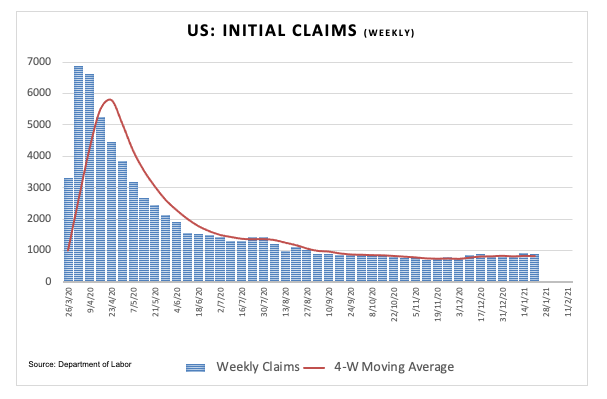
  • Initial Claims rose 900K WoW during last week.
  • The Philly Fed index surprised to the upside at 26.5 in January.

The US Dollar Index (DXY), which tracks the greenback vs. a basket of its G10 peers, trades in multi-session lows near the 90.00 support on Thursday.

US Dollar Index weaker on risk-on mood

The prevailing sentiment towards the riskier assets puts the buck under further pressure and forces the DXY to challenges the psychological support in the 90.00 neighbourhood.

The leg lower in the greenback comes despite yields of the key US 10-year benchmark manage to regain attention and jump to the area beyond 1.12%.

In the US calendar, weekly Initial Claims rose by 900K during last week and the Philly Fed manufacturing gauge improved to 26.5 for the current month (from 9.1). in addition, Housing Starts and Building Permits also surpassed estimates at 1.669 million units (+5.8%) and 1.709 million units (+4.5%), respectively, during the last month of 2020.
What to look for around USD

DXY’s upside run out of steam in the 91.00 region earlier in the week, sparking a subsequent a corrective move to the 90.00 zone. Occasional bullish attempts in the dollar, however, are expected to be short-live amidst the fragile outlook for the greenback in the short/medium-term, and always amidst the massive monetary/fiscal stimulus in the US economy, the “lower for longer” stance from the Federal Reserve and prospects of a strong recovery in the global economy.

US Dollar Index relevant levels

At the moment, the index is losing 0.32% at 90.18 and faces the next support at 89.20 (2021 low Jan.6) followed by 88.94 (monthly low March 2018) and the 88.25 (monthly low February 2018). On the other hand, a breakout of 91.01 (weekly high Dec.21) would open the door to 92.10 (100-day SMA) and finally 92.46 (23.6% Fibo of the 2020-2021 drop).

Author

Pablo Piovano

Born and bred in Argentina, Pablo has been carrying on with his passion for FX markets and trading since his first college years.


More from Pablo Piovano
Share:

Editor's Picks

AUD/USD holds above 0.6950 as bullish USD caps gains

AUD/USD edges lower during the Asian session on Tuesday, stalling a two-day recovery move from a two-month low, touched last week. An extended rout in the fixed income market keeps US bond yields elevated near multi-year highs. This, along with geopolitical uncertainties, helps the US Dollar retain its bullish tone despite receding October Fed hike bets. However, expectations for another RBA rate hike this month could act as a tailwind for the Aussie.

USD/JPY rises back above 158.00 despite hawkish BoJ outlook

USD/JPY rises back above 158.00 in the early European morning on Tuesday. The pair strengthens as the Japanese Yen fails to find any inspiration from hawkish BoJ expectations and looming intervention risks. Meanwhile, geopolitical uncertainty and elevated US bond yields keep the US Dollar near its YTD high despite receding October Fed hike bets. This, in turn, helps the pair stay supported.

Gold stays firm; looks at $4,200

Gold builds on Monday’s marginal bounce, although it struggles to reclaim the key $4,200 mark per troy ounce so far on Tuesday. The yellow metal’s advance comes on the back of the fresh downside momentum in the US Dollar in tandem with retreating US Treasury yields across the curve.

Crypto Today: Bitcoin, Ethereum, XRP bulls battle to restart uptrend amid ETF outflows

Bitcoin upholds a robust bullish outlook, trading at $85,837 on Tuesday as sellers push to regain control over the trend. Altcoins, meanwhile, reflect Bitcoin’s ranging action, with Ethereum trading sideways above $2,700 and Ripple hovering around the pivotal $1.50 level.

Japanese Yen nears 158.00: Two analysts agree it's bullish, and disagree on how far the breakout goes

The JPY is drifting near 158.00 against the USD ahead of a busy week of Japanese data and a still-unclear BoJ timetable. The two most recent FXStreet analyses agree on the direction, but they disagree on the target and the mechanism.

Eurozone inflation just hit 3.8%, its highest in three years. This chart shows why the ECB can’t simply hike its way out

The ECB would normally have a relatively straightforward answer to inflation running almost twice its target: raise interest rates. But these are not normal circumstances. This time, the bond market is already doing part of the tightening for it, leaving the ECB facing an increasingly difficult dilemma.