US Dollar set to close off an uneventful Monday with traders looking forward to NFP
- The US Dollar trades broadly stable at levels near Friday’s close.
- US markets are closed on Monday due to the Labor Day holiday.
- The US Dollar Index resides in the higher 101.00 region.


The US Dollar (USD) sidelines on Monday with a very mixed picture on the quote board against most major currencies. The US Dollar kicks off this week with a calm due to the Labor Day holiday in the US, but the economic calendar will be picking up speed towards the main event on Friday. The first Friday of the month will bring the US Jobs Report, with the Nonfarm Payrolls and other wage data for markets to move on.
Apart from the all-important payroll data, the calendar will also feature the Purchasing Managers Index (PMI) data, which tends to move markets as it gives fresh clues about the state of the economy. This could mean that the US Dollar Index might have moved already substantially ahead of Friday’s main event.
Daily digest market movers:Very quiet Monday
- US markets are closed on Monday in observance of Labor Day.
- China has warned Japan over economic retaliation over potential chip curbs, according to Bloomberg.
- On Saturday, the release of China’s Purchasing Managers Index numbers for August signaled that the contraction in the country’s manufacturing sector persists. The PMI came in at 49.1, lower than the 49.4 seen a month earlier.
- Equities are struggling across the board, with minor losses for all European indices and US futures on the back foot as well.
- The CME Fedwatch Tool shows a 69.0% chance of a 25 basis points (bps) interest rate cut by the Fed in September against a 31.0% chance for a 50 bps cut. Another 25 bps cut (if September is a 25 bps cut) is expected in November by 48.9%, while there is a 42.0% chance that rates will be 75 bps (25 bps + 50 bps) below the current levels and a 9.1% probability of rates being 100 (25 bps + 75 bps) basis points lower.
- The US 10-year benchmark rate trades at 3.90% and will not move as bond trading in the US is closed on Monday.
US Dollar Index Technical Analysis: Nothing moving
Pure technical traders, those who do not look at data or take no headline risk, will tell you that the US Dollar Index (DXY) failed to deliver on Friday. Although the recovery looked solid, the DXY closed below 101.90, which could mean more trouble ahead. A rejection could now take place, stalling the recovery rally, pushing down the DXY back towards 100.62 from a pure technical trading point of view.
Looking up, 101.90 still remains the first level to reclaim. A steep 2% uprising would be needed to get the index to 103.18. A very heavy resistance level near 104.00 not only holds a pivotal technical value, but it also bears the 200-day Simple Moving Average (SMA) as the second heavyweight to cap price action.
On the downside, 100.62 (the low from December 28) holds as support, although it looks rather feeble. Should it break, the low from July 14, 2023, at 99.58 will be the ultimate level to look out for. Once that level gives way, early levels from 2023 are coming in near 97.73.
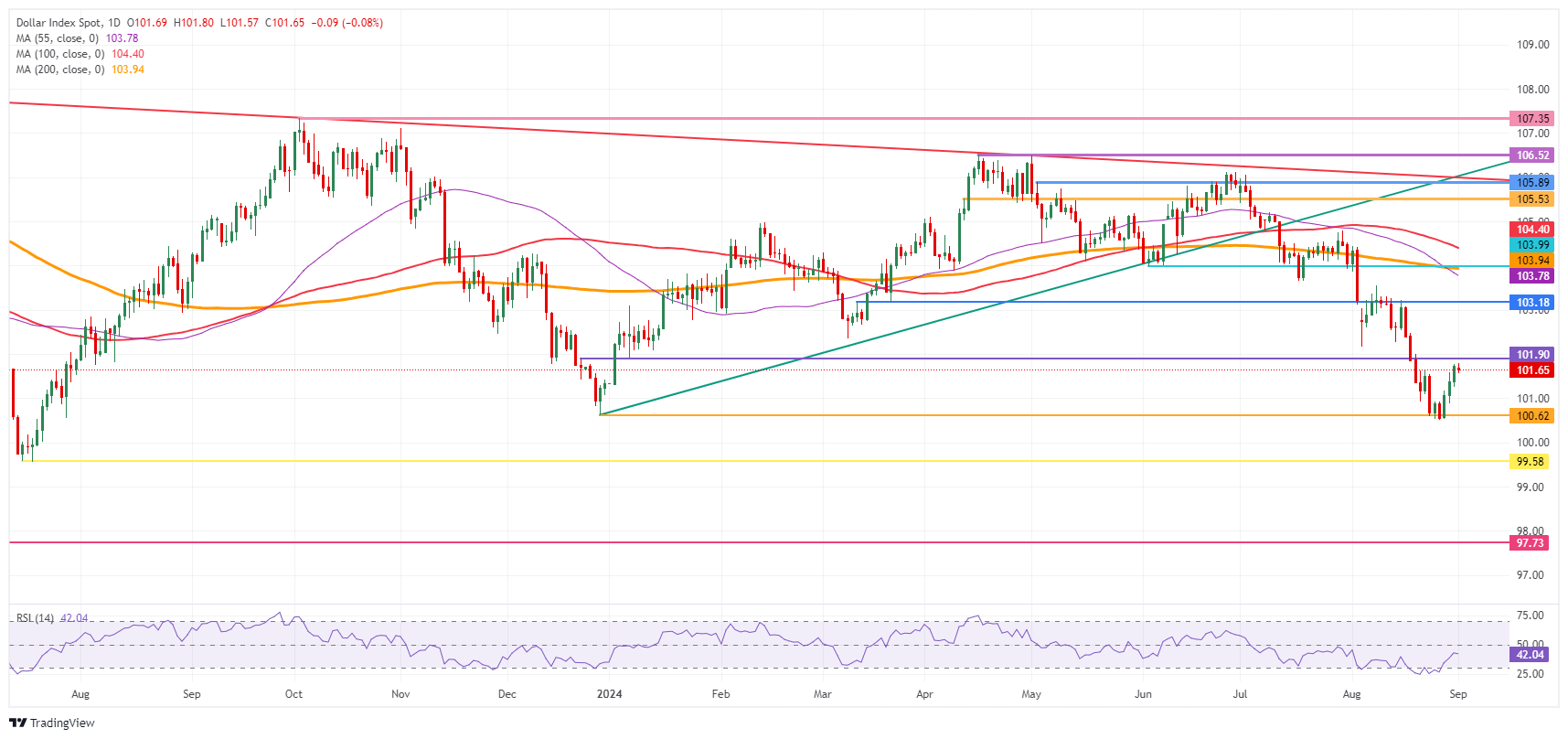
US Dollar Index: Daily Chart
Employment FAQs
Labor market conditions are a key element in assessing the health of an economy and thus a key driver for currency valuation. High employment, or low unemployment, has positive implications for consumer spending and economic growth, boosting the value of the local currency. Moreover, a very tight labor market – a situation in which there is a shortage of workers to fill open positions – can also have implications on inflation levels because low labor supply and high demand leads to higher wages.
The pace at which salaries are growing in an economy is key for policymakers. High wage growth means that households have more money to spend, usually leading to price increases in consumer goods. In contrast to more volatile sources of inflation such as energy prices, wage growth is seen as a key component of underlying and persisting inflation as salary increases are unlikely to be undone. Central banks around the world pay close attention to wage growth data when deciding on monetary policy.
The weight that each central bank assigns to labor market conditions depends on its objectives. Some central banks explicitly have mandates related to the labor market beyond controlling inflation levels. The US Federal Reserve (Fed), for example, has the dual mandate of promoting maximum employment and stable prices. Meanwhile, the European Central Bank’s (ECB) sole mandate is to keep inflation under control. Still, and despite whatever mandates they have, labor market conditions are an important factor for policymakers given their significance as a gauge of the health of the economy and their direct relationship to inflation.
Author
Filip Lagaart
FXStreet
Filip Lagaart is a former sales/trader with over 15 years of financial markets expertise under its belt.