Uranium’s next big move


Topic 1: Uranium’s next big move? The charts are heating up
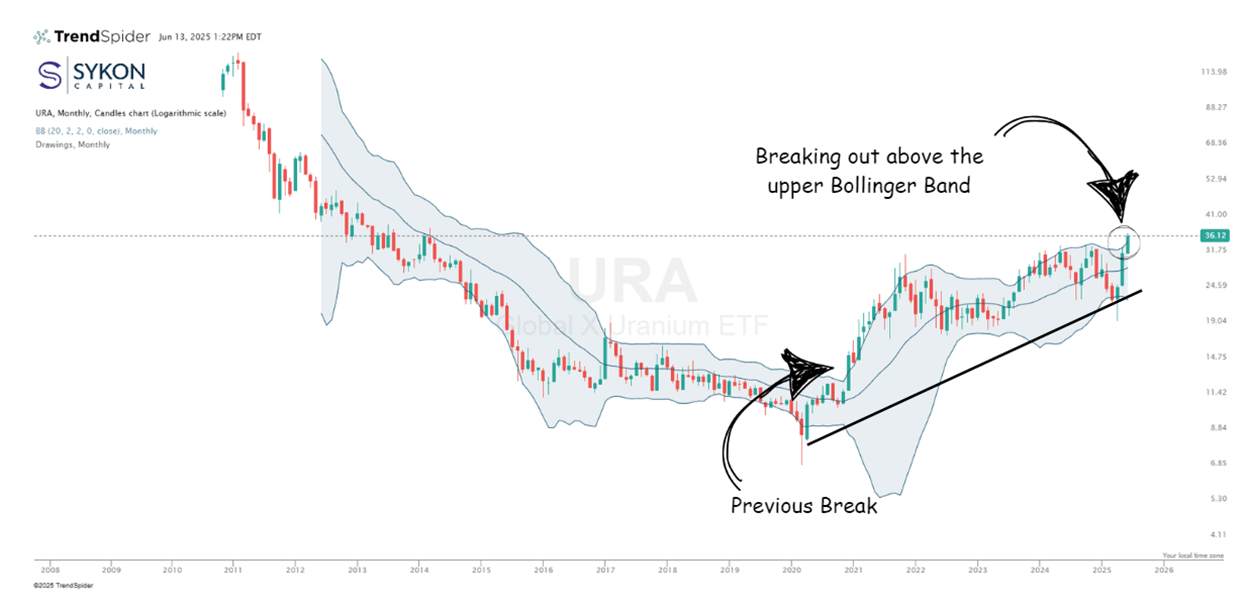
Source: SYKON Capital, TrendSpider
Uranium may be breaking out from another multi-year consolidation, similar to the setup we saw in late 2020. These periods of price compression, often identified by narrowing Bollinger Bands, tend to precede strong directional moves. When the bands expand, price typically follows the direction of the breakout. Right now, that direction appears to be higher.
The last breakout in the Global X Uranium ETF (URA) occurred in December 2020 around $14/share and rallied to nearly $27. We’re now seeing a similar technical setup.
But this time, the fundamentals may be even stronger:
- Global capacity goals for nuclear power are accelerating, many countries targeting 400GW by 2050, up from 100GW today. (Goldman Sachs)
- Supply remains constrained, with limited secondary sources and few new mines expected online within the next decade.(Discovery Alert).
- Regulatory reform is easing the path for new reactors, with faster NRC approvals and streamlined licensing. (World Nuclear News).
Put simply, the backdrop is more favorable than it was in 2020. If the breakout holds, uranium could be setting up for a move that’s not just technical, but structural.
Topic 2: A Changing of the guard? International equities show signs of leadership
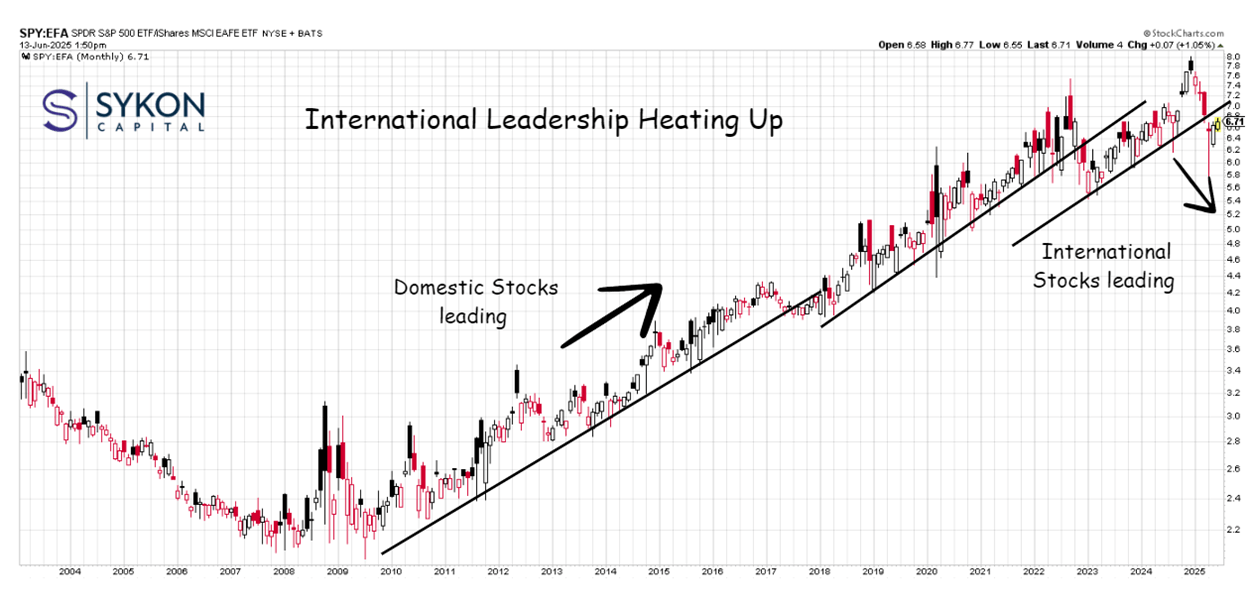
Source: SYKON Capital, StockCharts.com
Continuing our focus on structural market shifts, international equities may be quietly reclaiming a leadership role. A review of the monthly chart shows relative strength beginning to tilt away from U.S. equities, marking a possible inflection point after more than a decade of U.S. outperformance.
Since the end of the 2008 financial crisis, U.S. stocks have dominated global returns, driven by tech concentration, aggressive monetary policy, and the strength of the dollar. But those tailwinds are now turning into headwinds:
- We see valuations in U.S. markets remain elevated, especially in mega cap growth stocks.
- Dollar strength has likely peaked, which we see as creating a more favorable environment for international earnings.
These aren’t just cyclical blips, there are likely signs of longer-term shifts. Leadership transitions like this typically play out over years, not quarters.
So it’s worth asking:
What if the next decade looks more like the early 2000s than the 2010s?
U.S. exposure may have been the right answer for the last cycle, but cycles change. And home bias is not a strategy.
Topic 3: From narrow to broad: Is this the breakup of the Magnificent 7?
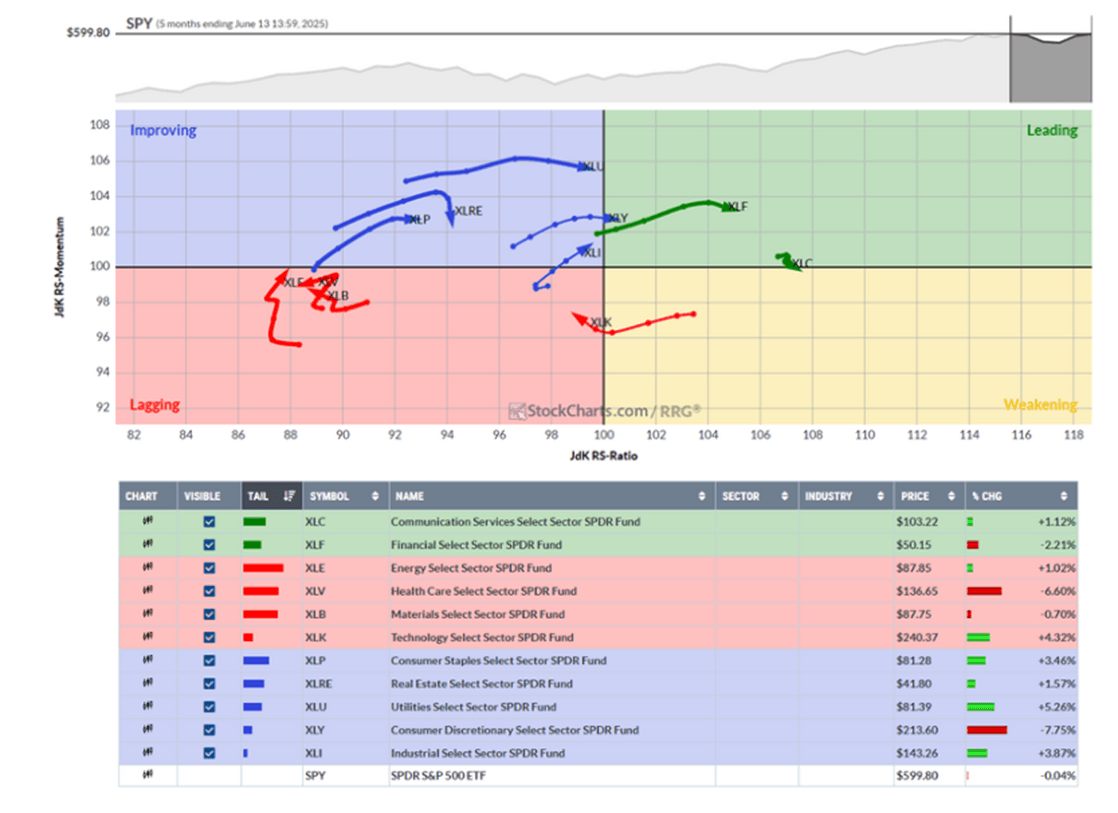
For much of 2023 and 2024, markets were led almost exclusively by mega-cap technology stocks. But leadership driven by a narrow group is rarely sustainable. Earlier this year, I noted that after periods of extreme performance divergence, equal-weighted indices often begin to outperform their market-cap-weighted counterparts.
Now, we’re seeing early signs that this shift may already be underway.
Using Relative Rotation Graphs (RRGs), we can visualize how sectors cycle through phases of leadership. Stocks typically rotate clockwise through the four RRG quadrants: from green (Leading), to yellow (Weakening), red (Lagging), and eventually blue (Improving).
At the moment, we’re beginning to see a broad rotation.
- Industrials, Utilities, Consumer Staples, Discretionary, and Real Estate are showing momentum.
- These sectors appear to be moving into leadership, joining Financials and Communication Services, which have already turned the corner.
This rotation suggests a meaningful broadening of market leadership, a departure from the concentrated tech-driven rallies we’ve become accustomed to. If this trend continues, more diversified strategies and equal-weighted exposures may take the lead from here.
What could be fueling this?
One potential driver: deregulatory tailwinds. Sectors with high regulatory burden, like financials, energy, and industrials, stand to benefit disproportionately from regulatory rollbacks, especially if policy continues to shift toward pro-business reform. This isn’t just a technical development. It’s another potential structural shift in how markets allocate capital and where the next cycle of leadership may emerge.
Unlock exclusive gold and silver trading signals and updates that most investors don’t see. Join our free newsletter now!
Author
CMT Association Research Team
CMT Association
The CMT Association is a global credentialing body that has served the financial industry for nearly 50 years.

















