|

US Election: Trump wins Florida, S&P 500 futures resilient

The latest trends show that Joe Biden is losing ground in battleground Florida, which is now called for President Donald Trump.

Republican Maria Elvira Salazar defeats Democrat Donna Shalala for a Florida House seat, per Associated Press.

“Trump's 3.5% victory in Florida almost tripled his 2016 margin of 1.2%,” FXStreet’s Senior Analyst Joseph Trevisani noted.

So far, Biden has won 13 states and Trump 16. But Biden's national tally is higher with 131 electoral votes compared to Trump's 108.

Trump is leading in the 6 swing states
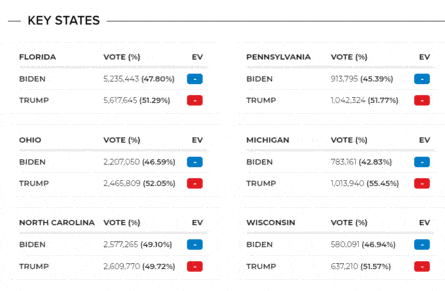
Meanwhile, Wisconsin is unlikely to announce a winner tonight, Michigan needs until Friday and Pennsylvania saying Wednesday or Thursday, according to the latest reports.

Market reaction

The risk sentiment is seen stabilizing over the last hour, with a Biden win back in the spotlight after Arizona’s swing. However, Florida called for Trump failed to have any impact on the market.

The S&P 500 futures held on to its recent bounce, trading 1.50% higher while the US dollar consolidates the retreat below 94.00.

Author

Dhwani Mehta

Dhwani Mehta

FXStreet

Residing in Mumbai (India), Dhwani is a Senior Analyst and Manager of the Asian session at FXStreet. She has over 10 years of experience in analyzing and covering the global financial markets, with specialization in Forex and commodities markets.


More from Dhwani Mehta
Share:

Editor's Picks

AUD/USD consolidates above 0.7000; remains close to monthly top

AUD/USD holds steady above 0.7000 during the Asian session on Friday, trading just below the previous day's monthly low amid diverging forces. A hawkish RBA continues to support the Aussie, while the recent decline in US bond yields keeps the US Dollar depressed near a three-week low. However, oil-driven inflation fears reinforce Fed hike bets, which, along with geopolitical risks, could benefit the safe-haven buck and cap the currency pair.

USD/JPY bounces off one-month low; climbs to 157.00 amid reviving USD demand

USD/JPY rebounds from the 156.00 neighborhood, or a one-month low touched during Friday’s Asian session, with bulls looking to extend momentum beyond 157.00 amid the emergence of some US Dollar buying. Meanwhile, Japan's National CPI rose to a nine-month peak and reaffirmed BoJ rate-hike bets, which could support the Japanese Yen and cap gains for the currency pair.

Gold holds above $4,000/three-month low as Fed hike bets and firm USD cap upside

Gold struggles to capitalize on its modest recovery from levels below the $4,000 psychological mark, or a three-month low set earlier this Friday, and retains a bearish tone through the first half of the European session. Federal Reserve officials recently signaled there is no urgency to raise interest rates. Traders, however, are still pricing in around an 80% chance that the US central bank will raise borrowing costs again at its December policy meeting.

Bitcoin, Ethereum, and Ripple rebound as major support levels cap recent sell-off

Bitcoin, Ethereum and Ripple rebound modestly on Friday after correcting and testing their key support zone the previous day. BTC holds the 50-day EMA, ETH finds support around the 100-day EMA, while XRP holds the horizontal floor near $1.300. The price action of these top three cryptocurrencies suggests a recovery if this critical support zone holds; a decisive close below these levels suggests a deeper correction.

US S&P Global PMI expected to show moderating business activity in October

The United States S&P Global preliminary Purchasing Managers Indices for October will be released on Friday, providing fresh insights into the health of the world's largest economy ahead of next week's Federal Reserve monetary policy meeting. The report includes the Manufacturing PMI, Services PMI and Composite PMI, which measure business activity across the private sector.

What November 3 means for the Fed's rate path and the US Dollar

The USD faces a decisive period ahead of the November 3 midterm elections. While markets anticipate another interest rate increase from the Fed in December, the battle for control of Congress could reshape fiscal policy expectations and, indirectly, the path of US monetary policy in 2027.