Traders reduce equity positions as they brace for Fed Minutes, Nvidia earnings
- Nvidia will release Q1 2025 earnings after the close on Wednesday.
- Wall Street expects adjusted EPS of $0.75 on revenue of $43.25 billion.
- FOMC Minutes will arrive in the mid-afternoon, about two hours before earnings.
- Dow Jones index sheds weight moderately in the lead-up to both announcements.

Wednesday is a significant day on the trading calendar with the power to determine the US equity market's direction heading into June. At 14:00 EST, the Federal Reserve (Fed) will unveil the Meeting Minutes from its early May Federal Open Market Committee (FOMC) decision, which will give traders a view on what to expect for interest rates in the second half of the year. Are Fed governors more worried by the Trump administration's tariff policy leading to an inflationary cycle, or are they more concerned with the unemployment picture?
Then, after the market closes at 16:00 EST, the most-watched stock of the era, Nvidia (NVDA), will release results for the first quarter of fiscal 2025 that ended in April. Though the market expects another double-beat and raise from CEO Jensen Huang, traders know that a reduced growth outlook or margin compression could be a major sell signal for the rest of the market.
At the time of writing, the Dow Jones Industrial Average (DJIA), which holds Nvidia as a constituent, is down 0.3%, while the NASDAQ Composite sheds 0.1%.
Nvidia earnings preview
Nvidia has bested Wall Street consensus for both the top and bottom lines for nine consecutive quarters, so that is what the market expects this go-round.
Wall Street's consensus figure for adjusted earnings per share (EPS) should be an easy beat as well, at $0.75. That figure is well below the $0.89 earned in the fourth quarter but 23% above the quarter one year ago. Wall Street expects a pullback in the EPS figure due to an already announced $5.5 billion write-down from Nvidia's H20 business with China.
The Trump administration halted exports of the H20 AI chip earlier this year, and the Trump administration's 150%-plus tariff on China remained in place for much of Q1, although semiconductors were largely exempted. President Donald Trump then lowered the tariff on China to 30% earlier this month.
Huang has said in recent public appearances that Nvidia is working to counteract the new trade barriers, and the market will expect more color on the company's plans to design a new chip destined for the Chinese market.
Recent announcements concerning demand from the United Arab Emirates and Saudi Arabia for Nvidia's AI chips, as well as Oracle's (ORCL) announcement of a $40 billion purchase of such hardware, will be front and center on the earnings call. The success of the earnings call will largely turn on the outlook for growth from Nvidia's data center business, which relies on the success of its new Blackwell architecture.
Wall Street expects Nvidia's Q1 revenue to jump 10% from Q4 to $43.25 billion, owing particularly to the ramp up in sales of the Blackwell chips to data centers.
Nvidia stock forecast
Nvidia shares are stuck between the January 7 all-time high (ATH) and the April 7 11-month range low. Having moved back into the former multi-year bottom trendline support range (light green) that broke down in March, a positive quarter will push NVDA stock back toward that ATH.
Any negative sentiment surrounding the earnings call will push shares back to support near the $114 level or the 50-day Simple Moving Average (SMA) near $115. Traders will note that the Relative Strength Index (RSI) is nearing overbought levels in the lead-up to the earnings call.
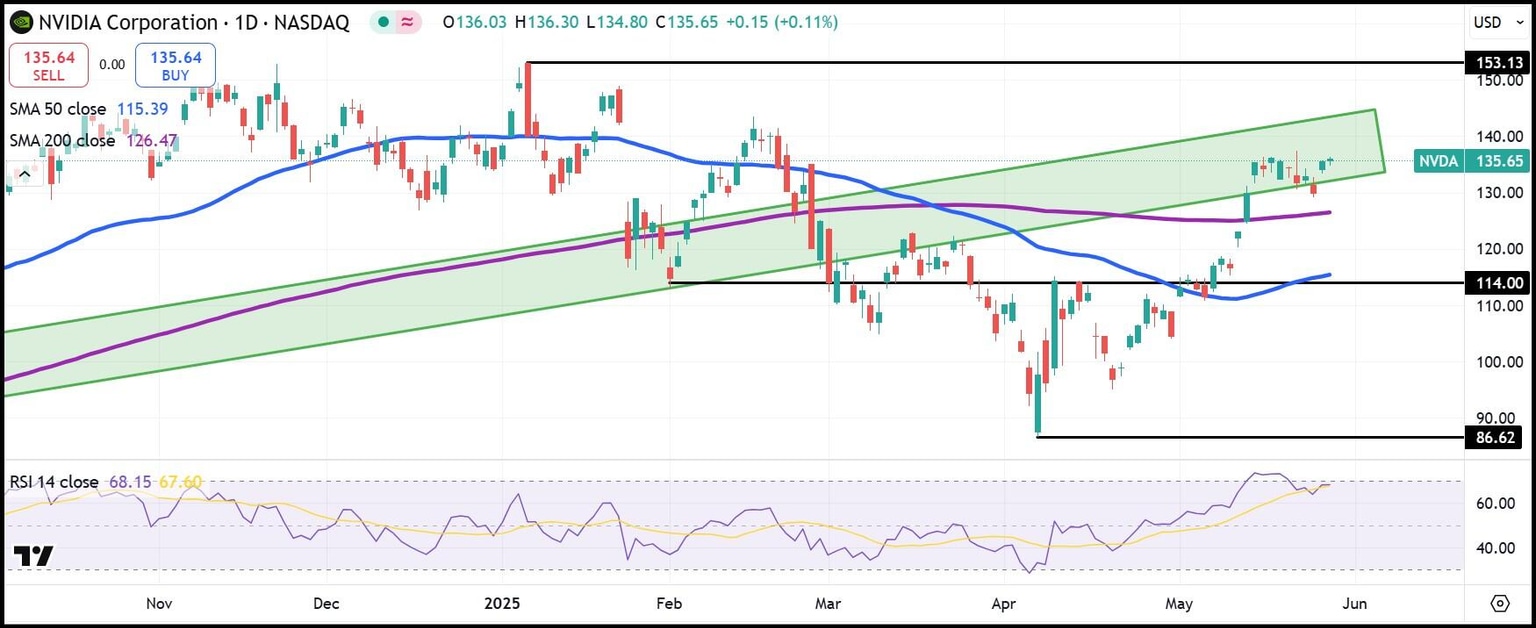
NVDA daily stock chart
Premium
You have reached your limit of 3 free articles for this month.
Start your subscription and get access to all our original articles.
Author
Clay Webster
FXStreet
Clay Webster grew up in the US outside Buffalo, New York and Lancaster, Pennsylvania. He began investing after college following the 2008 financial crisis.