Trade entry timing techniques: Nasdaq 100, Hang Seng, DAX 40


Weekly thoughts
How do you actually go about entering your trades?
Is it the same way every time?
It probably should be.
I call my entry techniques my ‘triggers’. Here’s a reminder of my trading framework with some examples of how it can be put into action for trades.
Setup – Signal – Trigger
Setup = Scenario (or ‘the why’)
What’s happening in the market? And what kind of trade will you use to take advantage of what you expect to happen next?
E.g. The market is in a pullback within an uptrend. So your bias is bullish and you plan to buy the dip.
E.g.2. The market has been consolidating following an uptrend. So your plan is to buy a continuation of the trend on a breakout.
Signal = Condition (or ‘the when’)
The specific conditions that need to be met for you to be ready to place a trade.
E.g. The price touches a S/R level, enters a supply/demand zone, a breakout occurs or a candlestick pattern, ABC pattern or price pattern completes or some combination of these.
Trigger = Tactics (or ‘the how’)
This is specifically how you go about placing the trade once the signal has occurred.
E.g. When price reaches a support level, you could place a ‘touch trade’, wait for a candle to close, wait for an indicator confirmation or use a lower timeframe to fine tune your entry.
E.g.2 On a breakout, you can enter a trade on the break, wait for a pullback entry or look for a confirming setup on a lower timeframe.
I’m zooming in on the trigger aspect this week..
Entry triggers (the “how”)
‘How’ do you enter trades? These are probably the 5 most common tactics:
1. Touch trade (blind entry)
Enter immediately when price tags your level or zone (support, resistance, supply/demand, fib).
- Most aggressive, best R:R if right, but highest false-signal rate.
2. Candle close confirmation
Wait for the bar to close before entering (e.g. breakout close, engulfing, pin bar).
- Helps filter noise, but you give up some entry precision.
3. Order-based entries
-
Stop-order entry (momentum trigger): Place a buy stop/sell stop to catch the market as it breaks through a level or pattern.
-
Limit-order entry (mean reversion trigger): Place a buy limit/sell limit at a level to catch a pullback or reversal.
4. Pullback /retest entry
Wait for price to come back closer to the level after the initial signal (e.g. breakout retest, 50% candle retrace).
- This often combines with limit orders to time entries.
5. Indicator confirmation
Only enter when an indicator flips in your favour (MA crossover, RSI cross, MACD turn).
- This is the most rule-based and conservative trigger, but usually lagging.
This list is not absolute, but it’s the way I categorise the different choices in my mind. You don’t need to use the same list - but if you haven’t thought about all the possibilities before, this is a way to start thinking about it.
You could also add volume or order flow or sentiment indicators or various other technical factors to this list, but for simplicity I’m keeping it to ‘price only’ today since these are accessible to everyone, are probably most important and arguably best suited for use in CFD and forex markets.
Setups and signals
We look at hundreds of charts each week and present you with three of our favourite setups and signals.
Nasdaq 100 (NAS/USD)
Setup
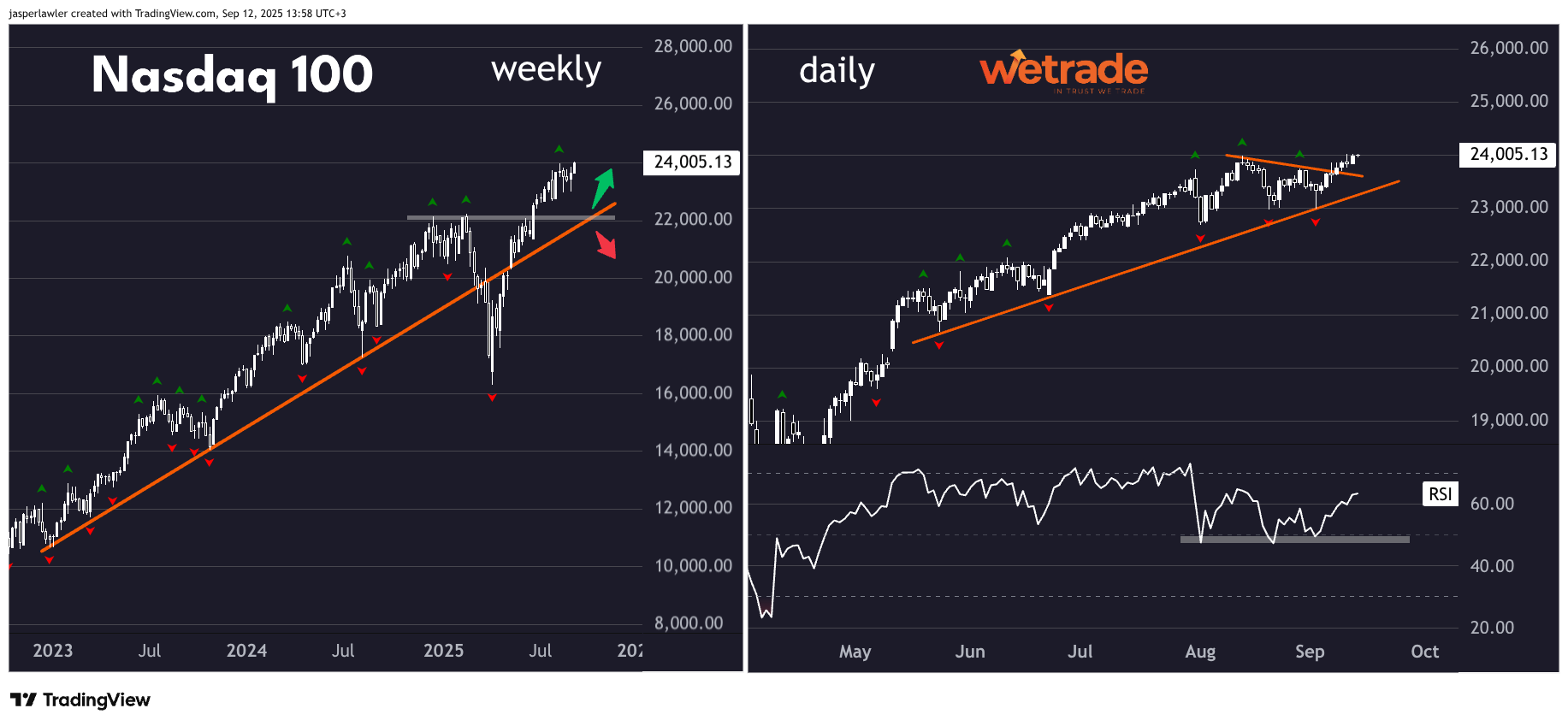
The price is in a long uptrend and close to record high territory. Price appears overbought but no price action signal yet to confirm a trend reversal. We are bullish while above 22,000.
Signal
Price has been consolidating in a triangle pattern and just broke out after recently bouncing off a rising trendline at the 23k level. Looking to trade the breakout or ‘fakeout’.
Hang Seng (H33/HKD)
Setup
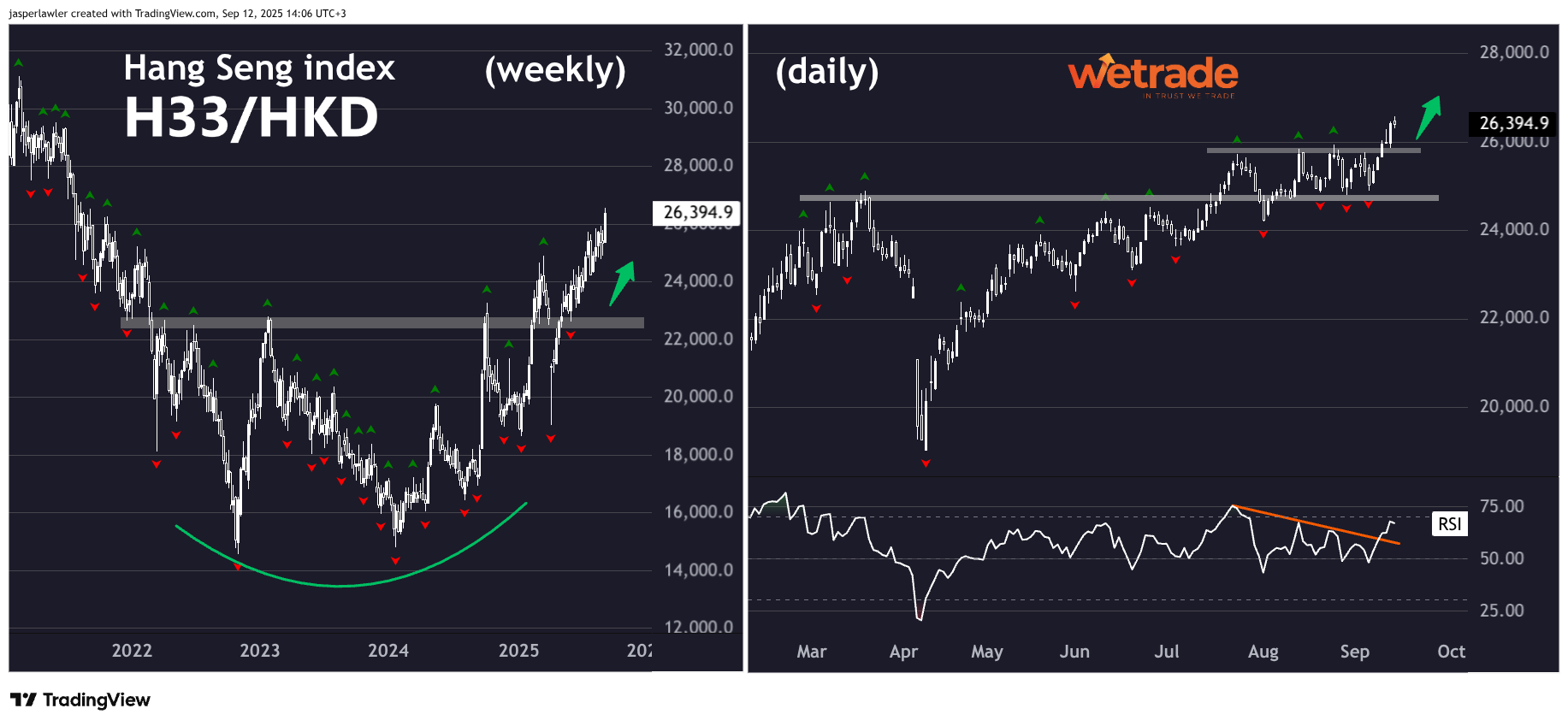
Price has completed a long base and broken higher into what looks like a new long term uptrend.
Signal
Price has broken out of a consolidation that took place just above the March high and now looks to be resuming the uptrend with former resistance at 26k the new near term support.
DAX (D40/EUR)
Setup
Price remains in a long term uptrend generally supported by the 30-week MA.
Signal
A price consolidation offers the opportunity to buy near support at current levels or wait for a breakout of resistance around 24,500. Bearish RSI divergence risks a break lower.

Author
Jasper Lawler
Trading Writers
With 18 years of trading experience, Jasper began his career as a stockbroker on Wall Street in New York City before sharpening his analytical skills at top trading firms in the City of London.

















