|

The two levels of resistance coming up for Okta

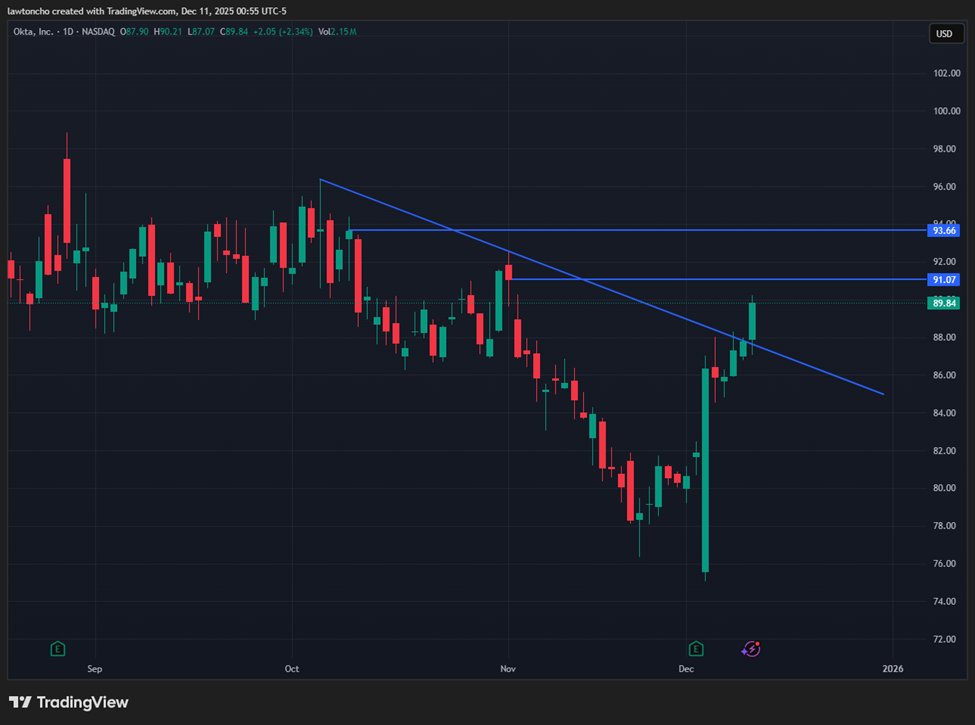
Okta put in a strong performance today, closing more than 2% higher than Monday’s finish, and that move caught my attention immediately. From a technical analysis standpoint, the stock is pushing through a downsloping trendline that has been containing price for a while. Any time I see that kind of shift in momentum, I start mapping out the levels that matter most to me, especially when I’m preparing for a potential pullback or reversal.

Before digging deeper into the setup, I want to share a bit of context for why I track Okta so closely. The company has long positioned itself as a key player in secure identity management, and because of that reputation, I’ve watched how traders tend to react around its major price swings. Over time, I’ve noticed that Okta often respects clean technical patterns and gap levels, which makes it a name I revisit when I’m looking for opportunities guided by both structure and sentiment. That familiarity is why I’m always ready with my levels ahead of the move rather than after it.

With today’s strength, there are two major resistance zones I’m keeping on my chart. The first level is the gap fill sitting near $91, which is the immediate area I’ll be watching should momentum continue upward. If price pushes through that region, my next level is the $93.66 gap fill zone, which I consider a secondary resistance level and a potential turning point for the stock. These are the two areas where I would personally look for shorting opportunities, assuming the price action confirms what I’m anticipating.

Even with a clear plan, trading never comes without uncertainty. That’s why I always emphasize proper risk management, especially when shorting into strength. Patience, discipline, and respect for the technicals are what keep me consistent, and Okta’s current setup is no exception. I’ll be watching closely to see how price behaves as it approaches these levels.
Author

Lawton Ho

Lawton Ho

Verified Investing

A marketing expert sharing his journey to mastering the charts.

More from Lawton Ho
Share:

Editor's Picks

AUD/USD sits at two-month lows near 0.6950 after Australian CPI data

AUD/USD is sitting at two-month lows near 0.6950 in the Asian session on Wednesday, as below-expectations August Australian underlying CPI data pours cold water on expectations for further RBA interest rate hikes. Chinese PMI data also fail to inspire the Australian Dollar, despite a pause in the US Dollar advance.

USD/JPY stays weak below 157.00 amid Japanese intervention risks

USD/JPY keeps losses below 157.00 in the Asian session on Wednesday, as hawkish BoJ expectations, along with intervention risks, underpin the Japanese Yen, countering dismal domestic factory output and retail sales data. Meanwhile, a broad US Dollar retreat also collaborates to the pair's downside.

Gold meets resistance just above $4,200

Gold now makes a U-turn and recedes toward the $4,150 region per troy ounce on Wednesday. Indeed, the precious metal fades the earlier move past the key $4,200 yardstick and retreats marginally as the US Dollar trims part of its daily losses amid mixed US Treasury yields.

Crypto Today: Bitcoin holds $83K as Ethereum remains below $2,700 and XRP consolidates

Bitcoin trades lethargically on Wednesday, with bulls battling to defend the immediate $83,000 level as immediate support. Ethereum trades in tandem with Bitcoin, holding below key levels of $2,700 on the upside and $2,600 on the downside. Ripple, meanwhile, hovers near $1.50,

The Euro is near a one-year low: Inflation could trigger its rebound, not its fall

EUR/USD has fallen to its lowest level since May 2025, but a fresh inflation shock in the Eurozone could give the Euro an unexpected lifeline. The pair hit 1.1312 on Wednesday and trades well below the January peak of 1.2082. The decline reflects a powerful combination of US Dollar strength, geopolitical uncertainty and renewed concerns about Europe's exposure to higher energy prices.

The Euro is near a one-year low: Inflation could trigger its rebound, not its fall

EUR/USD has fallen to its lowest level since May 2025, but a fresh inflation shock in the Eurozone could give the Euro (EUR) an unexpected lifeline. The pair hit 1.1312 on Wednesday and trades well below the January peak of 1.2082.















