The Japanese Yen weakens as traders pare Bank of Japan October hike bets
- USD/JPY climbs back above 158.00 to a one-week high as BoJ October hike bets fade.
- October BoJ hike pricing roughly halved since Monday.
- Tokyo core inflation due at 23:30 GMT, with a 2.4% forecast above target.

The Yen is falling on the timetable of the Bank of Japan (BoJ) rather than on Japanese inflation. The BoJ published its September meeting summary at 23:50 GMT on Wednesday, and traders cut bets on an October follow-up. Japanese rate markets now price about half the October move they did on Monday, a day before a Tokyo inflation figure forecast well above the BoJ's 2% target. USD/JPY trades just above 158.00 and is heading for its third weekly gain in a row.
A hike in September, a fifth of one priced for October
The BoJ raised its rate to 1.25% on September 18 by a 7-2 vote and said it would keep raising if its outlook holds. Analysts read it as moving every three months, which is a way of saying the next hike comes in December rather than October.
If the BoJ waits that long, the next change in the gap between US and Japanese rates can only come from the Fed on October 28, where futures put the odds of a hike near one in three. USD/JPY's last leg higher on Thursday came on a report of a third US aircraft carrier group heading to the Middle East, and buyers chose the Dollar over the Yen as a haven on the news.
Tokyo's core rate was last above 2% in December 2025
Tokyo's core inflation rate for September, which leaves out fresh food, is due at 23:30 GMT on Thursday, forecast at 2.4% from 1.8%. Tokyo's figures usually lead the national ones by about three weeks. US payrolls follow on Friday at 12:30 GMT.
Japanese wage figures for August, last at 4.7% YoY, come on Tuesday at 23:30 GMT. A hot Tokyo number could bring October back, though the summary of a meeting where the BoJ raised rates was enough to take half of it out.
Levels for the Yen into Tokyo's data
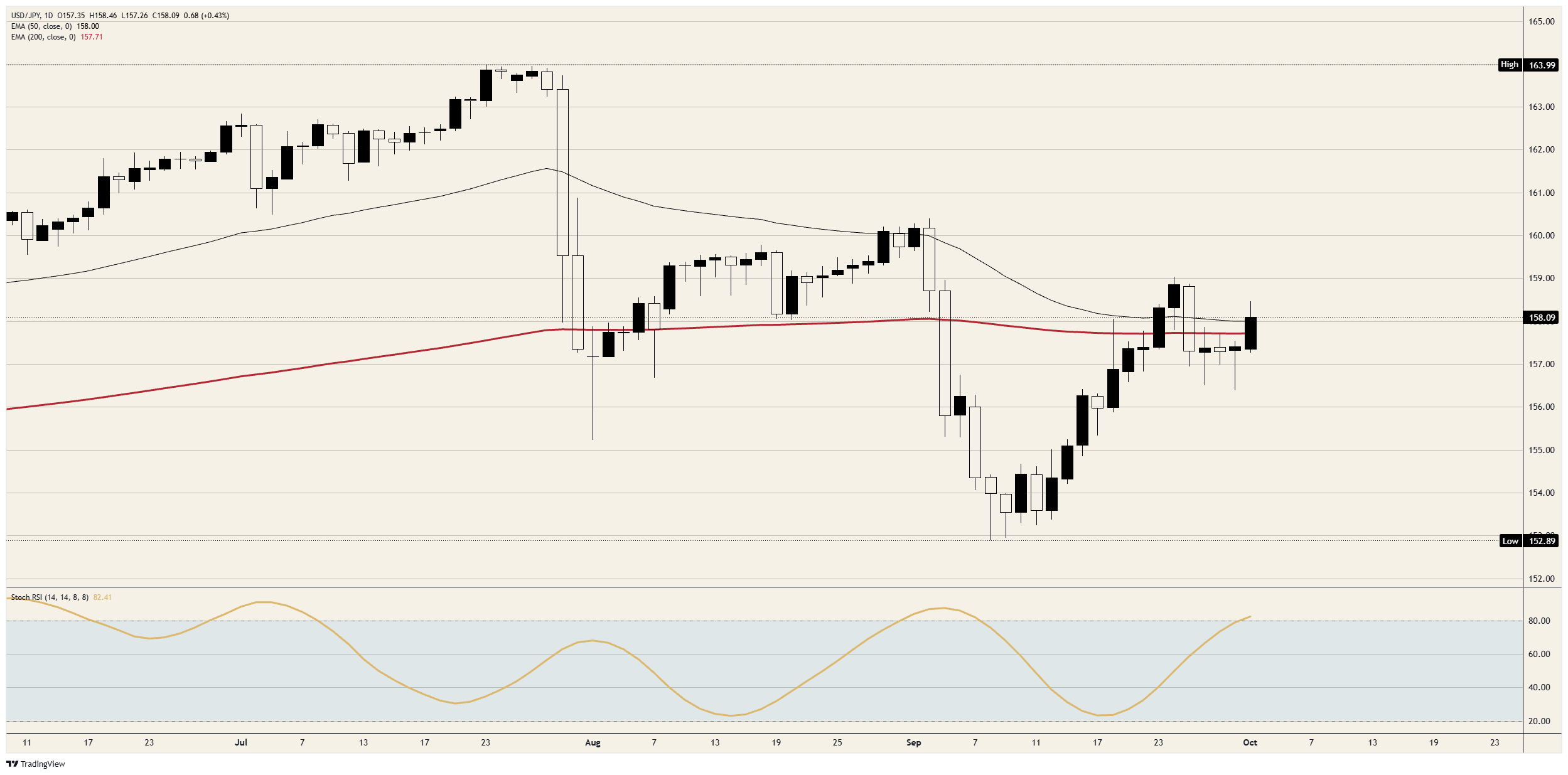
Resistance: Thursday's high came in just short of 158.50, and 159.00 is the September 24 high, where the last push stopped.
Support: 158.00, where the 50-day Exponential Moving Average (EMA) sits, has held since Thursday's last leg higher. 157.50 is next, and Thursday's low sits just above 157.00.
Bias: The lean is long while 157.50 holds on a closing basis, with 158.50 the first objective and 159.00 the second. The daily Stochastic Relative Strength Index (Stoch RSI) is near 82 and still rising, so the move is stretched going into Tokyo's data. A daily close below 157.00 ends the trade.
USD/JPY daily chart
Japanese Yen FAQs
The Japanese Yen (JPY) is one of the world’s most traded currencies. Its value is broadly determined by the performance of the Japanese economy, but more specifically by the Bank of Japan’s policy, the differential between Japanese and US bond yields, or risk sentiment among traders, among other factors.
One of the Bank of Japan’s mandates is currency control, so its moves are key for the Yen. The BoJ has directly intervened in currency markets sometimes, generally to lower the value of the Yen, although it refrains from doing it often due to political concerns of its main trading partners. The BoJ ultra-loose monetary policy between 2013 and 2024 caused the Yen to depreciate against its main currency peers due to an increasing policy divergence between the Bank of Japan and other main central banks. More recently, the gradually unwinding of this ultra-loose policy has given some support to the Yen.
Over the last decade, the BoJ’s stance of sticking to ultra-loose monetary policy has led to a widening policy divergence with other central banks, particularly with the US Federal Reserve. This supported a widening of the differential between the 10-year US and Japanese bonds, which favored the US Dollar against the Japanese Yen. The BoJ decision in 2024 to gradually abandon the ultra-loose policy, coupled with interest-rate cuts in other major central banks, is narrowing this differential.
The Japanese Yen is often seen as a safe-haven investment. This means that in times of market stress, investors are more likely to put their money in the Japanese currency due to its supposed reliability and stability. Turbulent times are likely to strengthen the Yen’s value against other currencies seen as more risky to invest in.
Author

Joshua Gibson
FXStreet
Joshua joins the FXStreet team as an Economics and Finance double major from Vancouver Island University with twelve years' experience as an independent trader focusing on technical analysis.