Tesla (TSLA Stock) market cap returns to $1 trillion

Tesla Inc. (TSLA) so far this week has gained 8.8% after the company announced it wanted to pay dividends in the form of additional shares by splitting its stock. The proposal has been approved by the company’s board and shareholders will vote at the annual meeting that has yet to be scheduled. If the stock split is approved, it will be the first stock split since the August 2020 five-for-one split made Tesla’s stock more affordable for employees and investors.
The electric car company, which debuted in 2010 at $17 per share, continues to be regarded by many critics as a failure, although it is currently trading above $1,000 per share. After the stock split in 2020, the stock price jumped 128%, increasing the market cap to $1 trillion once again and making the company the largest automaker in the US, after it dropped below $1 trillion in December 2021, following concerns that the stock’s valuation was inflated and due to the exercise of stock options by its CEO and co-founder Elon Musk. Tesla’s market capitalization dwarfs the total existing automaker sector, which includes Ford, GM and Volkswagen.
Its electric cars are among the most popular and the company has shipped nearly a million each year while increasing production in the US and Europe, despite competitors such as Ford and Rivian entering the market and giving consumers several new options.
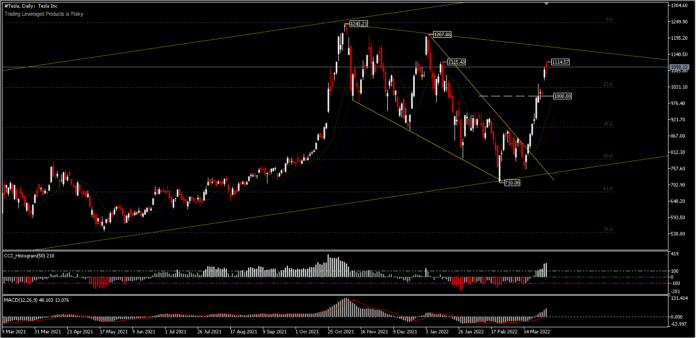
The start of 2022 for Tesla hasn’t been great for investors who are seeing their holdings dwindle, as price action drops to test $710. This decline is part of a price correction near the 61.8% FR level, so traders anticipate buying opportunities around the price level there. Currently the price is near the resistance at 1115.43 and has the chance to move further to 1207.88 and peak at 1243.21. There was some bad news on the announcement that Tesla’s factory in Shanghai would be closed for several days in light of the new lockdowns introduced in areas of China affected by the latest wave of COVID-19. However there were more good news, as accordng to New York (CNN Business), Elon Musk marked the company’s first deliveries from its new Berlin factory, easing investors’ fears about whether the EV maker would receive the necessary approvals from the German government.
“I’d say 30% of investors we talked to over the last six months thought Berlin was never going to open because of the red tape and bureaucracy,” said Dan Ives, tech analyst at Wedbush Securities. “Many investors were fearing [Tesla] would never have a beachhead in Europe and it would just be an empty factory.”
On the downside the 1000.00 level is a possibility that could be tested and price orders may indicate liquidity is in the area.