S&P 500 and Nasdaq futures face an upper-gate decision into the NY open

Both indices are holding above CP with the upper gate as the trigger zone; Dow remains in repair mode, mapping lower-gate defence first.
MacroStructure Index futures desk, Feb 27, 2026
Dow (YM), S&P 500 (ES), Nasdaq (MNQ/NQ)
Dow Futures (YM)
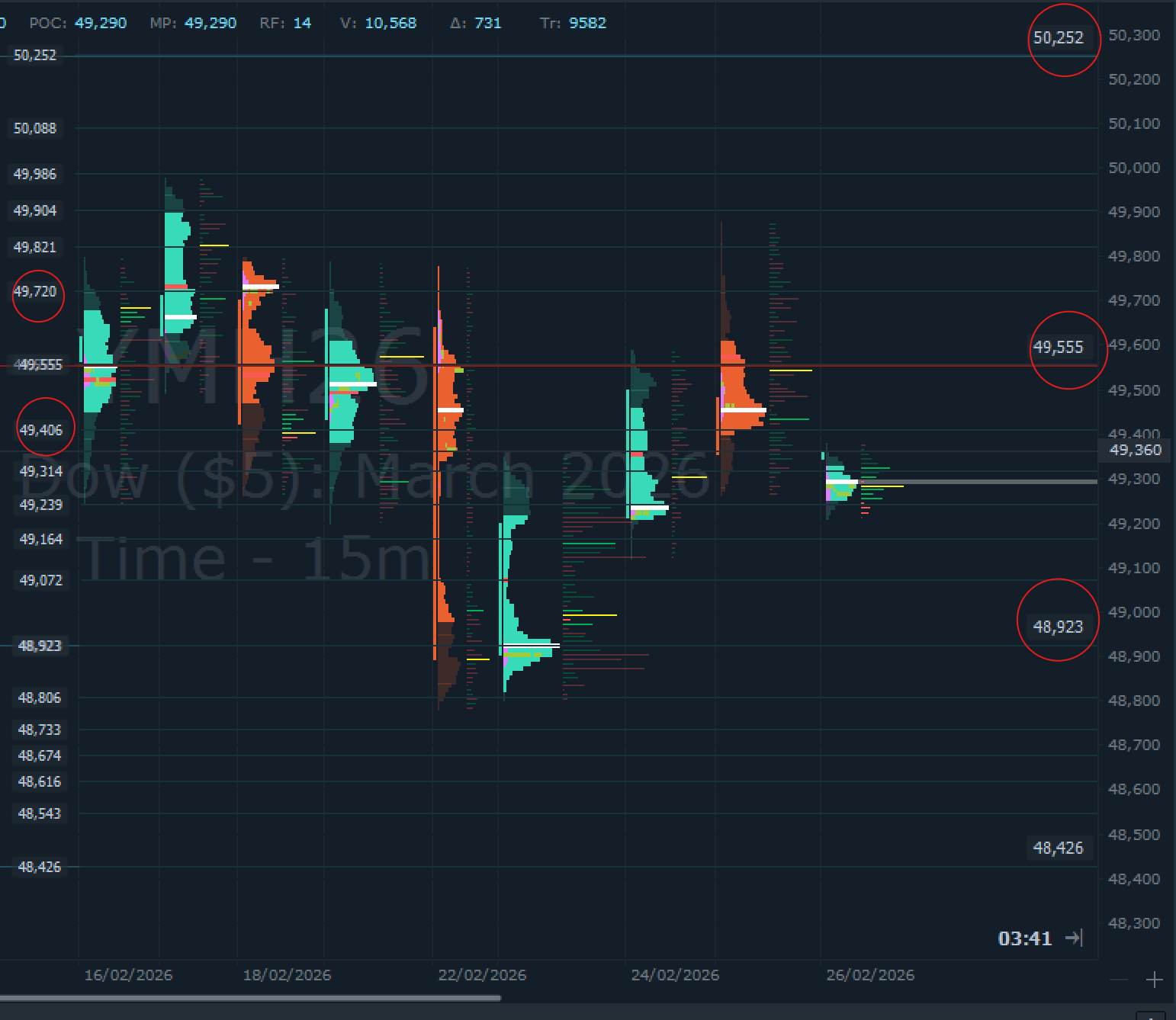
Dow futures hold the lower gate as value stabilises into the NY open
Defend the lower gate; reopen the CP. Acceptance above the CP shifts focus to the upper gate.
Market snapshot (London session)
- Current price: 49,354.
- TPO POC: 49,250.
- VPOC: 49,280.
- VAH / VAL: 49,310/49,250.
Value read: Value is concentrated around 49,250–49,310 (POC/VPOC/VAL clustered), and price is trading just above it.
State read: Early repair/transition, — buyers are defending the lower gate, but acceptance above CP (49,555) is the key confirmation for upside continuation.
Structure map
- UR: 50,252.
- UG: 49,720 – 49,821.
- CP: 49,555.
- LG: 49,406 – 49,314.
- LR: 48,923.
Trade plan (NY open focus: first 5–30 minutes)
Primary scenario (rotation attempt).
If: price holds above LG (49,406–49,314).
Then: rotation toward CP (49,555).
Execution zone: lower-gate edge → CP.
Tertiary scenario (upside continuation).
If: price reclaims and holds above CP (49,555).
Then: focus shifts to UG (49,720–49,821).
Execution zone: CP hold → upper gate
CP decision note: A tag of CP is not the same as acceptance (look for time + pullback support).
Secondary scenario (if gate fails).
If: acceptance back below 49,314.
Then: downside extension risk increases toward LR (48,923).
Downside refs: 49,239 → 49,164 → 49,072, then 48,923.
Open checklist (first 5–10 minutes)
- Bull trigger: holds 49,314–49,406 and reclaims value on pullbacks → rotation path stays open to 49,555.
- Bear trigger: acceptance below 49,314 + failed reclaim into LG → drift toward 49,239/49,164, then 49,072, with 48,923 as extension risk.
- Two-way risk zone: 49,406–49,555 often chops — cleaner execution tends to come from the edges (LG edge / CP edge).
Bottom line: Hold the lower gate (49,314–49,406) to keep the rotation path open back to CP (49,555). Acceptance above CP shifts focus to the upper gate (49,720–49,821). Failure below the gate increases downside risk toward 48,923.
S&P 500 futures (ES)
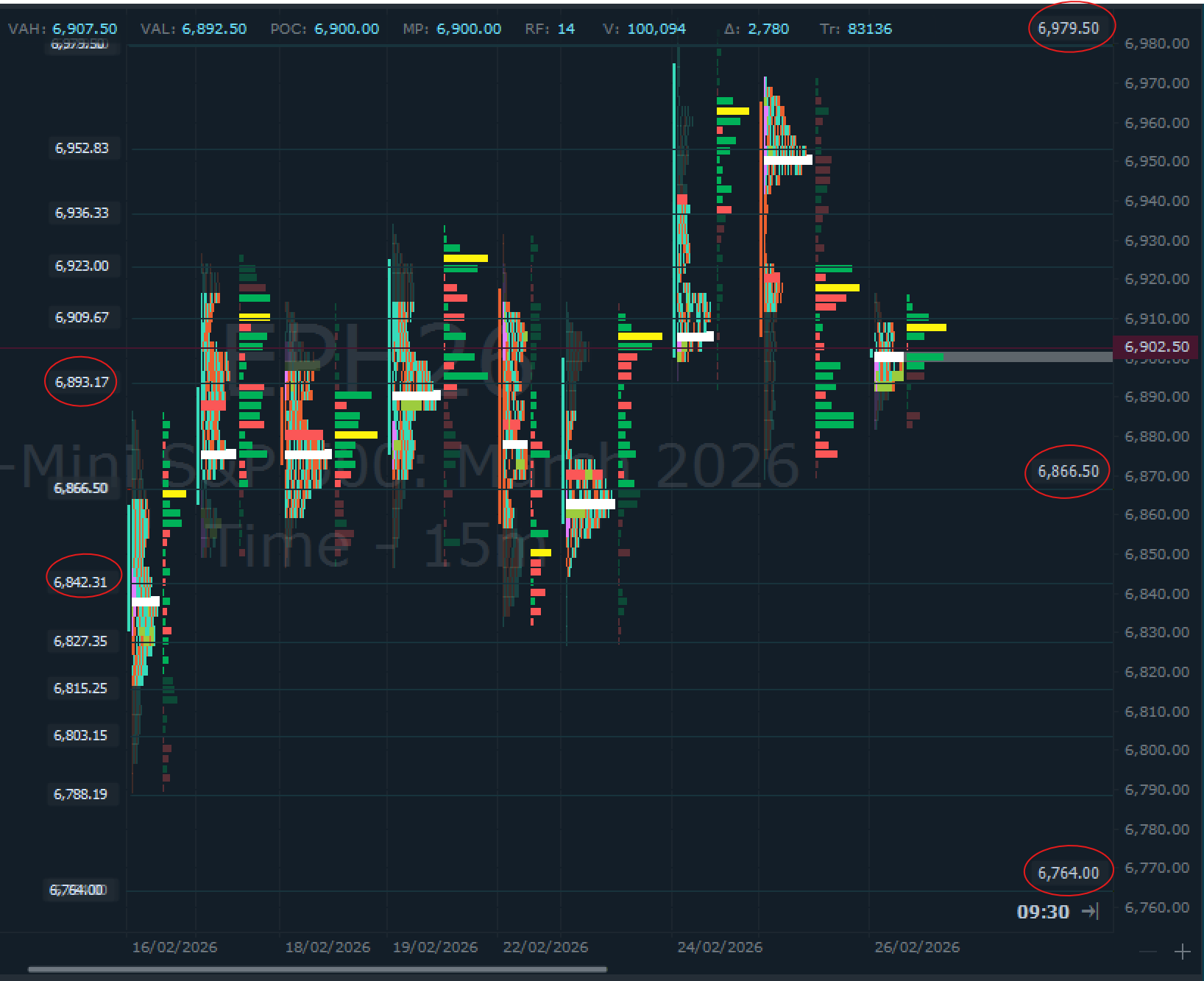
S&P 500 futures build above the central pivot as the upper gate becomes the NY open decision.
Hold the upper gate to reopen the upper range; lose it, and attention rotates back to CP, with the lower gate as the next risk zone.
Market snapshot (London session)
- Current price: 6,902.
- TPO POC: 6,897.
- VPOC: 6,907.
- VAH/VAL: 6,905/6,892.
Value read: Value is concentrated around 6,892–6,905, with VPOC slightly higher at 6,907. Price is working the upper edge of value inside the upper-gate band.
State read: Constructive pressure/early acceptance attempt — London is holding above CP (6,866) and spending time at the upper gate, but NY open decides continuation vs rotation.
Structure map
- UR: 6,979.
- UG: 6,893 – 6,909.
- CP: 6,866.
- LG: 6,842 – 6,827.
- LR: 6,764.
Trade plan (NY open focus: First 5–30 minutes)
Primary scenario (upside continuation).
If: price holds UG (6,893–6,909).
Then: rotation toward UR (6,979).
Execution zone: upper gate → upper range.
Upside refs: 6,923 → 6,936 → 6,952, then 6,979.
“Hold the upper gate” definition:
- Best case: acceptance above 6,909 (time building above).
- Still constructive: pullbacks defend 6,893 and rotate back into the band.
Secondary scenario (if the upper gate fails).
If: price fails to hold UG.
Then: focus shifts to CP (6,866).
- If CP holds: rotation/repair back toward value and UG.
- If CP fails: LG (6,842–6,827) becomes the next test, with expansion risk toward 6,764.
CP fail definition: repeated rejection below 6,866 with value rebuilding under it (not a single wick).
Critical note: Intraday CP matches daily CP — added weight at 6,866.
CP decision note: A tag of CP is not the same as acceptance.
Open checklist (first 5–10 minutes)
- Bull trigger: holds 6,893–6,909 on pullbacks → keep 6,923/6,936/6,952 in play toward 6,979.
- Bear trigger: rejection at UG + acceptance back under value → rotation risk increases to 6,866.
- Range-day note: sustained cycling inside 6,893–6,909 often reads as balance — trade edges, avoid the middle.
- Two-way risk zone: 6,893–6,866 can chop — cleaner execution from UG edge / CP edge.
Bottom line: The upper gate (6,893–6,909) is the decision band into the open. Hold/accept above it keeps the path active toward the upper range (6,979). Rejection shifts focus back to CP (6,866) — heavier today with intraday and daily CP aligned.
Nasdaq futures (MNQ/NQ)
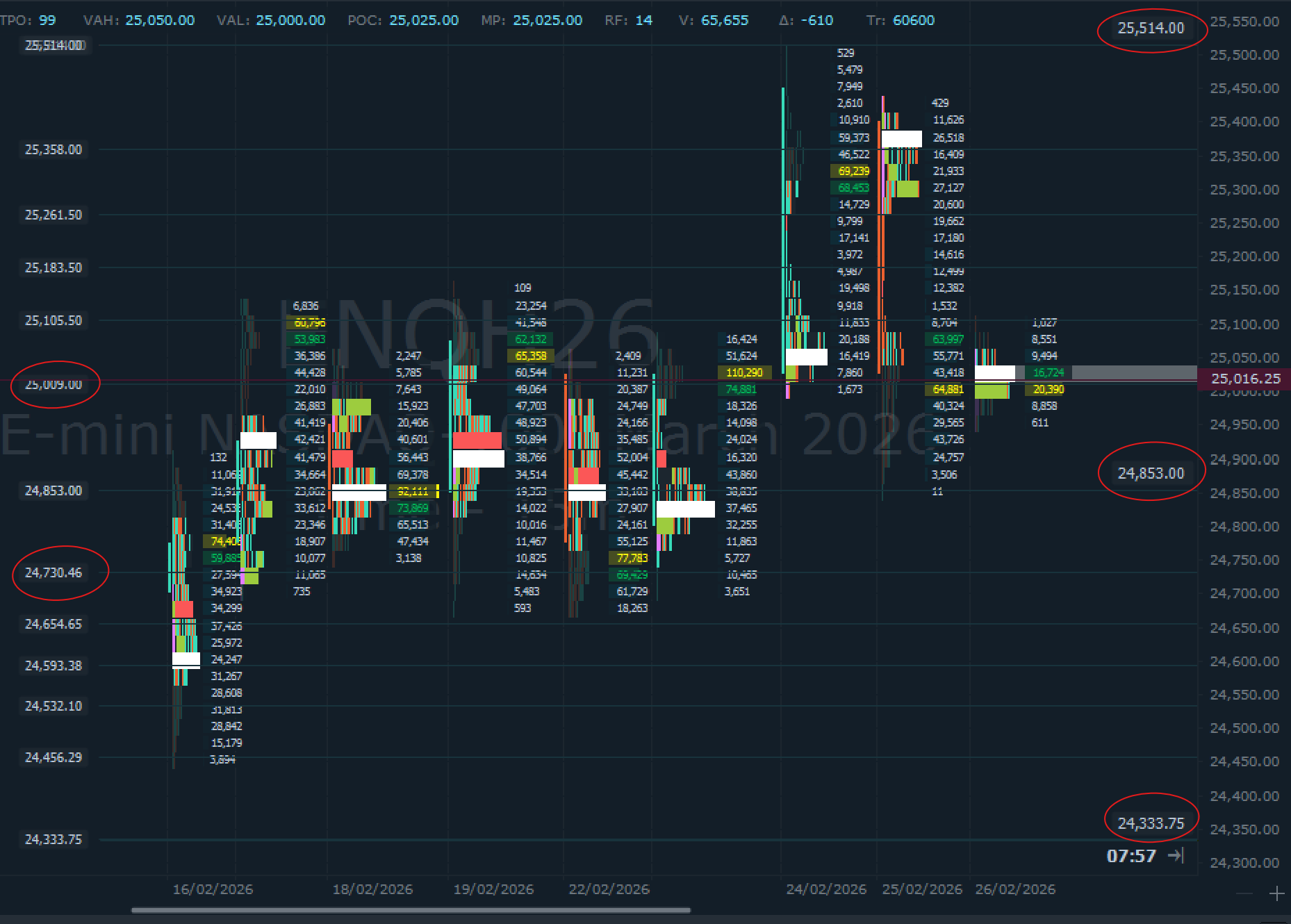
Nasdaq futures sit on value as the upper gate becomes the NY open decision
Hold the upper gate to reopen the upper range; reject it, and the map rotates back to CP, with the lower gate next if CP fails.
Market snapshot (London session)
- Current price: 25,016.
- TPO POC: 25,025.
- VPOC: 25,026.
- VAH/VAL: 25,050/25,000.
Value read: Value is concentrated around 25,000–25,050, with POC/VPOC clustered near 25,025–25,026. Price is sitting on value — often a two-way open unless the market accepts above VAH or rejects below VAL.
State read: Repair/decisionrepair/transition forming — London is holding above CP (24,853), but NY open decides acceptance through the upper gate vs rotation back to CP.
Structure map
- UR: 25,514.
- UG: 25,009 – 25,105.
- CP: 24,853.
- LG: 24,730 – 24,654.
- LR: 24,333.
Trade plan (NY open focus: First 5–30 minutes)
Primary scenario (upside continuation).
If: price holds UG (25,009–25,105).
Then: rotation toward UR (25,514).
Execution zone: upper gate → upper range.
Upside refs: 25,183 → 25,261 → 25,358, then 25,514.
“Hold the upper gate” definition:
- Best case: acceptance above 25,105.
- Still constructive: pullbacks defend 25,009 and rotate back into value.
Secondary scenario (if the upper gate fails).
If: price fails to hold UG.
Then: focus shifts to CP (24,853).
- If CP holds, repair back toward value and UG.
- If CP fails: LG (24,730–24,654) becomes the test zone, with expansion risk toward 24,333 if acceptance builds below LG.
CP fail definition: repeated rejection below 24,853 with value rebuilding under it (not a single wick).
Open checklist (first 5–10 minutes)
- Bull trigger: holds 25,009–25,105 → keep 25,183/25,261/25,358 in play toward 25,514.
- Bear trigger: rejection at UG + acceptance back below value → rotation risk increases toward 24,853.
- Value trigger: acceptance above VAH 25,050 supports the bullish path; acceptance below VAL 25,000 increases odds of rotation to CP.
- Range-day note: cycling inside 25,009–25,105 often reads as balance — trade edges, avoid chasing the middle.
- Two-way risk zone: 25,009–24,853 can chop — cleaner execution from UG edge / CP edge.
Bottom line: Nasdaq is sitting on value (25,000–25,050) with the upper gate (25,009–25,105) in focus. Acceptance above VAH (25,050) supports rotation toward 25,514. Rejection below VAL (25,000) increases the odds of rotation back to CP (24,853), with the lower gate next if CP fails.
Cross-index summary + rank
Summary
Nasdaq and S&P 500 are running a near-identical map: both are holding above CP and using the upper gate as the main decision into New York. That typically creates a clean “decision band” open — either accept above the gate and rotate higher, or reject and rotate back to CP.
Dow is slightly different: it’s still in repair mode from below, with the plan starting at the lower gate → CP before the upside ladder (CP → upper gate) becomes active.
Rank (clearest read → least clear)
- S&P 500 (ES) — cleanest alignment: above CP and working the upper gate with a straightforward continuation ladder to the upper range.
- Nasdaq (MNQ/NQ) — very similar to ES, but sitting directly on POC/VPOC inside value, which can create more two-way noise early.
- Dow (YM) — usable, but still a repair sequence from the lower gate; needs CP acceptance before the upside map becomes as clean as ES/NQ.
These desk updates document a structure-first process, observing how price accepts or rejects predefined levels over time. Coverage spans futures, commodities, forex, bonds, crypto, stocks, and indices, with structure providing context before direction. This observation is for informational purposes only and does not constitute financial advice.
Structure defines context; price reveals response.
Author

Denis Joeli Fatiaki
Independent Analyst
Denis Joeli Fatiaki possesses over a decade of extensive experience as a multi-asset trader and Market Strategist.