|

S&P 500 and market breadth

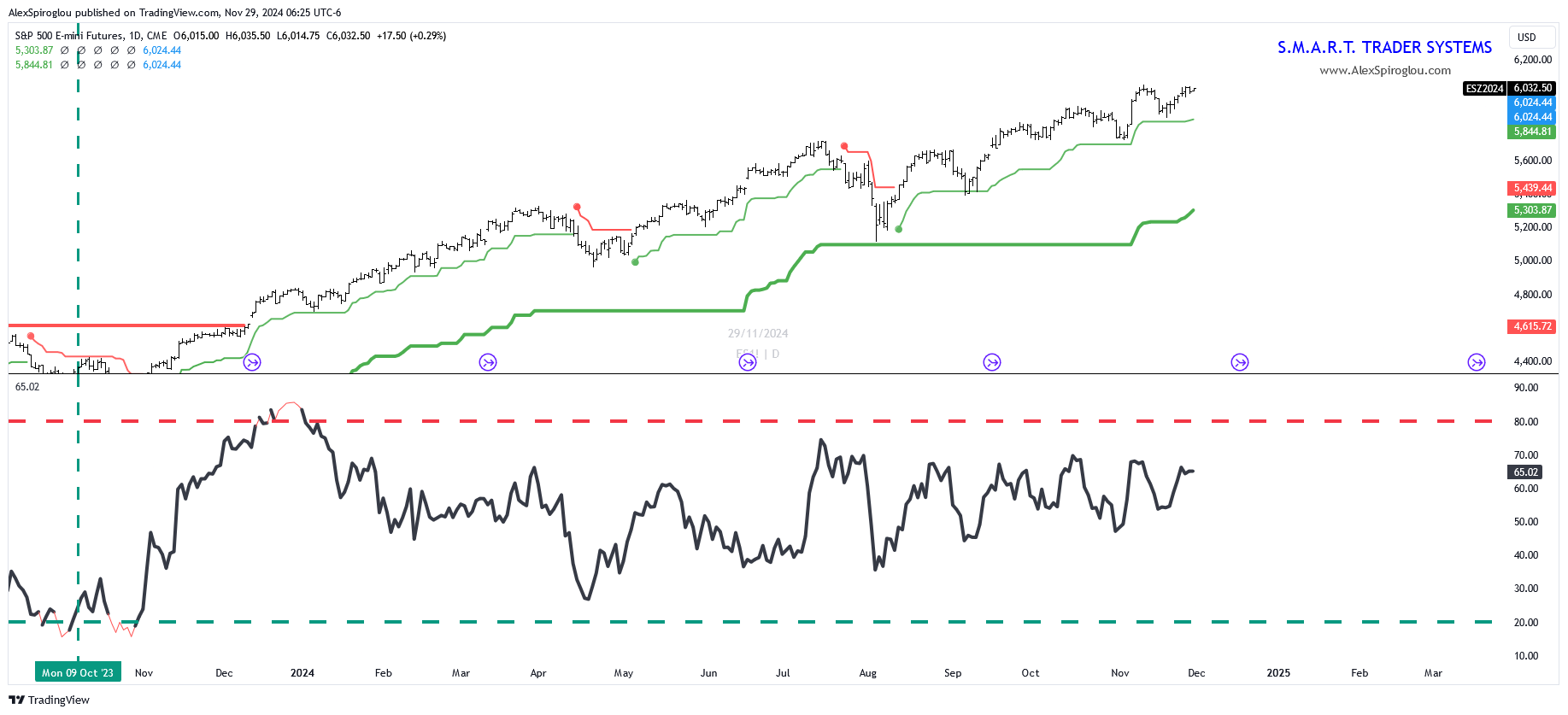
The chart of the S&P 500 alongside the percentage of NYSE stocks trading above their 50-day Exponential Moving Average (EMA) provides a snapshot of market breadth —a measure of participation across individual stocks.

Currently, 65% of NYSE stocks are above their 50 EMA, a healthy sign indicating broad market participation in the upward trend.

Market breadth is an important indicator for understanding overall market momentum. The percentage above the 50 EMA highlights how many stocks are in a short-term bullish phase. When a large proportion of stocks exceed this threshold, it often suggests robust underlying strength in the market. Conversely, a decline below key levels may signal weakening participation and potential trend reversals.

At 65%, the breadth suggests the market is in a favorable position, yet it has not reached extreme levels that typically warn of overbought conditions or momentum exhaustion.

Historically, readings closer to 80% or higher often coincide with temporary peaks, as buying pressure becomes overstretched. This middle-ground level reflects sustained bullish momentum without the risks associated with euphoria.

Monitoring market breadth helps traders gauge whether the broader market supports price action in major indices like the S&P 500. A divergence, where the index rises but breadth declines, can be an early warning of weakening momentum. For now, the positive breadth supports the current rally, reinforcing confidence in the market’s short-term trend.
Chart

Author

Alex Spiroglou, CFTe, DipTA (ATAA)

Alex Spiroglou is a quasi-systematic, cross-asset proprietary futures trader. His involvement with capital markets began in 1998, having worked for various proprietary trading and investment management firms in the UK and Greece.


More from Alex Spiroglou, CFTe, DipTA (ATAA)
Share:

Markets move fast. We move first.

Orange Juice Newsletter brings you expert driven insights - not headlines. Every day on your inbox.

By subscribing you agree to our Terms and conditions.

Editor's Picks

EUR/USD bounces toward 1.1750 as US Dollar loses strength

EUR/USD returned to the 1.1750 price zone in the American session on Friday, despite falling Wall Street, which indicates risk aversion. Trading conditions remain thin following the New Year holiday and ahead of the weekend, with the focus shifting to US employment and European data scheduled for next week.

GBP/USD nears 1.3500, holds within familiar levels

After testing 1.3400 on the last day of 2025, GBP/USD managed to stage a rebound. Nevertheless, the pair finds it difficult to gather momentum and trades with modest intraday gains at around 1.3490 as market participants remain in holiday mood.

Gold trims intraday gains, approaches $4,300

Gold retreated sharply from the $4,400  area and trades flat for the day in the $4,320 price zone. Choppy trading conditions exacerbated the intraday decline, although XAU/USD bearish case is out of the picture, considering growing expectations for a dovish Fed and persistent geopolitical tensions.

Cardano gains early New Year momentum, bulls target falling wedge breakout

Cardano kicks off the New Year on a positive note and is extending gains, trading above $0.36 at the time of writing on Friday. Improving on-chain and derivatives data point to growing bullish interest, while the technical outlook keeps an upside breakout in focus.

Economic outlook 2026-2027 in advanced countries: Solidity test

After a year marked by global economic resilience and ending on a note of optimism, 2026 looks promising and could be a year of solid economic performance. In our baseline scenario, we expect most of the supportive factors at work in 2025 to continue to play a role in 2026.

Crypto market outlook for 2026

Year 2025 was volatile, as crypto often is.  Among positive catalysts were favourable regulatory changes in the U.S., rise of Digital Asset Treasuries (DAT), adoption of AI and tokenization of Real-World-Assets (RWA).