Snapchat stocks trend following trade idea: How to play the long term trend accelerating higher

Introduction
VolatilityMarkets trend following trade
According to AQR the quantitative hedge fund and Yale University, over the past 100 years markets moved in trends. Trends are successive upwards and downwards movements in price that occur at a greater frequency than would be predicted by randomness alone. The following trade idea is a trend following trade idea which takes the assumption that the market will continue moving in the way it has over the previous sessions. Trend Trading, however is different than scalping due to the time horizon of the trade as trend following trades will take a week while scalping is done on a daily or intraday basis.
Market summary
Price
Snapchat last price was $ 11.985.
Trend analysis
In the short term Snapchat has been accelerating higher. In the long term Snapchat has been accelerating higher.
Value analysis
Over the past 20 days, the Snapchat price increased 11 days and decreased 9 days.
For every up day, there were 0.82 down days.
The average return on days where the price increased is 3.9469%
The average return on days where the price decreased is -2.6972%
Performance
Over the past 20 Days, the price has increased by 19.25% percent.
Over the past 20 days, the average return per day has been 0.9625% percent.
Trade Idea
Taking into account the long term trend accelerating higher, we propose a long trade idea with time horizon.
Trend trade idea
Buy $ 63,563 USD of Snapchat, take profit at $ 12.3091 level with 25.0% odds for a $ 1,718 USD gain, stop outat $ 11.3364 with 50.0% odds for a $ 1,000 USD loss through a one Week time horizon
Intraday predictions
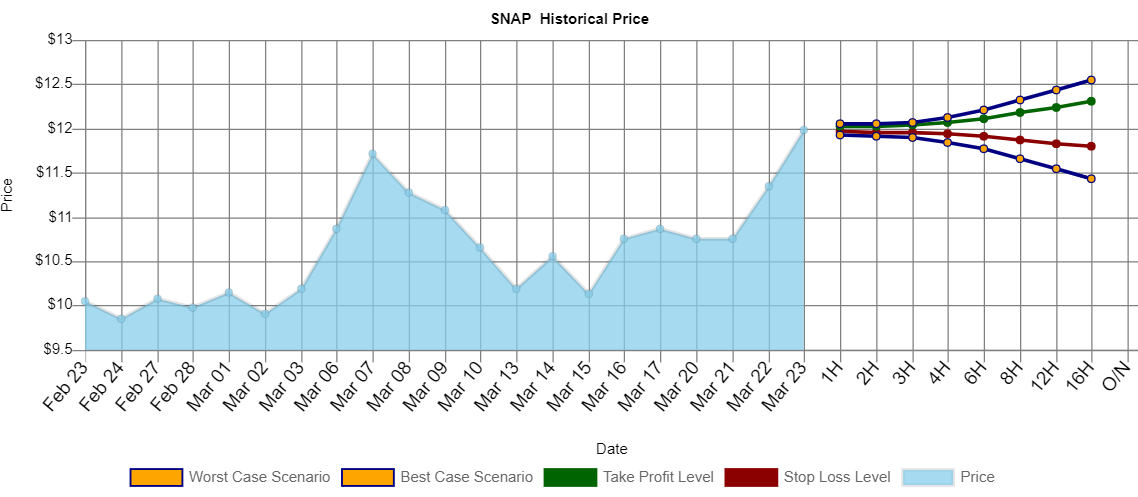
Snapchat trend analysis
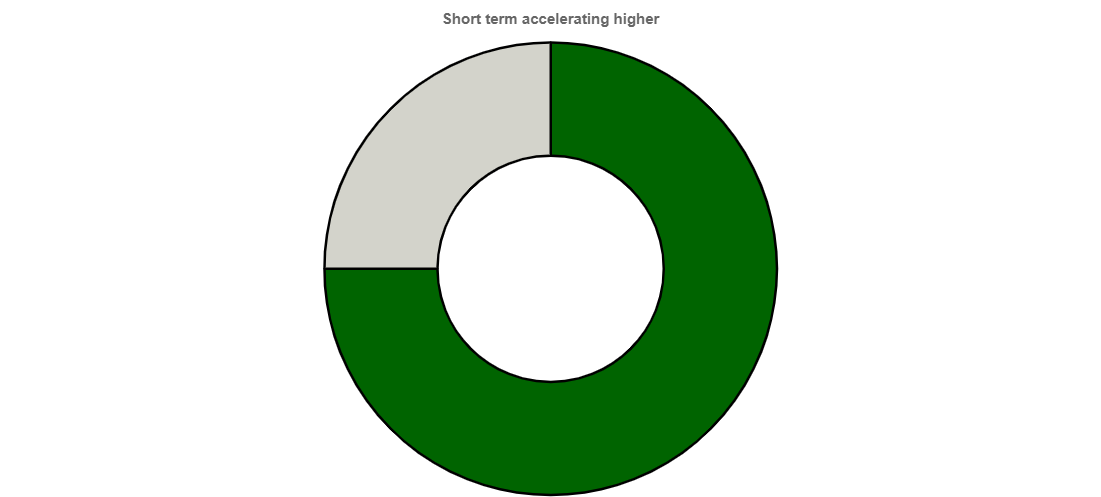
Snapchat last price was $ 11.985 . The short term trend accelerating higher is stronger than the long term trend accelerating higher. This trade goes long when the last change was higher and accelerating.
Snapchat value analysis
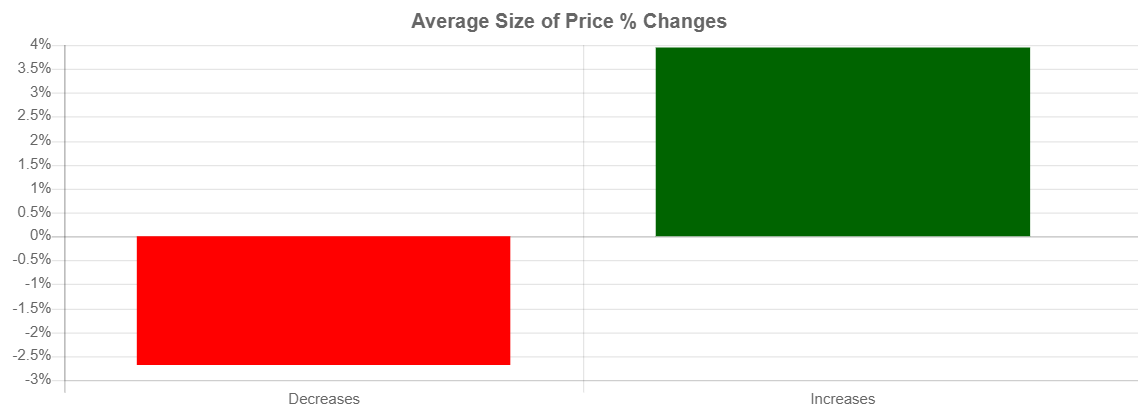
Over the past 20 days, the Snapchat price increased 11 days and decreased 9 days. For every up day, there were 0.82 down days. The average return on days where the price increased is 3.9469% The average return on days where the price decreased is -2.6972% Over the past 20 Days, the price has increased by 19.25% percent. Over the past 20 days, the average return per day has been 0.9625% percent.
Snapchat worst/best case scenario analysis
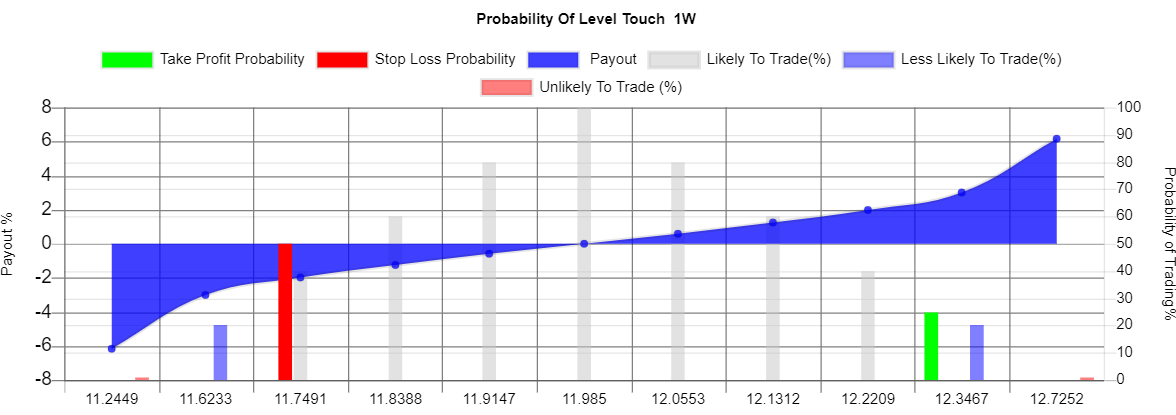
Within 1 week, our worst case scenario where we are 95% certain that this level won't trade for Snapchat, is $ 9.9704, and the best case scenario overnight is $ 13.9996. levels outside of this range are unlikely, but still possible, to trade. We are 50% confident that $ 11.3364 could trade and that $ 12.3091 could trade. These levels are within statistical probability.
Expected range
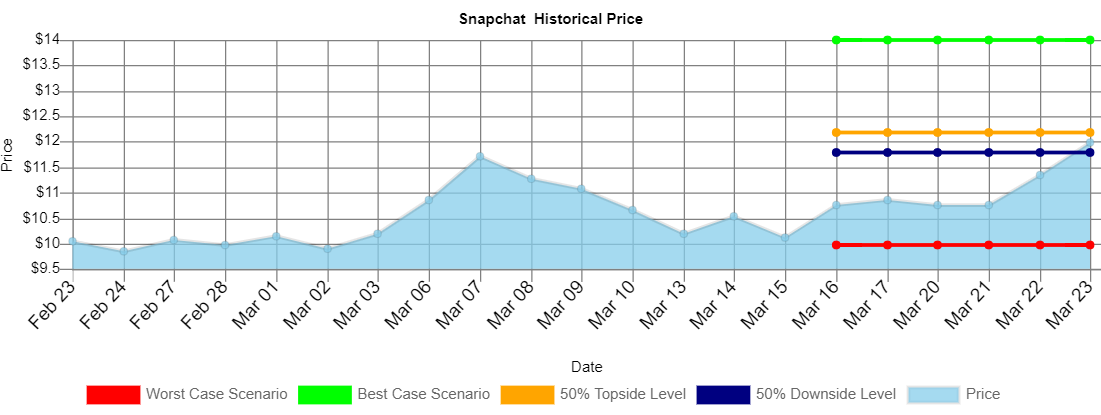
Within 1 week, our worst case scenario where we are 95% certain that this level won't trade for SNAP, is $ 9.9704 , and the best case scenario overnight is $ 13.9996 . levels outside of this range are unlikely, but still possible, to trade.
We are 50% confident that $ 11.3364 could trade and that $ 12.3091 could trade. These levels are within statistical probability.
Probability vs payout chart
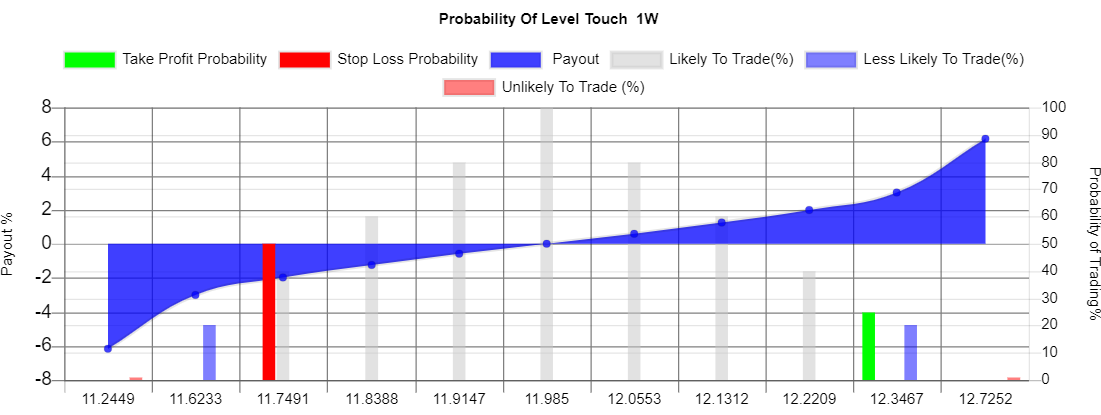
This graph contrasts the percentage payout of holding a position vs the probability that the payout occurs. The red and green columns represent the probability of stopping out and taking profit and their associated payouts.
Key takeaways
-
Price today $ 11.985.
-
Over the past 20 days, the Snapchat price increased 11 days and decreased 9 Days.
-
For every up day, there were 0.82 down days.
-
The average return on days where the price increased is 3.9469%.
-
The average return on days where the price decreased is -2.6972%.
-
Over the past 20 Days, the price has increased by 19.25% percent.
-
Over the past 20 days, the average return per day has been 0.9625% percent.
-
Over the past 20 days, The price has on average been accelerating: $ 0.0229 per day higher.
-
Over the last session, the price increased by $ 0.635.
-
Over the last session, the price increased by 5.2983 %.
-
Over the last session, the price accelerated by $ 0.035.
Author

Barry Weinstein
Volatility Markets Newswire
Barry Weinstein was a forex derivatives trader at BlueCrest Capital which was one of the largest hedge funds in Europe and then joined Credit Suisse where he assisted in running one of the largest FX Options portfolios in Europe.