Silver Price Forecast: XAG/USD holds steady above mid-$32.00s, over one-week top
- Silver consolidates in a range as bulls opt to wait for the release of the US NFP report.
- The setup suggests that the path of least resistance for the XAU/USD is to the upside.
- Any corrective pullback might still be seen as a buying opportunity and remain limited.

Silver (XAG/USD) oscillates in a narrow band during the Asian session on Friday and currently trades above mid-$32.00s, near its highest level in over a week touched the previous day. Moreover, the near-term bias seems tilted in favor of bullish traders and supports prospects for an extension of the weekly uptrend.
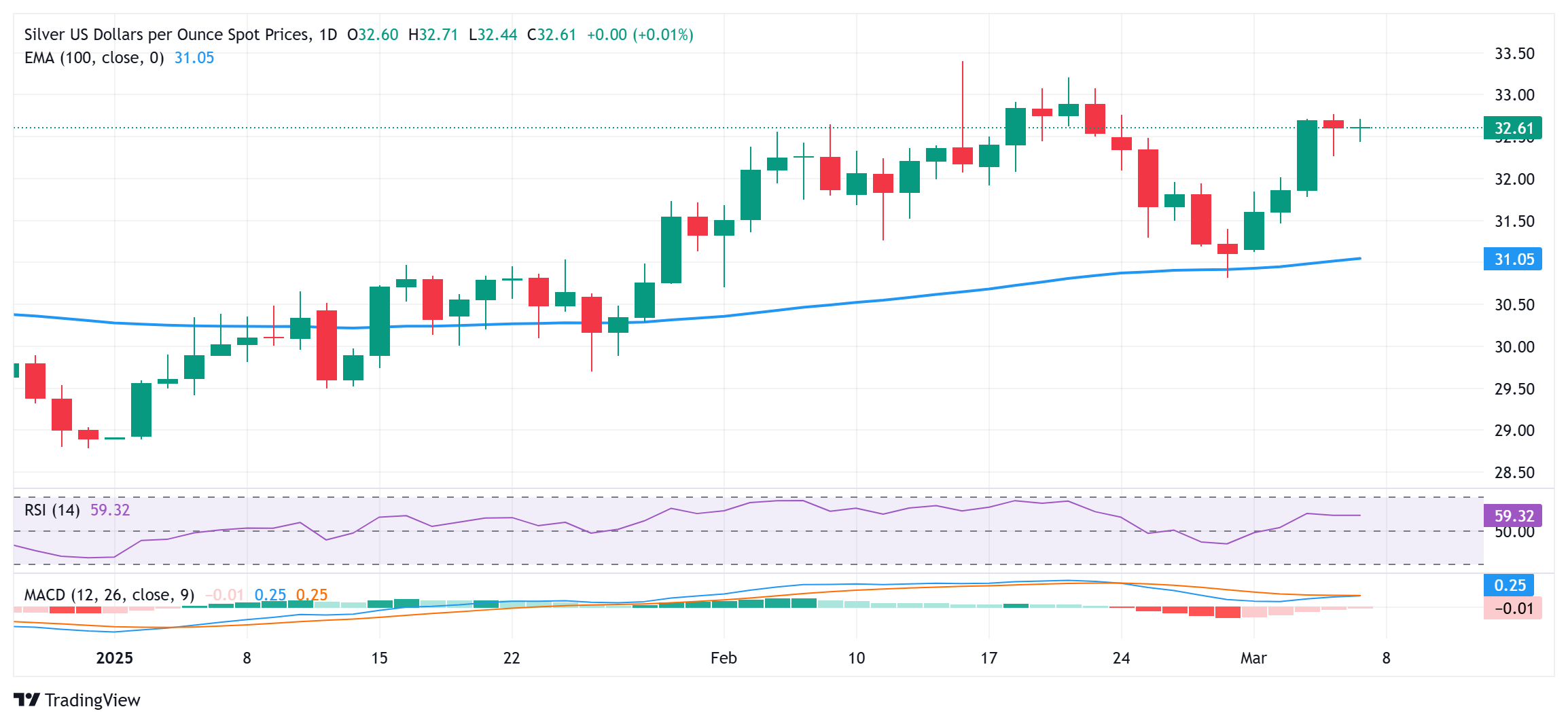
The recent bounce from sub-$31.00 levels, nearing the 100-day Exponential Moving Average (EMA), and the fact that oscillators on the daily chart have just started gaining positive traction validate the constructive outlook for the XAG/USD. Hence, some follow-through strength beyond the $33.00 mark, towards the February monthly swing high around the $33.40 area, looks like a distinct possibility.
The momentum could extend further towards the next relevant hurdle near the $33.60-$33.70 area before the XAG/USD climbs further towards the $34.00 round figure en route to the $34.50-$34.55 resistance zone. The white metal might then aim towards challenging a multi-year high, closer to the $35.00 psychological mark touched in October 2024.
On the flip side, the $32.30-$32.25 horizontal resistance breakpoint, which coincides with the overnight swing low, might still protect the immediate downside ahead of the $32.00 mark. This is followed by the $31.80 area, below which the XAG/USD could decline to the $31.25-$31.20 region en route to the 100-day EMA, currently pegged near the $31.10-$31.00 area and last week's swing low, around the $30.80 area.
A convincing break below the latter would shift the bias in favor of bearish traders and drag the XAG/USD towards the $30.00 psychological mark en route to the $29.55-$29.50 support and sub-$29.00 levels, or the year-to-date low touched in January.
Silver daily chart
Silver FAQs
Silver is a precious metal highly traded among investors. It has been historically used as a store of value and a medium of exchange. Although less popular than Gold, traders may turn to Silver to diversify their investment portfolio, for its intrinsic value or as a potential hedge during high-inflation periods. Investors can buy physical Silver, in coins or in bars, or trade it through vehicles such as Exchange Traded Funds, which track its price on international markets.
Silver prices can move due to a wide range of factors. Geopolitical instability or fears of a deep recession can make Silver price escalate due to its safe-haven status, although to a lesser extent than Gold's. As a yieldless asset, Silver tends to rise with lower interest rates. Its moves also depend on how the US Dollar (USD) behaves as the asset is priced in dollars (XAG/USD). A strong Dollar tends to keep the price of Silver at bay, whereas a weaker Dollar is likely to propel prices up. Other factors such as investment demand, mining supply – Silver is much more abundant than Gold – and recycling rates can also affect prices.
Silver is widely used in industry, particularly in sectors such as electronics or solar energy, as it has one of the highest electric conductivity of all metals – more than Copper and Gold. A surge in demand can increase prices, while a decline tends to lower them. Dynamics in the US, Chinese and Indian economies can also contribute to price swings: for the US and particularly China, their big industrial sectors use Silver in various processes; in India, consumers’ demand for the precious metal for jewellery also plays a key role in setting prices.
Silver prices tend to follow Gold's moves. When Gold prices rise, Silver typically follows suit, as their status as safe-haven assets is similar. The Gold/Silver ratio, which shows the number of ounces of Silver needed to equal the value of one ounce of Gold, may help to determine the relative valuation between both metals. Some investors may consider a high ratio as an indicator that Silver is undervalued, or Gold is overvalued. On the contrary, a low ratio might suggest that Gold is undervalued relative to Silver.
Author

Haresh Menghani
FXStreet
Haresh Menghani is a detail-oriented professional with 10+ years of extensive experience in analysing the global financial markets.

















