Shopify Stock Forecast: SHOP breaks through $40 resistance
- SHOP stock crossed above the $40 resistance level on Thursday.
- Wednesday saw Shopify shares advance 12%, earnings to be released next week.
- A new partnership with YouTube content creators has the market feeling optimistic.

Shopify (SHOP) stock is not giving back any of its 12% spike from Wednesday. early in Thursday's session, SHOP shares have advanced another 4.1% to $40.08. This price level is key since the market has kept SHOP from closing above $40 since early May. A close above $40 would then seem to signal that Shopify stock is back in an uptrend. The advanced is doubly impressive on Thursday since all three major US indices – the S&P 500, Dow, Nasdaq – are pulling back.
Also read: Amazon Stock Deep Dive: AMZN price target at $106 with near-term risks offset by long-term growth
Shopify Stock News: YouTube partnership creates large stepping stone for expansion
Shopify announced a new partnership with YouTube on Wednesday that led to the 12% spike. The agreement allows YouTube content creators to benefit by directly selling the products they mention in their videos. Shopify is essentially streamlining the e-commerce process by allowing YouTubers to directly market these products through YouTube rather than requiring consumers to leave the platform for another site. Buyers can checkout directly within YouTube, and Shopify will take care of the payment processing and fulfillment via content creators' Shopify stores.
"Commerce today is multichannel, and YouTube is one of the most influential channels on the planet," said Kaz Nejatian, VP of Product at Shopify. "Shopify's new YouTube integration will fundamentally change what opportunity looks like for independent brands in the creator economy.”
Sales of beauty products, electronics and fashion are thought to be big winners of this partnership. The news has also led some analysts to grow more optimistic about Shopify's earnings release next week on July 27. The news has mostly been negative during Q2. Of the 26 analysts who submitted earnings revisions in the past 90 days, 25 have made downward revisions, but recent revisions have been better than those earlier in the cycle. Analysts are expecting just $0.03 in adjusted earnings per share on revenue of $1.34 billion, because the major competitor to Amazon (AMZN) has launched a steep capex strategy of investing in the warehouse fulfillment segment rather than remaining a high-margin software business. Though both notes to investors were cautious, both Wells Fargo and Piper Sandler reiterated Overweight ratings on Shopify stock on Monday, July 18. Wells Fargo, however, lowered its price target from $55 to $40.
Shopify Stock Forecast: A move to $44 is likely soon
Shopify stock is uncertain to hold $40 on Thursday, but holding that price level is key. Only once since May 5 has SHOP stock closed above $40 and even then it was just $40.25. That session, May 13, also quickly lost its footing and sold off the following session. If $40 fails to hold, then SHOP will likely trend back toward support at $30, which it has used on four separate occasions in the past two months.
SHOP stock target for bulls is $44, caused by the gap in price on May 5. Markets tend to like to fill these gaps, and bulls have been trying to do so for three months now. With optimism spreading ahead of the July 27 earnings call, expect $44 to be reached before then. The Moving Average Convergence Divergence (MACD) indicator also recrossed in a bullish manner this week and provides more reason for optimism.
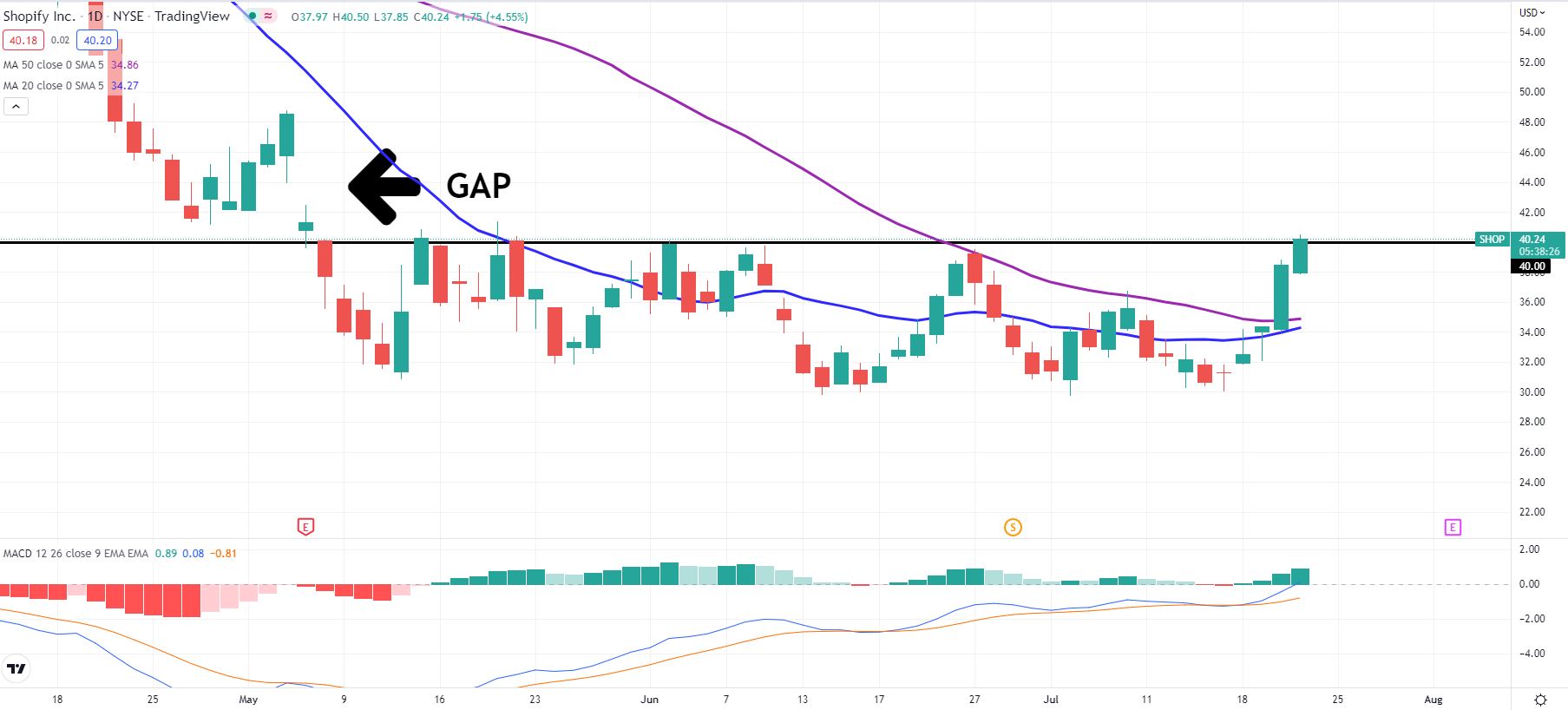
SHOP daily chart
Premium
You have reached your limit of 3 free articles for this month.
Start your subscription and get access to all our original articles.
Author

Clay Webster
FXStreet
Clay Webster grew up in the US outside Buffalo, New York and Lancaster, Pennsylvania. He began investing after college following the 2008 financial crisis.