Sempra Energy benefits from LNG growth and strategic investments

Key takeaways
- Sempra Energy is advancing ECA LNG Phase 1 and Port Arthur LNG Phase 1 to capture rising global LNG demand.
- Sempra Energy plans major transmission and distribution upgrades as capital spending rises through 2029.
- Sempra Energy is expanding wind, solar and rooftop solar capacity to accelerate renewable portfolio growth.
Sempra Energy (SRE - Free Report) is leveraging strategic investments to enhance operational reliability and deliver more efficient customer service. The company is also accelerating the growth of its renewable energy portfolio.
However, this Zacks Rank #3 (Hold) company faces risks from wildfires.
Key drivers boosting Sempra Energy
SRE is strategically positioned across North America to capitalize on rising global LNG demand. Its Sempra Infrastructure unit is advancing multiple natural gas liquefaction export projects, with significant construction progress as of September 2025 on both the ECA LNG Phase 1 and Port Arthur LNG Phase 1 projects.
Sempra Energy is steadily increasing infrastructure investments to keep pace with rising electricity demand, driven in part by the rapid expansion of AI data centers across the U.S. The company focuses mainly on transmission and distribution upgrades at its regulated utilities and expects capital spending to grow roughly 30% during 2026-2029. These initiatives aim to strengthen infrastructure, improve service efficiency, and support a projected rate base growth of about 10% annually through 2025-2029.
Sempra Energy is accelerating the growth of its renewable energy portfolio to tap into economic benefits and environmental, social, and governance incentives in the utility-scale renewable market.
Challenges that could impact SRE
In recent years, California has experienced some of its most severe wildfires, which can cause temporary power outages in SDG&E and SoCalGas service areas and potentially damage Sempra Energy’s electric and natural gas infrastructure, resulting in significant losses.
Sempra Infrastructure faces risks related to its partnerships with PEMEX and CFE, Mexico’s state-owned enterprises, including concerns about their financial stability, government regulations, and potential failure to meet contractual obligations. Any default by these counterparties could adversely impact Sempra’s operations and financial performance.
SRE stock price movement
In the past six months, Sempra Energy shares have risen 17.8% compared with the industry’s growth of 12.4%.
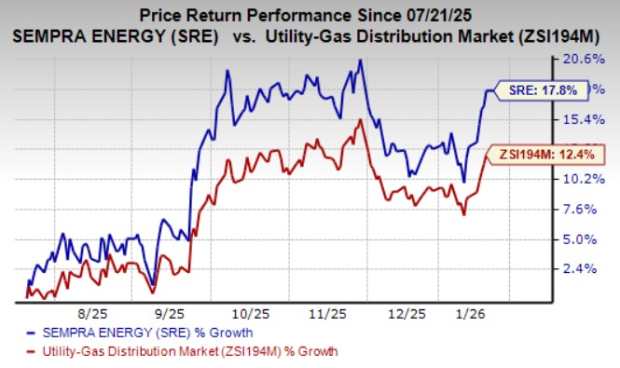
Image Source: Zacks Investment Research
Stocks to consider
Some better-ranked stocks from the same sector are One Gas, Inc. (OGS - Free Report) , Avista Corporation (AVA - Free Report) and Brookfield Infrastructure Corporation (BIPC - Free Report) , each carrying a Zacks Rank #2 (Buy) at present. You can see the complete list of today’s Zacks #1 Rank (Strong Buy) stocks here.
OGS’ long-term (three to five years) earnings growth rate is 6.66%. The Zacks Consensus Estimate for its 2026 earnings per share (EPS) is pinned at $4.71, which indicates a year-over-year increase of 7.7%.
AVA’s long-term earnings growth rate is 7.06%. The Zacks Consensus Estimate for its 2026 EPS is pegged at $2.76, which suggests a year-over-year rise of 9.3%.
The Zacks Consensus Estimate for BIPC’s 2026 sales is pinned at $3.88 billon, which indicates a year-over-year increase of 5.6%. The Zacks Consensus Estimate for its 2026 EPS is pegged at $10.71, which implies a massive year-over-year jump of 384.6%.
Want the latest recommendations from Zacks Investment Research? Download 7 Best Stocks for the Next 30 Days. Click to get this free report
Author

Zacks
Zacks Investment Research
Zacks Investment Research provides unbiased investment research and tools to help individuals and institutional investors make confident investing decisions.

















