|

RKT Stock Price: Rocket Companies Inc has three reasons to attract buyers as it flies at low orbit

  • NYSE: RKT is set to extend its falls toward the $20 mark, still above the IPO price.
  • Rocket Companies Inc.'s relatively low debut price and sliding shares may attract buyers.
  • The coronavirus crisis may increase demand for lending provided by Quicken Loans.

A quick rise and a quick fall for the firm behind Quicken Loans? Not so fast. While NYSE: RKT shares have been on the back foot, Rocket Companies has a sound business model that may thrive in coronavirus times for three reasons.

1) No fiscal support: Lawmakers in Washington are dithering around the next fiscal relief package, allowing federal unemployment benefits to lapse. President Donald Trump's executive order – which may be legally challenged – stipulated a top-up of $300/week for the unemployed, only half the previous payment. 

2) Low rates: While that poses a risk for debt payments, it also opens the door to further lending in the US – including from Quicken Loans. Interest rates remain depressed thanks to the Federal Reserve's open-ended bond-buying schemes and unequivocal support of the economy 

3) Suburban buying: Rocket Companies Inc. also owns Rocket Mortgages – and the housing market remains firm. Those who continue working from home are now seeking larger dwellings and are getting used to staying indoors. Demand for houses outside the large urban areas is rising. The thriving housing market may increase the demand for mortgages. 

All in all, the financial services company is well-positioned to take advantage of the current COVID-19 crisis – despite the dim recession prospects. 

RKT Stock Forecast
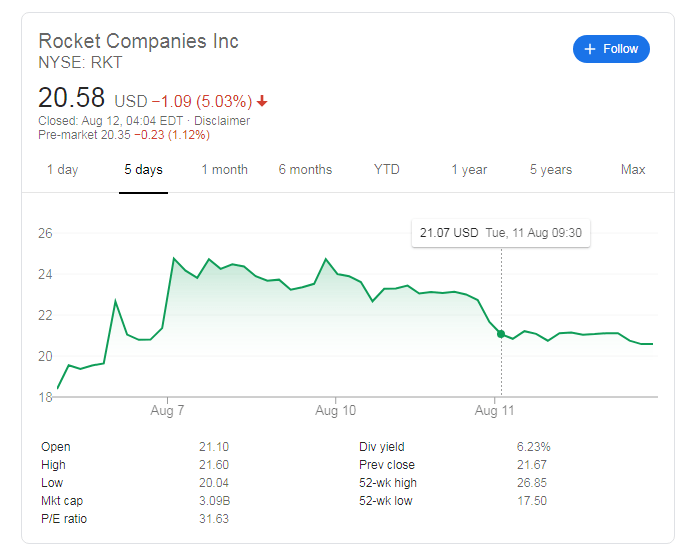
NYSE: RKT is priced at $20.35 at the time of writing, another minor decline after Tuesday's fall of 5%. Shares are now well below the peak of $26.85 hit shortly after the IPO but above the launch price of $18. 

Support awaits at the psychologically significant $20 level, followed closely by $19.50, which held it down before the surge. Immediate resistance is at the stubborn cap of $21.15, followed by $23. 

Author

Yohay Elam

Yohay Elam

FXStreet

Yohay is in Forex since 2008 when he founded Forex Crunch, a blog crafted in his free time that turned into a fully-fledged currency website later sold to Finixio.


More from Yohay Elam
Share:

Editor's Picks

GBP/USD bounces off lows, back above 1.3200

After bottoming out near 1.3160, GBP/USD manages to regain a bit of shine and reclaim the 1.3200 mark and beyond at the end of the week. Stronger-than-expected UK Retail Sales data seem to be helping the British Pound limit its losses, while the chaotic UK political environment keeps the bulls at bay for now.

EUR/USD looks consolidative around 1.1460

EUR/USD stages a modest rebound after slipping to a three-month low below 1.1420 at the end of the week. That said, the pair now looks to consolidate humble gains just above 1.1460 despite growing uncertainty surrounding the next round of US-Iran negotiations, which keeps the US Dollar’s downside contained.

Gold slips back to six-day lows, targets $4,100

Gold retreats for the third consecutive day on Friday, eroding gains seen in the first half of the week and approaching the key $4,100 mark per troy ounce. Indeed, the precious metal continues to face headwinds from the Fed's hawkish stance and renewed uncertainty surrounding the next round of US-Iran negotiations.

Breaking: Iran closes the Strait of Hormuz amid ceasefire deal violation
Iran says it is closing the Strait of Hormuz after accusing the United States (US) and Israel of violating the ceasefire. According to Iran, the decision came over the continued Israeli strikes in Lebanon. The Iranian Revolutionary Guard Corps Navy issued a warning to all vessels: "Do not approach the Strait of Hormuz; otherwise, your security will be jeopardized."
The Iran war didn't break the US economy, but what happens next?

Nearly four months after the start of the Iran war, the US economy remains remarkably resilient. While the conflict initially triggered a severe disruption to global energy markets and a sharp rise in Oil prices, recent diplomatic progress between Washington and Tehran has eased concerns about a prolonged supply shock.

Regime change: Inside Kevin Warsh's first move to make the Fed unreadable on purpose

The rate did not move. That was the least interesting thing about Kevin Warsh's first meeting in charge of the Fed. The FOMC held its benchmark at 3.50%-3.75% for the fourth straight meeting, exactly as priced, and then the new chair used his first press conference to dismantle the machinery the market has leaned on for a decade.