Ralph Lauren (RL Stock) is a retail stock you can buy and hold

Ralph Lauren (NYSE:RL) and brands like Levi Strauss (NYSE:LEVI) and Calvin Klein parent PVH Corp (NYSE:PVH) are winning in the retail wars for two reasons. The first is a well-loved brand, the second is a push into direct-to-consumer sales and eCommerce. The combination has the company set up to outperform most others in the industry and there are other reasons to like this stock as well. The stock is yielding nearly 2.8% compared to just over 2.0% for Levi Strauss and less than 0.25% for PVH. Trading at 12.5X its earnings it is also a value relative to the broader market and one that pays an above-average dividend in that respect as well. While the retail sector is as shaky as ever, Ralph Lauren is a winning investment growing on a global scale.
"While the global operating environment remains as volatile as ever, our talented, passionate teams are delivering on the multiple growth opportunities to scale our business with creativity and discipline — from driving high-quality new consumer recruitment to expanding digital and elevating our touch points in every region and channel,” says CEO Patrice Louvet.
Ralph Lauren wows the market with results
Ralph Lauren has been outperforming over the past few quarters so it was no surprise to see strong results. What is surprising is the revenue results beat the Marketbeat.com consensus by over 700 basis points and there is good news on the bottom line as well. The company reported $1.5 billion in net sales for a gain of 8.7% over last year that was driven by strength in all regions and channels. The top line was impacted by FX headwinds, however, which shaved more than 400 basis points off the currency-neutral results. On a comp-store basis, sales are up in the mid-teens.
The better news, however, is that pricing actions, mix, and efforts to mitigate supply chain hurdles more than offsetting the impacts of higher freight costs. The adjusted gross and operating margins contracted versus last year but less than expected which left the bottom line results ahead of the consensus as well. On the bottom line, the $1.88 in adjusted EPS beat the consensus by nearly 1000 basis points and the outlook for the remainder of the year is favorable too.
Ralph Lauren is expecting to see revenue growth accelerate in the 2nd fiscal quarter of the year and for margins to improve as well. The company is looking for revenue growth in the range of 11% for the 2nd quarter and 8% for the year compared to a low-single-digit consensus expectation and the operating margin should improve as much as 200 basis points by the end of the year.
Ralph Lauren is a high-quality dividend
Ralph Lauren is not only a relatively high-yielding stock but it is also a high-quality payer. The company is distributing only 33% of its earnings and there are no red flags on the balance sheet. The company has some debt but it is net cash with positive cash flow and ample coverage, ample enough to leave room for buybacks as well. The company repurchased $213 million worth of shares in the Q1 period and can be expected to repurchase more shares as the year wears on.
The technical outlook: Ralph Lauren moves higher
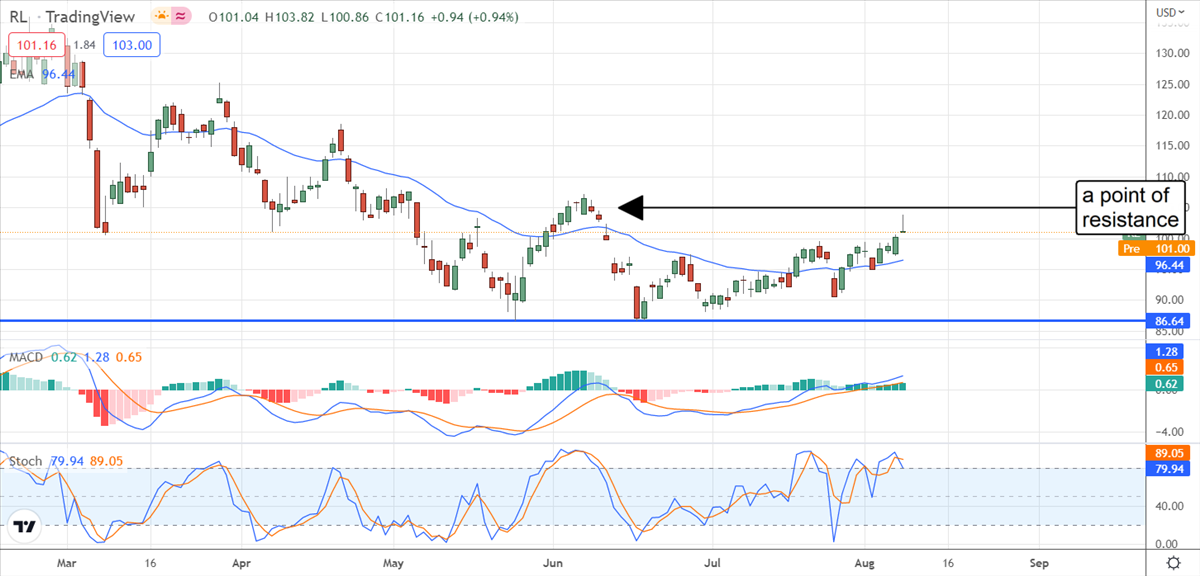
The price action in Ralph Lauren is up in premarket action and may move higher in the open session. The caveat is that price action is still below the $105 level which could produce stiff resistance. If the market can get above the $105 level a move up to the $110 to $115 range is expected. If not, this stock may be range bound at the current levels until later in the year.
Author

Jacob Wolinsky
ValueWalk
Jacob Wolinsky is the founder of ValueWalk, a popular investment site. Prior to founding ValueWalk, Jacob worked as an equity analyst for value research firm and as a freelance writer. He lives in Passaic New Jersey with his wife and four children.