Premium repricing meets Astro timing – Why the index still favors downside

After a sharp and clean decline from 6960, the index has retraced into a well-defined premium zone at 6899–6900, completing what appears to be a full redistribution phase. This includes a liquidity sweep beneath 6655, structural breaks, and a mitigation of prior inefficiencies. Having now compressed into a narrow consolidation band, the market sits at a critical juncture where deeper downside targets supported by both ICT structure and astro-cycle alignment remain active unless bulls reclaim control through a strong break in structure. We now find the market in a tighter equilibrium band, indicating a compressed state after clearing major inefficiencies and structural liquidity.
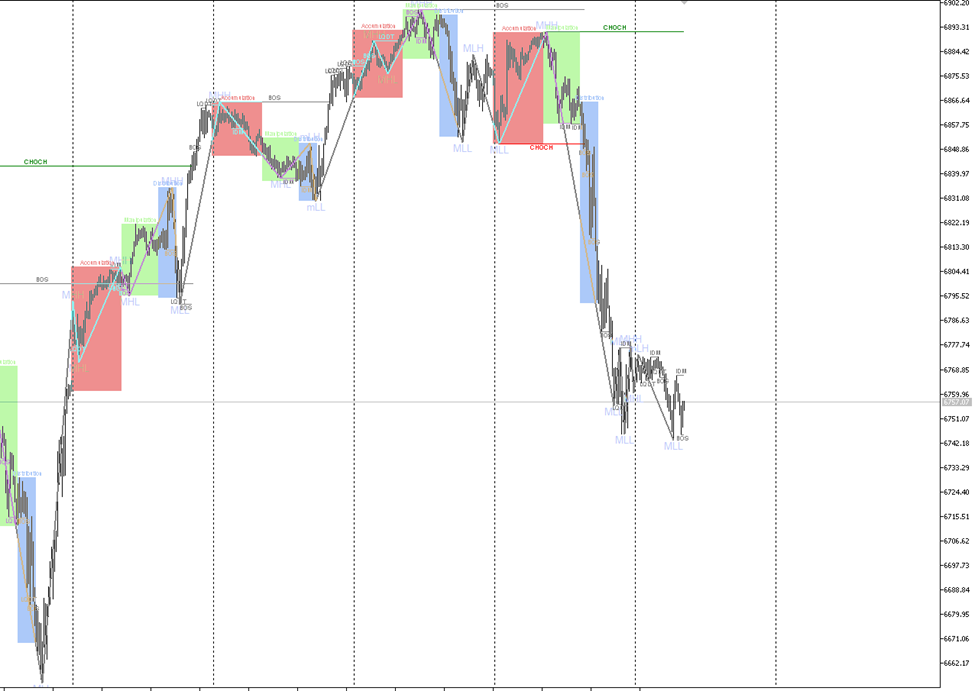
From an ICT (Inner Circle Trader) perspective, the drop from 6960 saw a clear BOS (Break of Structure) and SIBI (Sell-side Imbalance), and the pullback into 6899 was textbook Liquidity Grab -> Repricing -> Mitigation, clearing the 6920-6940 FVG. The failure of structure in that zone restarted the sell program, with price heading toward the 6705 area—the Sun‐position zone—and aligning with deeper downside liquidity clusters and unmitigated FVGs. Hence, the current structure supports further downside until a credible structure break occurs.
Quantitative and energy-surface models further support this view. Volatility is compressed: the ATR and variance clusters place the market inside a low-energy domain between roughly 6705–6680, while the regression mean sits at ≈ 6840—the Saturn cycle anchor point. As such, the “minimal surface area” mapping puts the strongest confluence at 6705–6688, where structural demand, liquidity pools and equilibrium energy align most tightly. This reinforces the structural path toward that zone unless volatility expands substantially.
Adding macro-legal context, we note that U.S. bankruptcy code reforms under the Trump administration—such as the Small Business Reorganization Act of 2019 (SBRA) and the Honoring American Veterans in Extreme Need (HAVEN) Act illustrate structural change in how default risk and mission-critical credit flows operate. While not directly linked to market technicals in the index, these legal reforms highlight that systemic risk and policy cycles can influence sentiment, credit conditions and institutional capital behaviour.
One takeaway could be that when legal frameworks shift, market structures often adapt and in the present index environment, that means readiness for a directional break when the equilibrium resolves.
In the near term, we expect range behaviour between 6690–6840, until a liquidity imbalance forces resolution. A bullish shift requires reclaiming 6848; if that fails, primary targets remain 6705, 6666, with deeper potential toward 6624 if volatility expands. Optimal zones could be 6880–6900 for shorts, 6705/6688 for longs. The added macro-legal signal from U.S. bankruptcy reform underscores that structural regimes matter and this index structure, combining technical, cyclical and legal-cycle overlays, is primed for a meaningful move.
Author

Faysal Amin
Mind Vision Traders
Faysal Amin is a seasoned financial analyst and market strategist with over a decade of experience in global markets, including equities, forex, and commodities.