|

Pound Sterling Price News and Forecast: GBP trades flat while US Midterm Elections take centre stage
British Pound trades flat while US Midterm Elections take centre stage

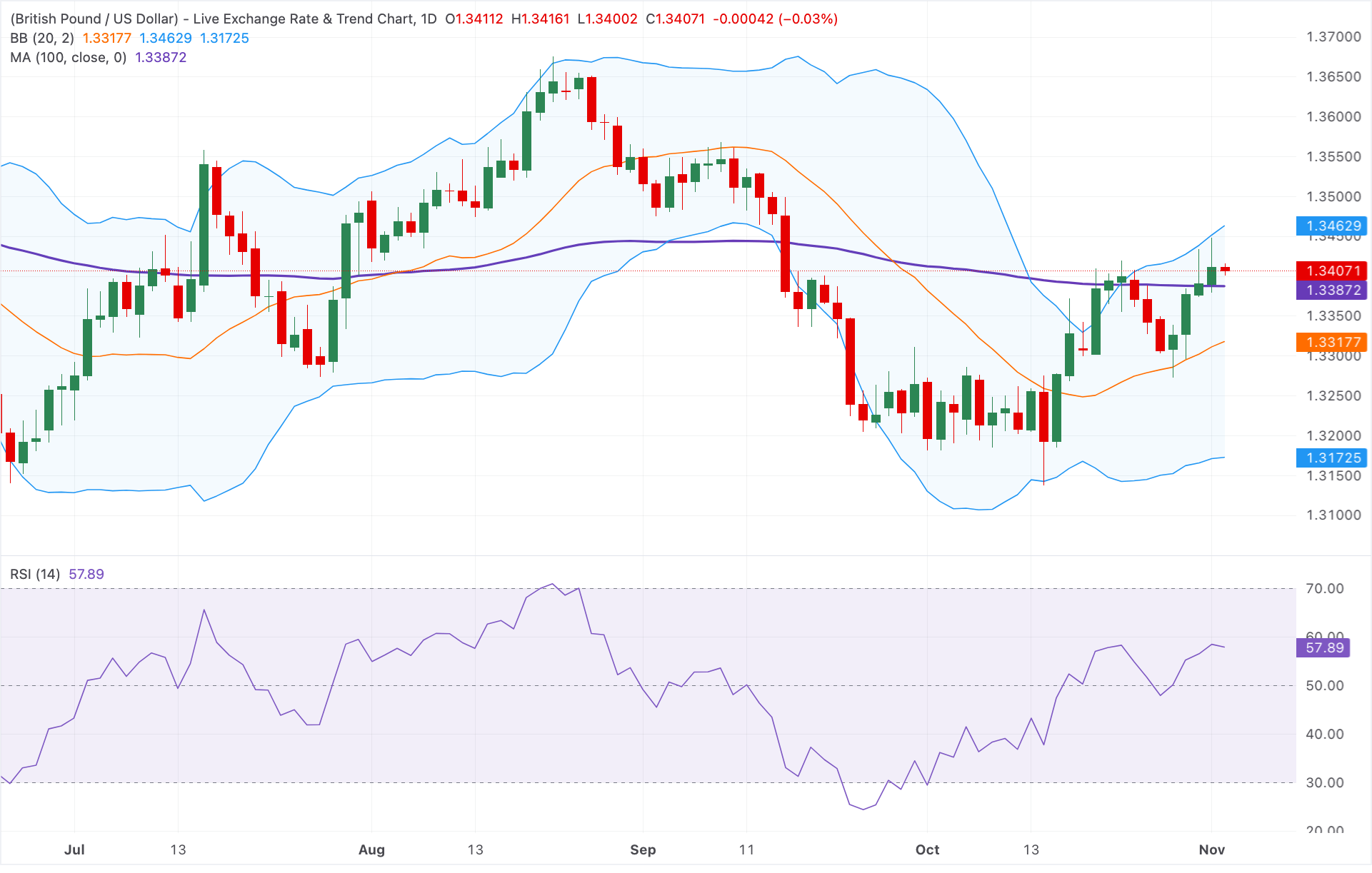
The British Pound (GBP) trades almost flat at around 1.3410 against the US Dollar (USD) during the European trading session on Tuesday. The GBP/USD pair consolidates as investors shift their focus to United States (US) Midterm Elections, which will begin later in the North American session.

Analysts at Deutsche Bank describe today’s US midterm elections as “the main event,” noting that voters will decide the entire House of Representatives, a third of the Senate, and 36 state Governors. Read more...
GBPUSD

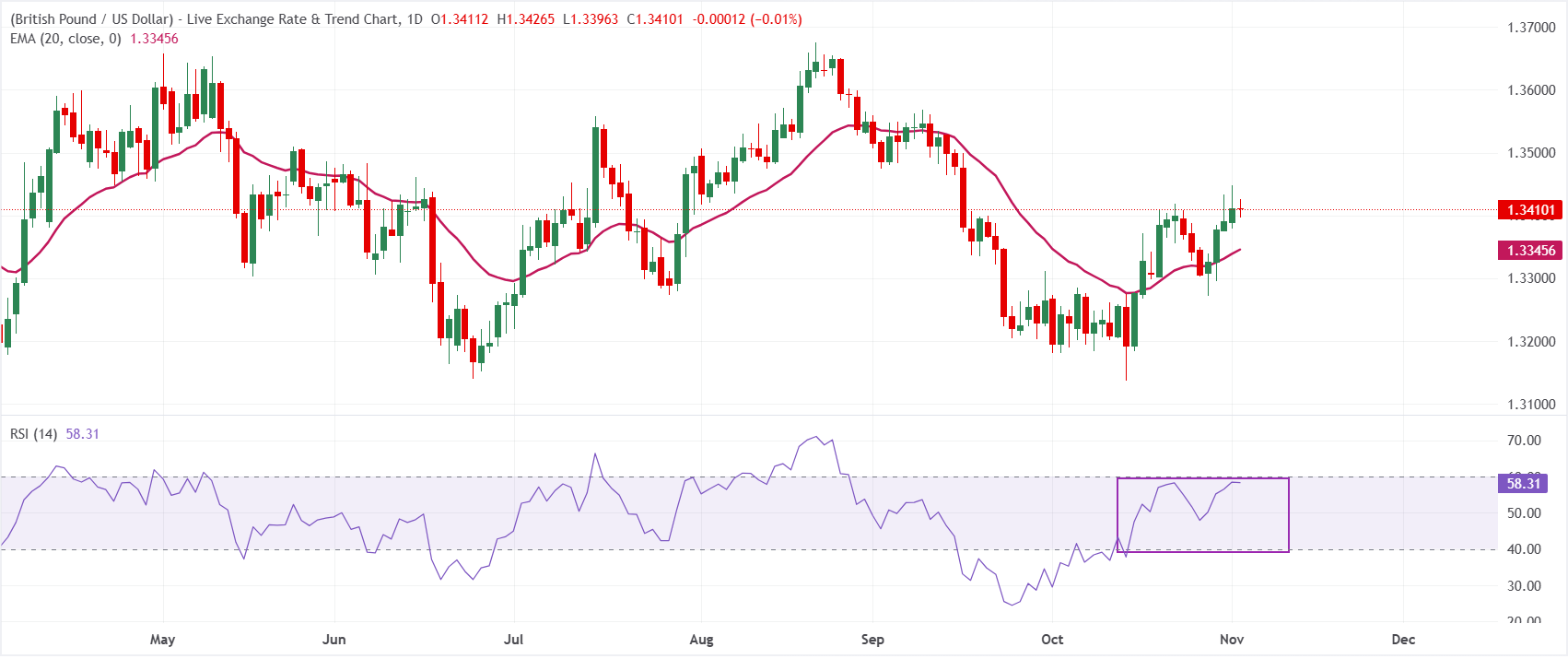
British Pound/US Dollar faces rejection at 0.5 Arc – Potential decline toward 1.3322

Based on Arc Cycle Analysis applied to the 4h chart, British Pound / U.S. Dollar is interacting with the 0.5 Resistance Arc within the current Arc Cycle. Bullish momentum is fading near this boundary, and a failure to break above the Arc could trigger a downside rebound toward 1.3322.

The 0.5 Arc continues to act as a resistance boundary, capping upside expansion. Bullish attempts are struggling beneath the Resistance Arc, and the market may fail to break above it. Read more...
GBPUSD

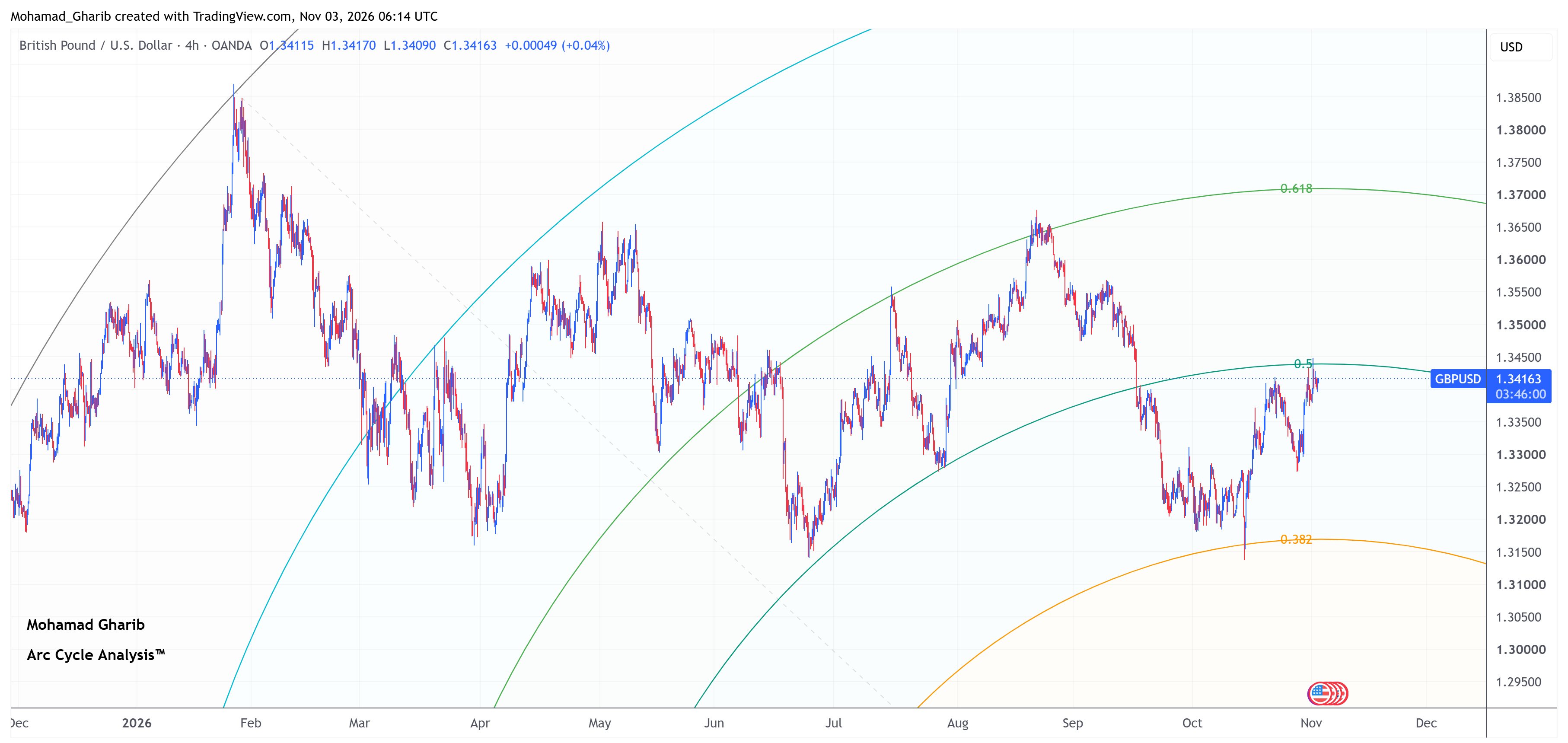
GBP/USD Price Forecast: Holds steady above 1.3400, retains constructive tone above key support

The GBP/USD pair trades on a flat note near 1.3405 during the early European trading hours on Tuesday. Traders prefer to wait on the sidelines ahead of the key events later this week, including the US midterm elections, the Bank of England (BoE) interest rate decision and US September jobs data.

The BoE is expected to raise the Bank Rate to 4.0% from 3.75% at its November policy meeting on Thursday. This would be its first hike since August 2023, when inflation was still more than the BoE’s 2% target. ING analysts said that after Thursday's expected rate hike, a follow-up hike from the BoE in February is also likely, but said that market pricing for BoE rate hikes "looks extreme.” Read more..
GBPUSD

Author

FXStreet Team

Composed of a group of economic journalists and FX experts, the FXStreet content team produces and oversees all content published on FXStreet. It provides a purely journalistic approach to the Forex market.


More from FXStreet Team
Share:

Editor's Picks

AUD/USD drops to two-week low, further below 0.7000 after RBA's less hawkish rate hike

AUD/USD drifts lower for the second straight day on Tuesday, hitting a fresh two-week low during the Asian session after the Reserve Bank of Australia's (RBA) widely expected 25 bps rate hike. The decision was far from unanimous, with three members preferring to hold rates at 4.60%. This tempers expectations of further tightening, which, along with modest US Dollar strength, weighs on the currency pair.


USD/JPY fails near 159.00 amid weak USD, intervention risks

USD/JPY edges lower during Tuesday’s Asian session, reversing part of the previous day's gains to 158.00 as the US Dollar remains depressed amid hopes for Iran diplomacy and ahead of US midterm elections. Meanwhile, intervention risks support the Japanese Yen, though the uncertainty over the timing of the next BoJ rate hike caps gains. This keeps the pair confined within a familiar range and warrants caution before placing directional bets.


Gold struggles near $3,900 as traders assess Middle East developments,US election risks

Gold (XAU/USD) loses momentum on Tuesday as Oil prices rebound after the Wall Street Journal (WSJ) reported a US strike on Iran’s Qeshm Island. At the time of writing, XAU/USD trades around $3,909, down 0.93% on the day.

Crypto Today: Bitcoin, Ethereum, XRP under pressure as investors pull capital

Bitcoin trades downward at $76,566 on Tuesday, testing six-week lows. Ethereum, like Bitcoin, trades under pressure as it consolidates within a narrow support range. Meanwhile, Ripple hovers marginally above $1.25.

BoE is set to hike rates this week: Warns against 'unwarranted' aggressive tightening
We see a hike as a done deal this week and another, while not yet our baseline scenario, is possible in February should inflation stay above 4%, commodity prices remain high and activity remain resilient. We remain of the view, however, that aggressive tightening is unwarranted, for four main reasons: There are no clear signs of second-round inflation effects, nor do we think that there will be.
The 2% inflation target came from a throwaway remark. It now moves trillions
The Federal Reserve's 2% inflation goal grew out of an off-the-cuff remark by a New Zealand politician in 1988. Bond investors still price long-term US debt as if 2% holds, so a change in how the Fed measures inflation would move markets.