British Pound trades flat while US Midterm Elections take centre stage
- The British Pound flattens against the US Dollar in the countdown to US Midterm Elections.
- Deutsche Bank sees a 95% chance of Democrats’ victory in the House, and a 79% chance of retaking the Senate.
- The BoE is expected to hike policy rates by 25 bps to 4%, with a 7-2 majority.

The British Pound (GBP) trades almost flat at around 1.3410 against the US Dollar (USD) during the European trading session on Tuesday. The GBP/USD pair consolidates as investors shift their focus to United States (US) Midterm Elections, which will begin later in the North American session.
Democrats are seen winning in both House and Senate
Analysts at Deutsche Bank describe today’s US midterm elections as “the main event,” noting that voters will decide the entire House of Representatives, a third of the Senate, and 36 state Governors.
Deutsche Bank points out that Republicans currently control both chambers of Congress, but that “the incumbent President’s party usually loses ground in midterm votes.” They add that polling averages and prediction markets are “consistently pointing to Democratic gains today,” with Polymarket “giv[ing] the Democrats a 95% chance of victory in the House as of this morning, and a 79% chance of retaking the Senate.”
On the economic front, investors await key US economic releases this week, especially Nonfarm Payrolls (NFP) data for October, which is scheduled for Friday.
Later in the day, financial markets will pay attention to the US JOLTS Job Openings data for September, which will be published at 15:00 GMT. According to estimates, US employers posted 7.13 million fresh jobs, slightly higher than 7.097 million in August.
On the other side of the Atlantic, investors await the Bank of England’s (BoE) monetary policy decision on Thursday. The BoE is almost certain to hike interest rates by 25 basis points (bps) to 4%, with a 7-2 majority.
Strategists at Brown Brothers Harriman (BBH) argue that “firmer UK inflation and economic activity back the move,” after a year on hold. They added that doves Alan Taylor and Swati Dhingra are likely to “supporting a hold”.
GBP/USD Technical Analysis
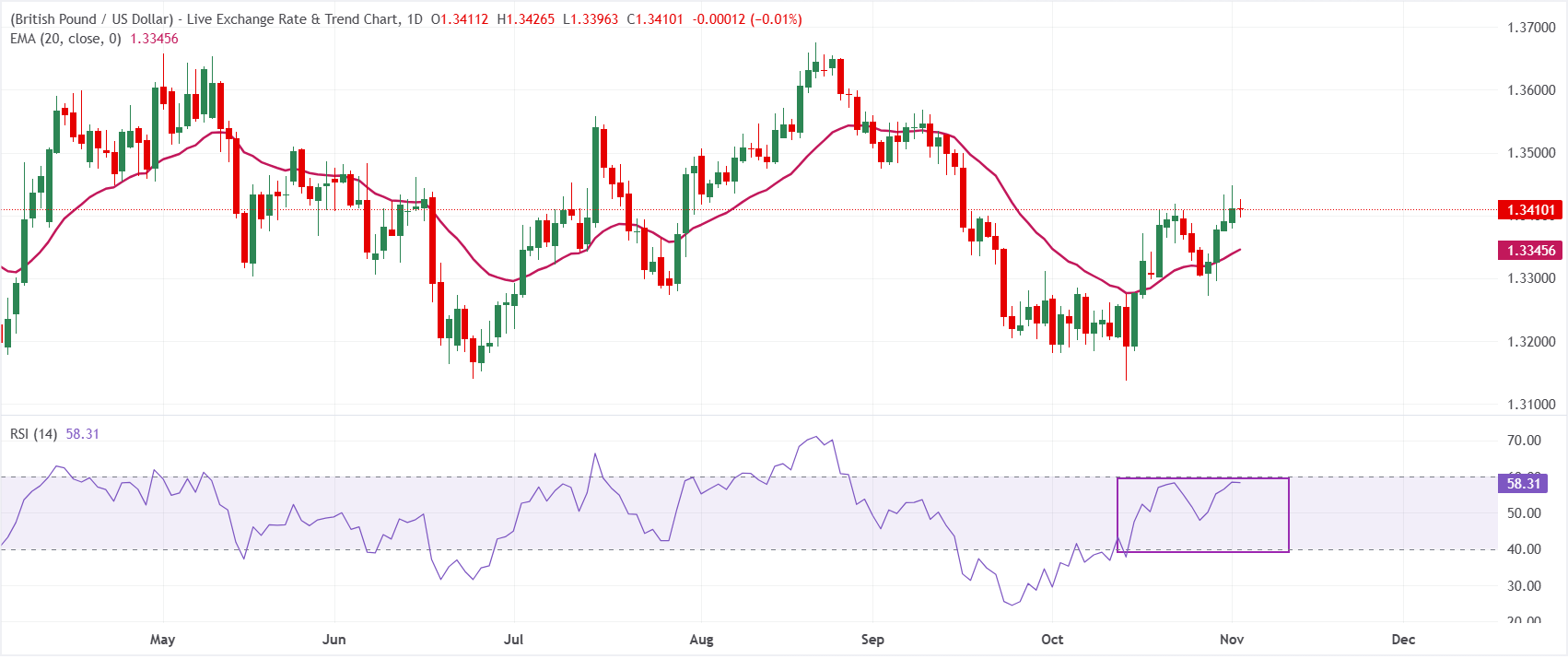
In the daily chart, GBP/USD trades at 1.3410, extending its recovery above the 20-period exponential moving average (EMA) at 1.3346, which now underpins a bullish near-term bias. The EMA acting as immediate support suggests buyers are regaining control, while the Relative Strength Index (14) at 58.31 stays in positive territory without yet signaling overbought conditions, hinting that upside pressure could persist as long as price holds over the moving average.
On the downside, initial support is located at the 20-period EMA at 1.3346, with the 1.3410 area acting as a near-term pivot that would need to give way to undermine the constructive tone. With no major technical resistance levels immediately overhead in this dataset, the pair appears poised to probe higher levels, though a daily close back below the EMA would weaken the bullish structure and open the door to a deeper corrective slide.
(The technical analysis of this story was written with the help of an AI tool. Know more.)
Economic Indicator
BoE Interest Rate Decision
The Bank of England (BoE) announces its interest rate decision at the end of its eight scheduled meetings per year. If the BoE is hawkish about the inflationary outlook of the economy and raises interest rates it is usually bullish for the Pound Sterling (GBP). Likewise, if the BoE adopts a dovish view on the UK economy and keeps interest rates unchanged, or cuts them, it is seen as bearish for GBP.
Read more.Next release: Thu Nov 05, 2026 12:00
Frequency: Irregular
Consensus: 4%
Previous: 3.75%
Source: Bank of England
Author

Sagar Dua
FXStreet
Sagar Dua is associated with the financial markets from his college days. Along with pursuing post-graduation in Commerce in 2014, he started his markets training with chart analysis.