Indian Rupee extends winning streak against US Dollar amid lower oil prices
- The Indian Rupee gains further against the US Dollar due to lower oil prices.
- The risk premium on oil prices erodes due to hopes for US-Iran diplomacy resolution.
- US midterm elections are the next key trigger for global markets.

The Indian Rupee (INR) extends its winning streak against the US Dollar (USD) for the third trading day on Tuesday. In the opening trade, the USD/INR pair is down 0.15% to near 94.83.
The Indian currency strengthens as oil prices continue to face selling pressure on the back of improved hopes for United States (US)-Iran diplomatic resolution.
As of writing, the MCX Crude Oil contract expiring on November 19 is up 1.65% to near Rs. 9,222, but is down almost 7.5% from its recent multi-month high of Rs. 9,972.
Oil risk premium eases as diplomacy headlines reshape market tone
According to TD Securities, recent headlines suggesting that US President Donald Trump is willing to give diplomacy more time, and "signaling attacks may not be imminent immediately before/after the midterms," have already seen "a portion of the geopolitical risk premium priced out of crude oil and petroleum products." The strategists add that "with flows elevated, and a large portion of recent upside attributed to a risk premium, these headlines will have an increasingly large impact on the market," as positioning and sentiment adjust to the evolving geopolitical narrative.
However, TD Securities has cautioned that “headlines alone are unlikely to shed the whole risk premium.” TD Securities adds that “so long as there is no concrete conclusion to the war, and tanker and Houthi attacks remain prevalent, we do not anticipate a complete erosion of the risk premium via diplomacy headlines alone,” underscoring that persistent geopolitical threats continue to underpin pricing.
Lower oil prices bode well for currencies from economies, such as India, which rely heavily on oil imports to meet their energy needs.
Investors brace for US midterm elections
Strategists at Brown Brothers Harriman (BBH) note that “the US midterm elections will be held on Tuesday,” with “Democrats widely expected to win the House of Representatives.” They add that “Senate control is much closer, but the tide favors the Democratic Party,” as “Democrats need a net gain of four seats to secure a majority in the Senate” — a target that is “within reach as Republicans are defending six of the seven toss-up seats.”
BBH highlights that betting markets “favor a Democratic sweep,” with Polymarket and Kalshi “putting the odds around 70%.” In their view, that “points to a relatively muted initial market reaction if Democrats win both chambers,” whereas “a Republican Senate hold would be the bigger surprise and could spark more market volatility.”
USD/INR Technical Analysis
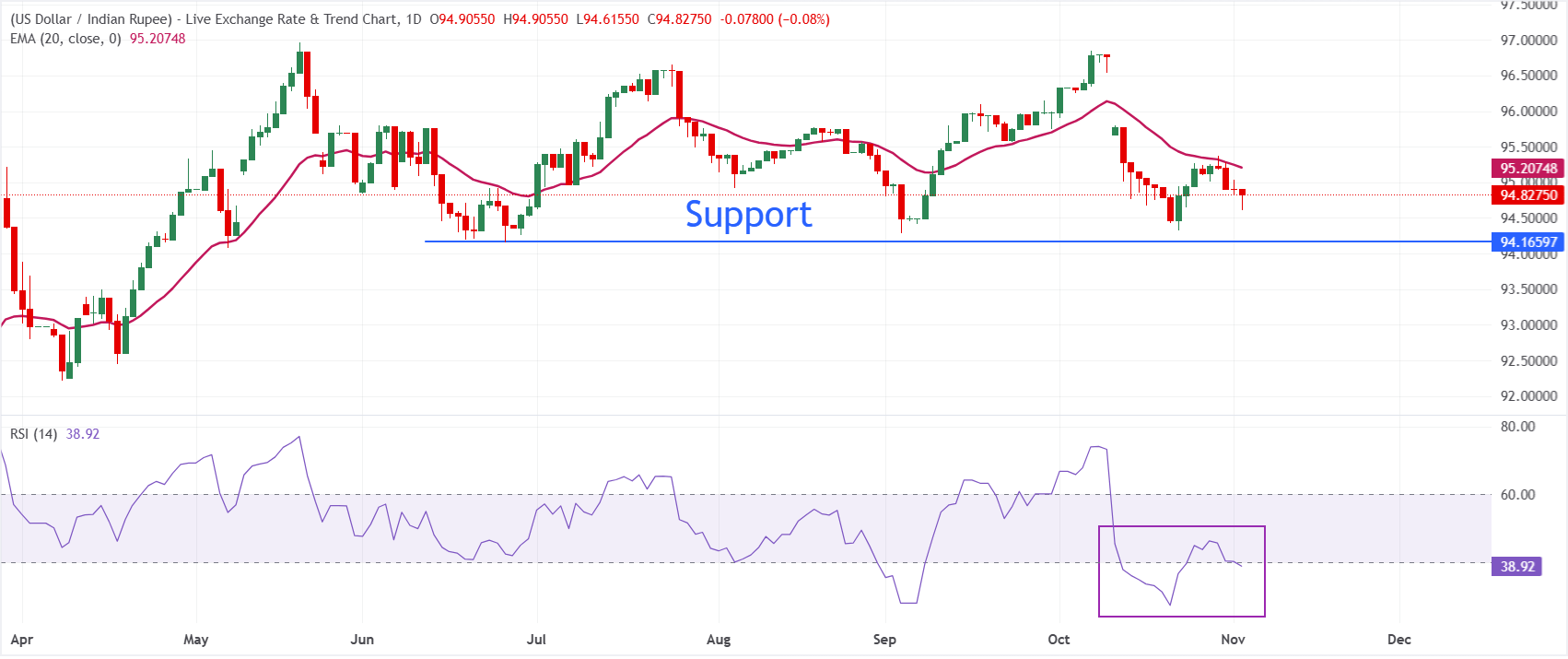
In the daily chart, USD/INR trades at 94.83, keeping a bearish near-term tone as spot holds beneath the 20-day Exponential Moving Average (EMA) at 95.21. The pair’s position under this short-term trend gauge suggests rallies remain capped, while the Relative Strength Index (14) at 38.9 stays below the neutral 50 line, hinting at prevailing downside pressure rather than an oversold extreme.
On the topside, immediate resistance is located at the 20-day EMA at 95.21, and a daily close above this barrier would be needed to soften the current bearish bias. With no nearby technical supports highlighted by the present dataset, traders may look to recent lows and price action itself for interim floors, while momentum readings imply that bounces could be limited as long as USD/INR trades below the 95.21 area.
(The technical analysis of this story was written with the help of an AI tool. Know more.)
Indian Rupee FAQs
The Indian Rupee (INR) is one of the most sensitive currencies to external factors. The price of Crude Oil (the country is highly dependent on imported Oil), the value of the US Dollar – most trade is conducted in USD – and the level of foreign investment, are all influential. Direct intervention by the Reserve Bank of India (RBI) in FX markets to keep the exchange rate stable, as well as the level of interest rates set by the RBI, are further major influencing factors on the Rupee.
The Reserve Bank of India (RBI) actively intervenes in forex markets to maintain a stable exchange rate, to help facilitate trade. In addition, the RBI tries to maintain the inflation rate at its 4% target by adjusting interest rates. Higher interest rates usually strengthen the Rupee. This is due to the role of the ‘carry trade’ in which investors borrow in countries with lower interest rates so as to place their money in countries’ offering relatively higher interest rates and profit from the difference.
Macroeconomic factors that influence the value of the Rupee include inflation, interest rates, the economic growth rate (GDP), the balance of trade, and inflows from foreign investment. A higher growth rate can lead to more overseas investment, pushing up demand for the Rupee. A less negative balance of trade will eventually lead to a stronger Rupee. Higher interest rates, especially real rates (interest rates less inflation) are also positive for the Rupee. A risk-on environment can lead to greater inflows of Foreign Direct and Indirect Investment (FDI and FII), which also benefit the Rupee.
Higher inflation, particularly, if it is comparatively higher than India’s peers, is generally negative for the currency as it reflects devaluation through oversupply. Inflation also increases the cost of exports, leading to more Rupees being sold to purchase foreign imports, which is Rupee-negative. At the same time, higher inflation usually leads to the Reserve Bank of India (RBI) raising interest rates and this can be positive for the Rupee, due to increased demand from international investors. The opposite effect is true of lower inflation.
Author

Sagar Dua
FXStreet
Sagar Dua is associated with the financial markets from his college days. Along with pursuing post-graduation in Commerce in 2014, he started his markets training with chart analysis.