Japanese Yen weakens against US Dollar, US Midterm Elections in focus
- Japanese Yen underperforms its major peers despite hawkish BoJ expectations.
- Japan signals that it is ready to intervene whenever needed.
- ING expects US Midterm Elections to have limited impact on the US Dollar.

The Japanese Yen (JPY) is down against its major currency peers, except the Australian Dollar (AUD), on Tuesday. The US Dollar (USD) is up 0.28% to near 158.30 against the Japanese currency.
Japanese Yen Price Today
The table below shows the percentage change of Japanese Yen (JPY) against listed major currencies today. Japanese Yen was the weakest against the Canadian Dollar.
| USD | EUR | GBP | JPY | CAD | AUD | NZD | CHF | |
|---|---|---|---|---|---|---|---|---|
| USD | 0.13% | 0.03% | 0.25% | -0.28% | 0.21% | -0.12% | 0.17% | |
| EUR | -0.13% | -0.09% | 0.11% | -0.42% | 0.07% | -0.25% | 0.04% | |
| GBP | -0.03% | 0.09% | 0.19% | -0.34% | 0.17% | -0.17% | 0.13% | |
| JPY | -0.25% | -0.11% | -0.19% | -0.52% | -0.03% | -0.36% | -0.06% | |
| CAD | 0.28% | 0.42% | 0.34% | 0.52% | 0.50% | 0.16% | 0.46% | |
| AUD | -0.21% | -0.07% | -0.17% | 0.03% | -0.50% | -0.34% | -0.04% | |
| NZD | 0.12% | 0.25% | 0.17% | 0.36% | -0.16% | 0.34% | 0.30% | |
| CHF | -0.17% | -0.04% | -0.13% | 0.06% | -0.46% | 0.04% | -0.30% |
The heat map shows percentage changes of major currencies against each other. The base currency is picked from the left column, while the quote currency is picked from the top row. For example, if you pick the Japanese Yen from the left column and move along the horizontal line to the US Dollar, the percentage change displayed in the box will represent JPY (base)/USD (quote).
The Asia-Pacific currency underperforms even as financial markets are expecting the Bank of Japan (BoJ) to remain on the monetary tightening path after it left interest rates steady at 1.25% last week, with an 8–1 majority.
Analysts at Commerzbank highlight that the BoJ’s latest assessment “suggested underlying inflation is broadly consistent with the 2% target,” while Governor Kazuo Ueda “emphasised upside inflation risks and the need for further policy normalisation.” In rate markets, Commerzbank points out that “the OIS market is pricing in 20bp hike by end-2026 and a total hike of 69bp by September 2027,” underscoring expectations for a measured but persistent tightening path.
Japan signals readiness to act on disorderly moves
Commerzbank said in a note that Japanese authorities have sharpened their rhetoric on currency stability, with Finance Minister Satsuki Katayama explicitly “signal[ling] readiness to intervene in currency markets if movements become disorderly.” Commerzbank highlights Katayama’s warning that “If there are disorderly movements or excessively speculative moves, we will take action,” underscoring a more forceful policy stance toward curbing excessive Yen volatility.
Meanwhile, the US Dollar is broadly under pressure ahead of US Midterm Elections later in the North American session. As of writing, the US Dollar Index (DXY), which tracks the Greenback’s value against six major currencies, trades flat at around 101.85. Still, the DXY is close to its monthly low of 101.43 posted on Monday.
ING strategists write that “we don’t expect today’s US midterm results to cause structural shifts in FX, but the Dollar may face some short-term pressure should the Democrats secure both the House (widely expected) and the Senate (close call).” Their baseline is that “markets fully price in a Republican loss of the House, but only partially a Democratic clean sweep,” and that “a blue sweep can put some pressure on the Dollar.”
ING warns that “fears of tougher regulation could weigh on AI stocks (we’ve recently seen how that can hit the greenback), while markets could price in greater risks of decision-making gridlock around issues such as government funding and the debt ceiling.” Even so, they stress that “we doubt that’s enough to trigger a structural directional shift in the Dollar.
USD/JPY Technical Analysis
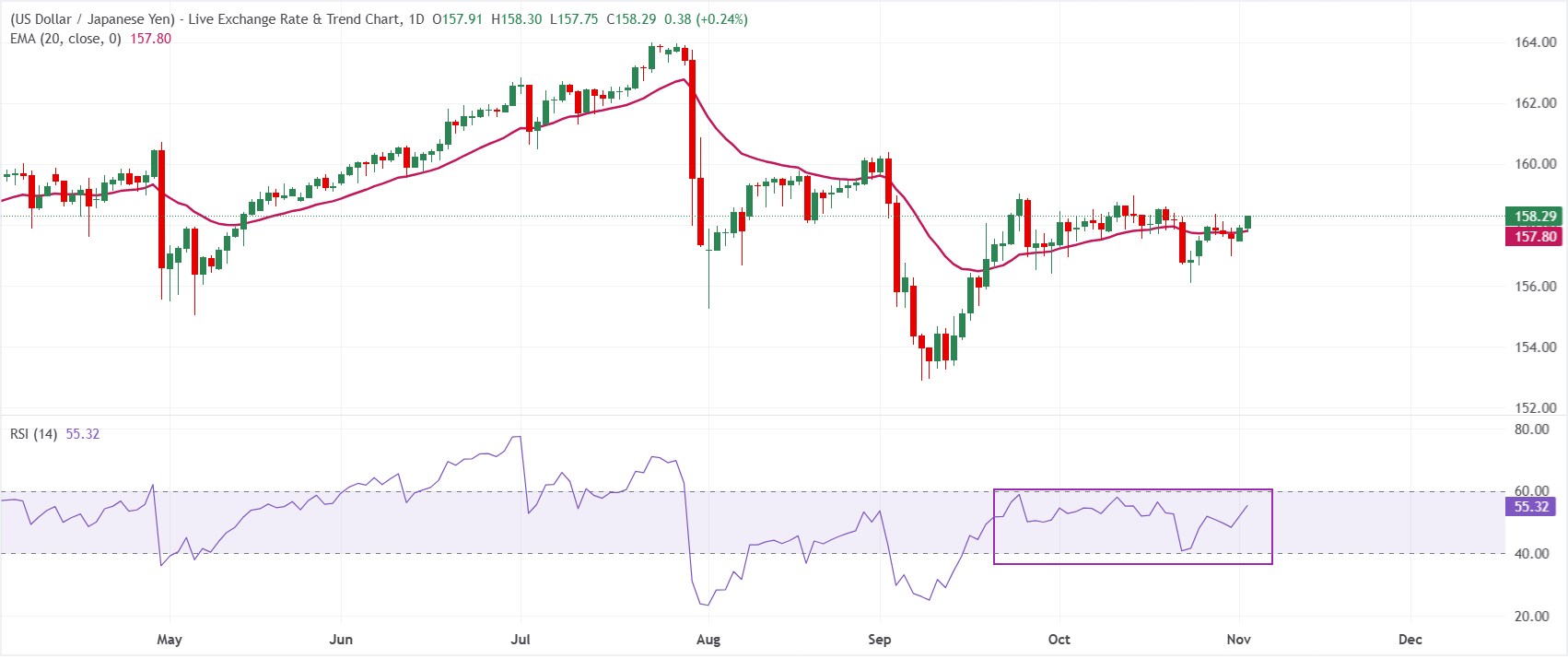
In the daily chart, USD/JPY trades at 158.29. The pair holds above the 20-day Exponential Moving Average (EMA) at 157.80, keeping the near-term bias mildly bullish as price respects trend support. The 20-day EMA rising beneath spot hints at a constructive underlying tone, while the Relative Strength Index (RSI) at 55.33 stays in neutral-to-positive territory, suggesting steady rather than overstretched upside pressure.
On the downside, immediate support is seen at the 158.29 area as a near-term pivot, followed by the 20-day EMA at 157.80, where buyers are likely to defend the broader uptrend. With no notable technical resistances immediately overhead in this dataset, price action could continue to probe higher levels as long as spot holds above the 157.80 region and momentum remains stable.
(The technical analysis of this story was written with the help of an AI tool. Know more.)
Economic Indicator
BoJ Interest Rate Decision
The Bank of Japan (BoJ) announces its interest rate decision after each of the Bank’s eight scheduled annual meetings. Generally, if the BoJ is hawkish about the inflationary outlook of the economy and raises interest rates it is bullish for the Japanese Yen (JPY). Likewise, if the BoJ has a dovish view on the Japanese economy and keeps interest rates unchanged, or cuts them, it is usually bearish for JPY.
Read more.Last release: Fri Oct 30, 2026 03:03
Frequency: Irregular
Actual: 1.25%
Consensus: 1.25%
Previous: 1.25%
Source: Bank of Japan
Author

Sagar Dua
FXStreet
Sagar Dua is associated with the financial markets from his college days. Along with pursuing post-graduation in Commerce in 2014, he started his markets training with chart analysis.