Pound Sterling remains resilient against USD amid fears of Trump tariffs-led US slowdown
- The Pound Sterling advances against the US Dollar around 1.2900 ahead of the US inflation data for February.
- Fed dovish bets have accelerated on US President Trump's tariffs-led slowdown fears.
- BoE officials support a “gradual and cautious” interest rate cut approach.

The Pound Sterling (GBP) trades close to the four-month high around 1.2930 against the US Dollar (USD) in North American trading hours on Tuesday. The GBP/USD pair trades firmly as the US Dollar Index (DXY), which tracks the Greenback’s value against six major currencies, extends its downside to near 103.30 ahead of the United States (US) Consumer Price Index (CPI) data for February, which will be released on Wednesday.
Investors will pay close attention to the US inflation data as it will influence market speculation over the Federal Reserve’s (Fed) monetary policy outlook. Year-on-year headline inflation is estimated to have grown by 2.9%, slower than 3% in January. In the same period, the core CPI – which excludes volatile food and energy prices – is expected to have decelerated to 3.2% from the prior release of 3.3%.
Lately, traders have raised bets supporting the Fed to start reducing interest rates in May amid fears of US President Donald Trump's tariff agenda-led slowdown. According to the CME FedWatch tool, the likelihood for the Fed to cut interest rates in May has increased to 51% from 37% a day ago.
However, a slew of Fed officials, including Chair Jerome Powell, has been guiding a “wait and see” approach amid a lack of clarity on President Donald Trump’s tariff and taxation policies. On Friday, Jerome Powell said, “Uncertainty around Trump administration policies and their economic effects remains high, and the net effect of trade, immigration, fiscal, and regulation policy is what matters for the economy and the monetary policy.”
Meanwhile, the US JOLTS Job Openings data for January has come in line with estimates. US employers posted 7.74 million new jobs, almost as expected, slightly higher than the 7.51 million seen in December.
Daily digest market movers: Pound Sterling outperforms its peers as traders reassess BoE dovish bets
- The Pound Sterling trades higher against its major peers, except the Euro (EUR), on Tuesday as traders become increasingly confident that the Bank of England (BoE) will keep interest rates at their current levels for longer. Traders are confident about the BoE maintaining a restrictive monetary policy stance for longer amid strong wage growth in the United Kingdom (UK), which fuels inflation in the services sector.
- Last week, four BoE policymakers, including Governor Andrew Bailey, guided before the Parliamentary Treasury Committee a gradual path for “unwinding monetary policy restrictiveness” as the inflation persistence is less likely to fade “on its own accord.”
- On the contrary, BoE Monetary Policy Committee (MPC) Catherine Mann argues in favor of a swift monetary expansion approach due to “substantial volatility” coming from financial markets, especially from “cross-border spillovers”.
- This week, investors will focus on the UK monthly Gross Domestic Product (GDP) and the factory data for January, which will be released on Friday. The UK economy is estimated to have grown at a moderate pace of 0.1%, compared to 0.4% in December.
Technical Analysis: Pound Sterling holds consistently above 1.2900
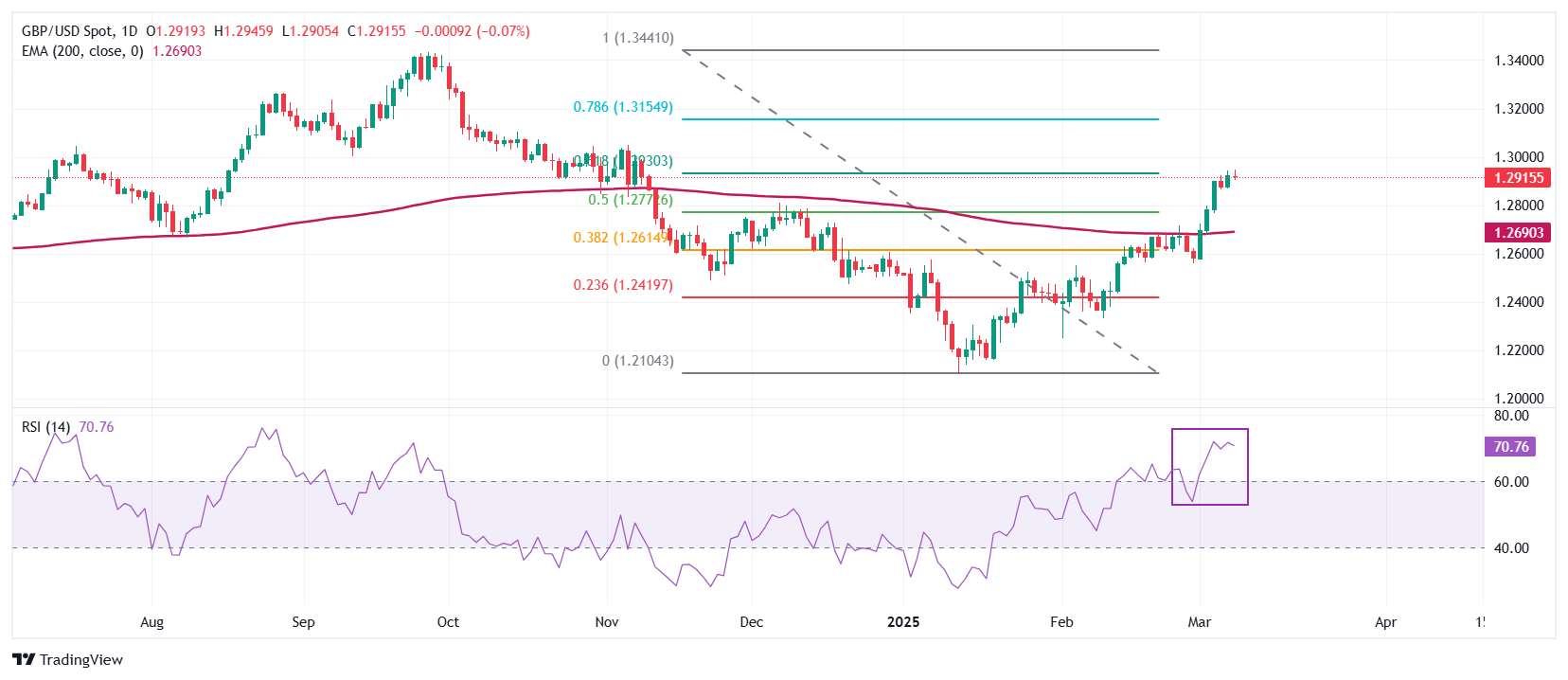
The Pound Sterling gathers strength to break above the 61.8% Fibonacci retracement plotted from the late September high to mid-January low around 1.2930 on Tuesday. The long-term outlook of the GBP/USD pair has turned bullish as it holds above the 200-day Exponential Moving Average (EMA), which is around 1.2692.
The 14-day Relative Strength Index (RSI) holds above 60.00, suggesting a strong bullish momentum.
Looking down, the 50% Fibo retracement at 1.2767 and the 38.2% Fibo retracement at 1.2608 will act as key support zones for the pair. On the upside, the psychological 1.3000 level will act as a key resistance zone.
BoE FAQs
The Bank of England (BoE) decides monetary policy for the United Kingdom. Its primary goal is to achieve ‘price stability’, or a steady inflation rate of 2%. Its tool for achieving this is via the adjustment of base lending rates. The BoE sets the rate at which it lends to commercial banks and banks lend to each other, determining the level of interest rates in the economy overall. This also impacts the value of the Pound Sterling (GBP).
When inflation is above the Bank of England’s target it responds by raising interest rates, making it more expensive for people and businesses to access credit. This is positive for the Pound Sterling because higher interest rates make the UK a more attractive place for global investors to park their money. When inflation falls below target, it is a sign economic growth is slowing, and the BoE will consider lowering interest rates to cheapen credit in the hope businesses will borrow to invest in growth-generating projects – a negative for the Pound Sterling.
In extreme situations, the Bank of England can enact a policy called Quantitative Easing (QE). QE is the process by which the BoE substantially increases the flow of credit in a stuck financial system. QE is a last resort policy when lowering interest rates will not achieve the necessary result. The process of QE involves the BoE printing money to buy assets – usually government or AAA-rated corporate bonds – from banks and other financial institutions. QE usually results in a weaker Pound Sterling.
Quantitative tightening (QT) is the reverse of QE, enacted when the economy is strengthening and inflation starts rising. Whilst in QE the Bank of England (BoE) purchases government and corporate bonds from financial institutions to encourage them to lend; in QT, the BoE stops buying more bonds, and stops reinvesting the principal maturing on the bonds it already holds. It is usually positive for the Pound Sterling.
Author

Sagar Dua
FXStreet
Sagar Dua is associated with the financial markets from his college days. Along with pursuing post-graduation in Commerce in 2014, he started his markets training with chart analysis.