Pound Sterling trades lower against US Dollar, US-UK CPI data comes into focus
- The Pound Sterling extends its downside against its peers amid growing UK economic risks.
- US President Trump imposes 30% tariffs on imports from the Eurozone and Mexico, keeping markets risk-averse.
- This week, investors will closely monitor CPI data for June from both the UK and the US.

The Pound Sterling (GBP) slides to near 1.3450 against the US Dollar (USD) during the European trading session on Monday, the lowest level in three weeks. The GBP/USD pair declines as demand for risk-perceived assets has diminished, following a jittery market mood amid trade tensions between the United States (US) and the European Union (EU).
Over the weekend, US President Donald Trump announced 30% tariffs on imports from the EU and Mexico as they failed to close a trade agreement during the 90-day reciprocal tariff pause period. Trump also warned that he will raise tariffs if they retaliate or announce countermeasures.
Fresh tariff threats have rekindled global trade worries, leading to an increase in demand for safe-haven assets. At the time of writing, the US Dollar Index (DXY), which tracks the Greenback’s value against six major currencies, trades firmly near 98.00.
However, US President Trump has stated that the EU and South Korea are in talks to secure a deal.
This week, the US CPI data for June to be released on Tuesday will be the key trigger for the US Dollar. The CPI report is expected to show that prices rose at a faster pace. Such a scenario will discourage Federal Reserve (Fed) officials from lowering interest rates. Still, US President Trump has been criticizing the Fed, specifically its Chair Jerome Powell, for maintaining a restrictive monetary policy stance.
According to the CME FedWatch tool, there is a 62.8% chance that the Fed will reduce interest rates in September. The Fed is almost certain to leave borrowing rates steady in the current range of 4.25%-4.50% in the policy meeting at the end of this month.
Daily digest market movers: Pound Sterling continues to underperform
- The Pound Sterling starts the week on a negative note, extending the losses seen on Friday and trading at its lowest level since June 23 against the US Dollar (USD). The British currency was hit badly at the end of last week after data showed the United Kingdom (UK) Gross Domestic Product (GDP) shrank for a second consecutive month in May, contributing to concerns over ballooning fiscal risks.
- The Office for National Statistics (ONS) reported that the economy contracted by 0.1% in May. However, the pace of decline was more moderate than the 0.3% contraction seen in April. Declining factory output contributed significantly to shrinking economic growth.
- UK fiscal risks have escalated lately as Chancellor of the Exchequer Rachel Reeves has increased the welfare spending bill, which is expected to increase the financial burden for the administration by £4.8 billion by fiscal year 2029-2030.
- Meanwhile, investors brace for significant volatility by the Pound Sterling this week as the UK Consumer Price Index (CPI) data for June and the labor market data for the three-months ending May are scheduled to be released on Wednesday and Thursday, respectively.
- Investors will closely monitor the UK labor market data as the latest survey from the Recruitment and Employment Confederation trade body and accountants KPMG has signaled that the availability of individuals for jobs has increased significantly. Agencies reported that the index of staff availability rose to 66.1 from 63.3 in May, the highest reading since November 2020, Reuters reports.
- Cooling labor market conditions often lead to an increase in market expectations for interest rate cuts by the Bank of England (BoE), a scenario that is unfavorable for the Pound Sterling. For now, traders are increasingly confident that the BoE will reduce interest rates by 25 basis points (bps) to 4% in the August monetary policy meeting.
British Pound PRICE Last 7 days
The table below shows the percentage change of British Pound (GBP) against listed major currencies last 7 days. British Pound was the weakest against the Australian Dollar.
| USD | EUR | GBP | JPY | CAD | AUD | NZD | CHF | |
|---|---|---|---|---|---|---|---|---|
| USD | 0.80% | 1.27% | 2.24% | 0.58% | -0.10% | 1.19% | 0.32% | |
| EUR | -0.80% | 0.48% | 1.19% | -0.24% | -0.84% | 0.38% | -0.49% | |
| GBP | -1.27% | -0.48% | 0.68% | -0.68% | -1.30% | -0.09% | -1.07% | |
| JPY | -2.24% | -1.19% | -0.68% | -1.40% | -2.09% | -0.82% | -1.83% | |
| CAD | -0.58% | 0.24% | 0.68% | 1.40% | -0.67% | 0.61% | -0.39% | |
| AUD | 0.10% | 0.84% | 1.30% | 2.09% | 0.67% | 1.33% | 0.23% | |
| NZD | -1.19% | -0.38% | 0.09% | 0.82% | -0.61% | -1.33% | -0.99% | |
| CHF | -0.32% | 0.49% | 1.07% | 1.83% | 0.39% | -0.23% | 0.99% |
The heat map shows percentage changes of major currencies against each other. The base currency is picked from the left column, while the quote currency is picked from the top row. For example, if you pick the British Pound from the left column and move along the horizontal line to the US Dollar, the percentage change displayed in the box will represent GBP (base)/USD (quote).
Technical Analysis: Pound Sterling trades below 20 and 50-day EMAs
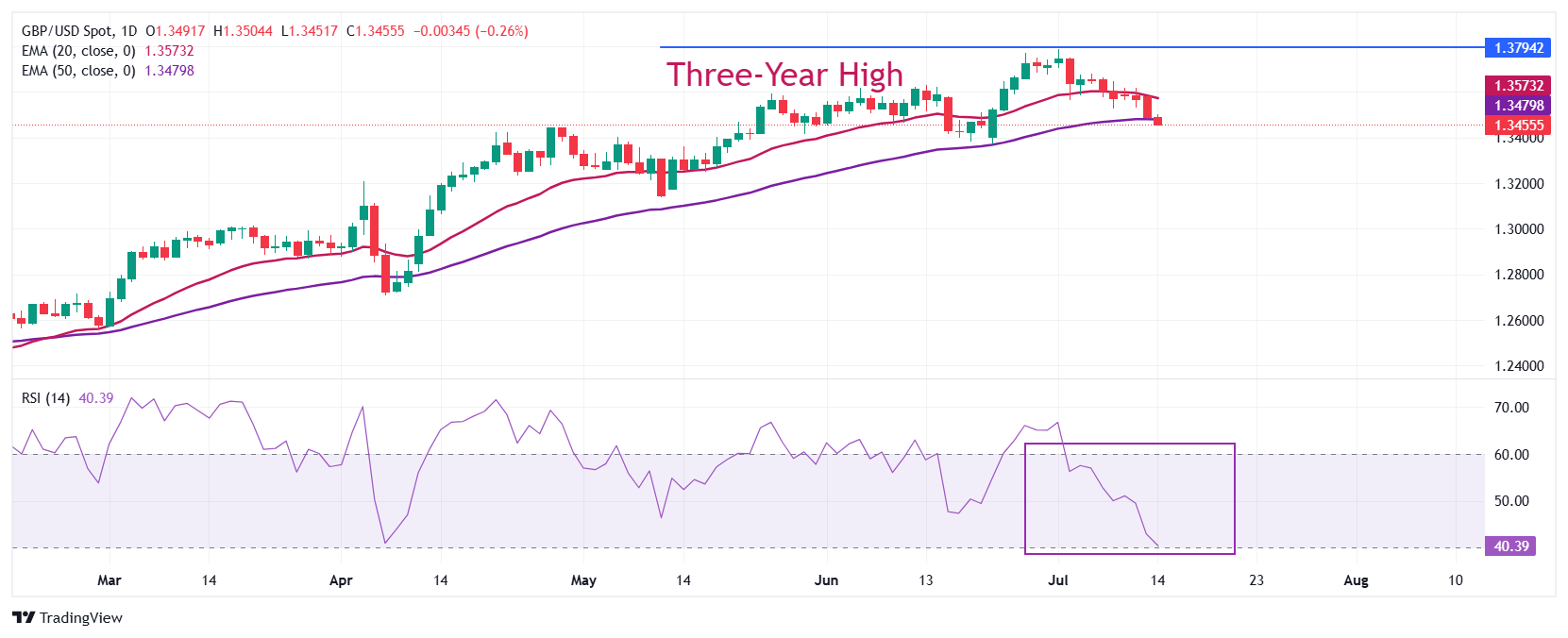
The Pound Sterling extends its losing streak on Monday against the US Dollar. The near-term trend of the GBP/USD pair turns bearish as it slides below 20 and 50-day Exponential Moving Averages (EMAs), which trade around 1.3573 and 1.3480, respectively.
The 14-day Relative Strength Index (RSI) falls to near 40.00. A fresh bearish momentum would emerge if the RSI breaks below this level.
Looking down, the June 23 low of 1.3370 will act as a key support zone. On the upside, the three-and-a-half-year high around 1.3800 will act as a key barrier.
Economic Indicator
Core Consumer Price Index (YoY)
The United Kingdom (UK) Core Consumer Price Index (CPI), released by the Office for National Statistics on a monthly basis, is a measure of consumer price inflation – the rate at which the prices of goods and services bought by households rise or fall – produced to international standards. The YoY reading compares prices in the reference month to a year earlier. Core CPI excludes the volatile components of food, energy, alcohol and tobacco. The Core CPI is a key indicator to measure inflation and changes in purchasing trends. Generally, a high reading is seen as bullish for the Pound Sterling (GBP), while a low reading is seen as bearish.
Read more.Next release: Wed Jul 16, 2025 06:00
Frequency: Monthly
Consensus: 3.5%
Previous: 3.5%
Source: Office for National Statistics
The Bank of England is tasked with keeping inflation, as measured by the headline Consumer Price Index (CPI) at around 2%, giving the monthly release its importance. An increase in inflation implies a quicker and sooner increase of interest rates or the reduction of bond-buying by the BOE, which means squeezing the supply of pounds. Conversely, a drop in the pace of price rises indicates looser monetary policy. A higher-than-expected result tends to be GBP bullish.
from
Author

Sagar Dua
FXStreet
Sagar Dua is associated with the financial markets from his college days. Along with pursuing post-graduation in Commerce in 2014, he started his markets training with chart analysis.