Pound Sterling underperforms as soft UK job data boosts BoE dovish bets
- The Pound Sterling weakens against its major peers as the BoE is expected to cut interest rates in December.
- BoE’s Greene argues in favor of holding interest rates at their current levels for longer.
- Weakening US job market conditions prompt Fed dovish bets.

The Pound Sterling (GBP) underperforms its major currency peers, except the Japanese Yen (JPY), on Wednesday. The British currency faces selling pressure amid growing expectations that the Bank of England (BoE) will resume its monetary expansion cycle at the December meeting.
Traders expect the BoE to reduce interest rates further by 20 basis points (bps) this year, according Reuters. Market participants have raised dovish bets, following the release of the United Kingdom (UK) labour market data for the three months ending September, released on Tuesday.
The employment report showed that employers laid off 22K workers. This is the first time the overall labour force has been reduced since March 2024. Additionally, the ILO Unemployment Rate accelerated to 5%, the highest level seen since March 2021.
Meanwhile, consumer inflation expectations are also expected to cool off as growth in Average Earnings, a wage growth measure, has slowed. In three months ending September, Average Earnings Excluding Bonuses decelerated to 4.6% on an annualized basis, the slowest growth seen in over three years.
Contrary to accelerating BoE dovish expectations, policymaker Megan Greene stated at a UBS conference in London on Tuesday that the central bank should continue holding interest rates at their current levels, while expressing confidence that job conditions and wage growth will start improving from here. "I am worried about inflation persistence in the UK, means monetary policy needs to be more restrictive than otherwise," Greene said, and added, “wage settlements data for next year from surveys is higher than we would like to see."
Pound Sterling Price Today
The table below shows the percentage change of British Pound (GBP) against listed major currencies today. British Pound was the weakest against the Swiss Franc.
| USD | EUR | GBP | JPY | CAD | AUD | NZD | CHF | |
|---|---|---|---|---|---|---|---|---|
| USD | 0.11% | 0.34% | 0.46% | 0.07% | -0.05% | 0.02% | -0.14% | |
| EUR | -0.11% | 0.23% | 0.34% | -0.02% | -0.16% | -0.09% | -0.25% | |
| GBP | -0.34% | -0.23% | 0.12% | -0.27% | -0.39% | -0.32% | -0.48% | |
| JPY | -0.46% | -0.34% | -0.12% | -0.40% | -0.51% | -0.46% | -0.61% | |
| CAD | -0.07% | 0.02% | 0.27% | 0.40% | -0.12% | -0.06% | -0.21% | |
| AUD | 0.05% | 0.16% | 0.39% | 0.51% | 0.12% | 0.07% | -0.08% | |
| NZD | -0.02% | 0.09% | 0.32% | 0.46% | 0.06% | -0.07% | -0.16% | |
| CHF | 0.14% | 0.25% | 0.48% | 0.61% | 0.21% | 0.08% | 0.16% |
The heat map shows percentage changes of major currencies against each other. The base currency is picked from the left column, while the quote currency is picked from the top row. For example, if you pick the British Pound from the left column and move along the horizontal line to the US Dollar, the percentage change displayed in the box will represent GBP (base)/USD (quote).
Daily digest market movers: Soft US labour market data prompts Fed dovish bets
- The Pound Sterling declines to near 1.3115 against the US Dollar (USD) during the European trading session on Wednesday. The GBP/USD pair has come under pressure after ending a four-day winning streak on Tuesday, following the UK employment data release. Meanwhile, a slight recovery move in the US Dollar has also weighed on the pair.
- At the press time, the US Dollar Index (DXY), which tracks the Greenback’s value against six major currencies, rises to near 99.60 after attracting bids near its weekly low around 99.30 posted on Tuesday.
- The US Dollar fell sharply on Tuesday due to increasing Federal Reserve (Fed) dovish expectations. According to the CME FedWatch tool, the probability of the Fed cutting interest rates by 25 basis points (bps) to the 3.50%-3.75% range in the December meeting has increased to 68% from 62.4% seen on Monday.
- Fed dovish speculation accelerated after the release of the ADP Employment Change four-week average data, which demonstrated further weakness in job growth. Private payroll processor ADP reported that employers laid off an average of 11.25K workers each week for the four weeks ending October 25.
- Lately, almost all Federal Open Market Committee (FOMC) members have warned of downside labour market risks, and have kept the door open for further interest rate cuts if job growth deteriorates further.
- Meanwhile, the reopening of the US government after the longest shutdown in history is expected to improve the economic outlook. On Monday, the US Senate advanced a government funding bill to the House of Representatives, where Speaker Mike Johnson has assured that it will be passed on Wednesday.
Technical Analysis: Pound Sterling sees more downside towards 1.3000
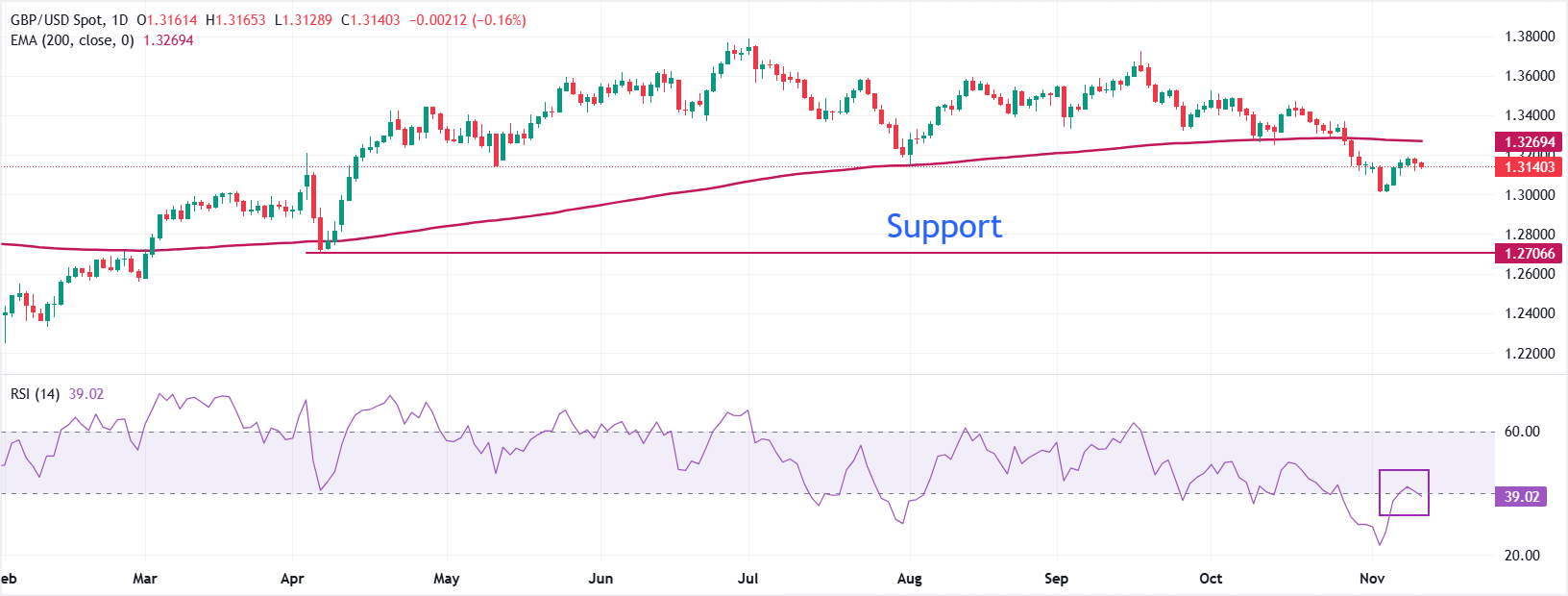
The Pound Sterling slides to near 1.3115 against the US Dollar on Wednesday. The overall trend of the pair remains bearish as it trades below the 200-day Exponential Moving Average (EMA), which is around 1.3269.
The 14-day Relative Strength Index (RSI) struggles to return above 40.00. A fresh bearish momentum would emerge if the RSI resumes its downside journey.
Looking down, the April low near 1.2700 will act as a key support zone. On the upside, the October 28 high around 1.3370 will act as a key barrier.
BoE FAQs
The Bank of England (BoE) decides monetary policy for the United Kingdom. Its primary goal is to achieve ‘price stability’, or a steady inflation rate of 2%. Its tool for achieving this is via the adjustment of base lending rates. The BoE sets the rate at which it lends to commercial banks and banks lend to each other, determining the level of interest rates in the economy overall. This also impacts the value of the Pound Sterling (GBP).
When inflation is above the Bank of England’s target it responds by raising interest rates, making it more expensive for people and businesses to access credit. This is positive for the Pound Sterling because higher interest rates make the UK a more attractive place for global investors to park their money. When inflation falls below target, it is a sign economic growth is slowing, and the BoE will consider lowering interest rates to cheapen credit in the hope businesses will borrow to invest in growth-generating projects – a negative for the Pound Sterling.
In extreme situations, the Bank of England can enact a policy called Quantitative Easing (QE). QE is the process by which the BoE substantially increases the flow of credit in a stuck financial system. QE is a last resort policy when lowering interest rates will not achieve the necessary result. The process of QE involves the BoE printing money to buy assets – usually government or AAA-rated corporate bonds – from banks and other financial institutions. QE usually results in a weaker Pound Sterling.
Quantitative tightening (QT) is the reverse of QE, enacted when the economy is strengthening and inflation starts rising. Whilst in QE the Bank of England (BoE) purchases government and corporate bonds from financial institutions to encourage them to lend; in QT, the BoE stops buying more bonds, and stops reinvesting the principal maturing on the bonds it already holds. It is usually positive for the Pound Sterling.
Author

Sagar Dua
FXStreet
Sagar Dua is associated with the financial markets from his college days. Along with pursuing post-graduation in Commerce in 2014, he started his markets training with chart analysis.