|

PBOC's Yi Gang: Yuan is stable, not an economic war device

The People's Bank of China (PBoC) Governor Yi Gang delivered statements over the weekend addressing accusations of China using Yuan devaluation as a tool in the Sino-US trade war that continues to silently escalate in the background.

Yi Gang noted that the Yuan remains at a "reasonable equilibrium level" and is maintaining stability, while also admitting that yuan volatility is 'normal'. Yi commented that the Yuan's current exchange rate mechanism allows for two-way fluctuation, insinuating that the USD/CNY's current fluctuations are a result of movement in the US Dollar, and Gang concluded that the Yuan can be expected to remain within a "reasonable range" against the Greenback, which continues to appreciate. Gang topped his comments off by saying, "Economic growth, employment, inflation and the two-way fluctuation of the yuan are within reasonable range".

FXStreet's own Senior Analyst Joseph Trevisani noted that questions about China's currency manipulation are a moot point: 

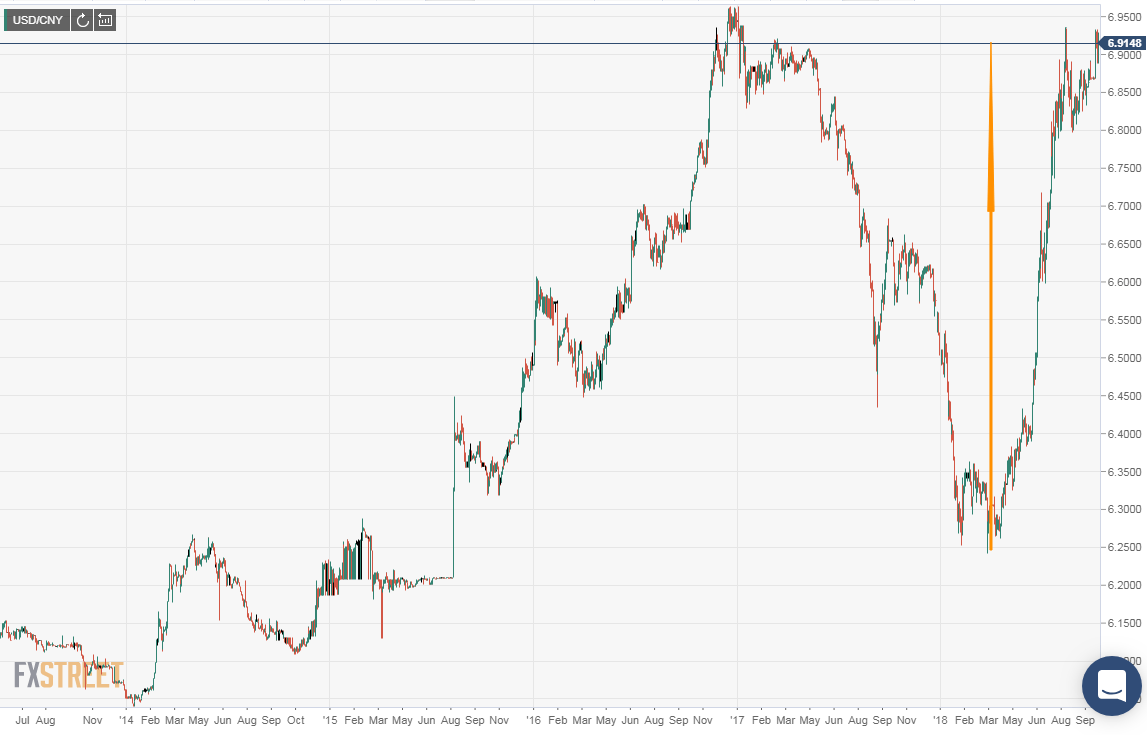
"Whether China is officially designated a currency manipulator by the Treasury Department is irrelevant. A glance at the yuan chart tells you all you need to know. Beijing's currency policy is an adjunct to its trade policy." - FXStreet's Joseph Trevisani
Author

Joshua Gibson

Joshua joins the FXStreet team as an Economics and Finance double major from Vancouver Island University with twelve years' experience as an independent trader focusing on technical analysis.


More from Joshua Gibson
Share:

Editor's Picks

USD/JPY stays below 160.50 as markets assess BoJ decision

USD/JPY fluctuates in a relatively narrow range above 160.00 on Tuesday as markets assess the Bank of Japan's (BoJ) decision to raise the policy rate by 25 at the June meeting. Meanwhile, investors keep a close eye on news coming out of the Middle East, while preparing for the critical Fed meeting.

AUD/USD struggles for direction, still below 0.7100

AUD/USD looks to extend Monday’s recovery, although a challenge to the 0.7100 barrier remains elusive ahead of the opening bell in Asia. The Aussie Dollar was unable to take advantage of the RBA's relatively cautious message, which included keeping its OCR unchanged at 4.35% and leaving the possibility of further tightening in the future.

Gold: $4,000 or $4,500? The Fed may decide Gold’s next big move

Gold now surrenders part of its initial advance and recedes to the vicinity of the $4,350 mark per troy ounce on Tuesday. The early enthusiasm sparked by the US-Iran peace deal has faded somewhat, prompting investors to adopt a more prudent stance as they await further details of the agreement and key guidance from the Fed.

XRP pulls back as subdued ETF inflows, layered resistance cap upside
Ripple (XRP) remains elevated above $1.23 at the time of writing on Tuesday, struggling amid a capped upside. Despite an improved overall market sentiment driven by news of a peace agreement between the United States and Iran to end the war in the Middle East, capital inflows remain notably subdued.
1% rate, 160 Yen: Why Japan’s historic hike changed little
The Bank of Japan (BoJ) pushed its short-term policy rate to 1% on Tuesday, the highest setting since 1995 and a 31-year milestone in a normalization cycle barely two years old. It is the kind of number that should mark a turning point for the Yen, and it did almost nothing.
Why a hawkish RBA is no longer enough to lift the Australian Dollar

The Reserve Bank of Australia delivered more than what markets expected: a hawkish hold that should have supported the Aussie. But markets widely ignored it, focusing instead on slowing economic growth and proving that central bank messaging alone isn’t always enough to drive currencies.