Palantir stock pauses rally ahead of most-watched earnings release on Monday
- Palantir is set to deliver Q1 earnings after the close on Monday.
- Wall Street expects $0.13 in adjusted EPS in the first quarter.
- Revenue is forecast to arrive at $862.1 million, up 36% from a year earlier.
- Government AI contracts appear safe, but the market worries over valuation.

Palantir (PLTR) stock is taking the Monday session off as investors hold their breath for the artificial intelligence (AI) company's first-quarter earnings results scheduled for after the close. The market expects big things for Palantir but realizes the risk-return status has changed after the Peter Thiel-backed company has rallied 71% over the past month.
The broader US stock market is also taking a wait-and-see approach after an economic survey underperformed and US President Donald Trump announced specific new tariffs for the film industry. Trump called Hollywood dying in a social media post on Sunday and called for 100% tariffs on foreign-made films.
S&P Global's US Purchasing Managers Index (PMI) for April arrived at 50.6 on Monday, down from 51.2 in March and below the consensus.
The S&P 500 looks primed to end its nine-day streak of gains, its longest such streak in over two decades. The index is down about half a percentage point, the same as Palantir shares, at the time of writing. The Dow Jones Industrial Average (DJIA), however, has gained slightly.
Palantir earnings preview
Wall Street expects Palantir to earn $0.13 in adjusted earnings per share (EPS) for the quarter ending in March. This compares with $0.08 in the year-ago period for a 63% projected gain.
For revenue, Wall Street is calculating a consensus of $862.1 million, which would be a 36% gain YoY.
While there is much talk about Trump cutting government spending, the initial data shows that overall spending under Trump has risen by $154 billion in the first three months of his term compared with a year earlier. Since Palantir gets much of its revenue from the US government, this is good news for shareholders.
With the war between Russia and Ukraine continuing despite Trump's peace-making efforts, continued funding of Israel, and missile campaign against the Houthis in Yemen, Palantir's many military contracts look safe for now. Despite searching for domestic programs to cut, the Trump administration has projected a significant increase in US military spending levels for 2026.
Wedbush Securities analysts said that government cost-cutting efforts mostly appear likely to sidestep Palantir contracts.
“Palantir is helping lead the AI Revolution into the use case phase as its AIP product moat is unmatched in our view,” wrote the analysts in a client note ahead of earnings.
CEO Alex Karp will probably face questions regarding Palantir's TITAN vehicle. The mobile intelligence-gathering vehicle is being tested by the US Army to gather intelligence on the battlefield. In April, the Army reported to Congress that the TITAN program was among its best-performing new programs.
One year ago, Palantir won a $178 million contract to provide the Army with 10 TITAN prototypes. Palantir has delivered three prototypes so far and expects to deliver the other seven in the fourth quarter of this year.
Palantir stock forecast
The main piece of concern is that Palantir stock is already trading just beneath the all-time high from February 19 of $125.41. With huge profit gains projected in the years ahead, Palantir shares currently garner a 225x price-to-earnings ratio. A major beat and raise, in which management signals a better outlook than the projected $0.55 full-year consensus EPS, could push shares up to the 61.8% Fibonacci Extension at $129.59. The 78.6% Fibo sits at $138.13, another possibility.
On the downside, the 50-day Simple Moving Average (SMA) sits near $92. Long-term support rests between $63 and $67, where the 200-day SMA is also located.
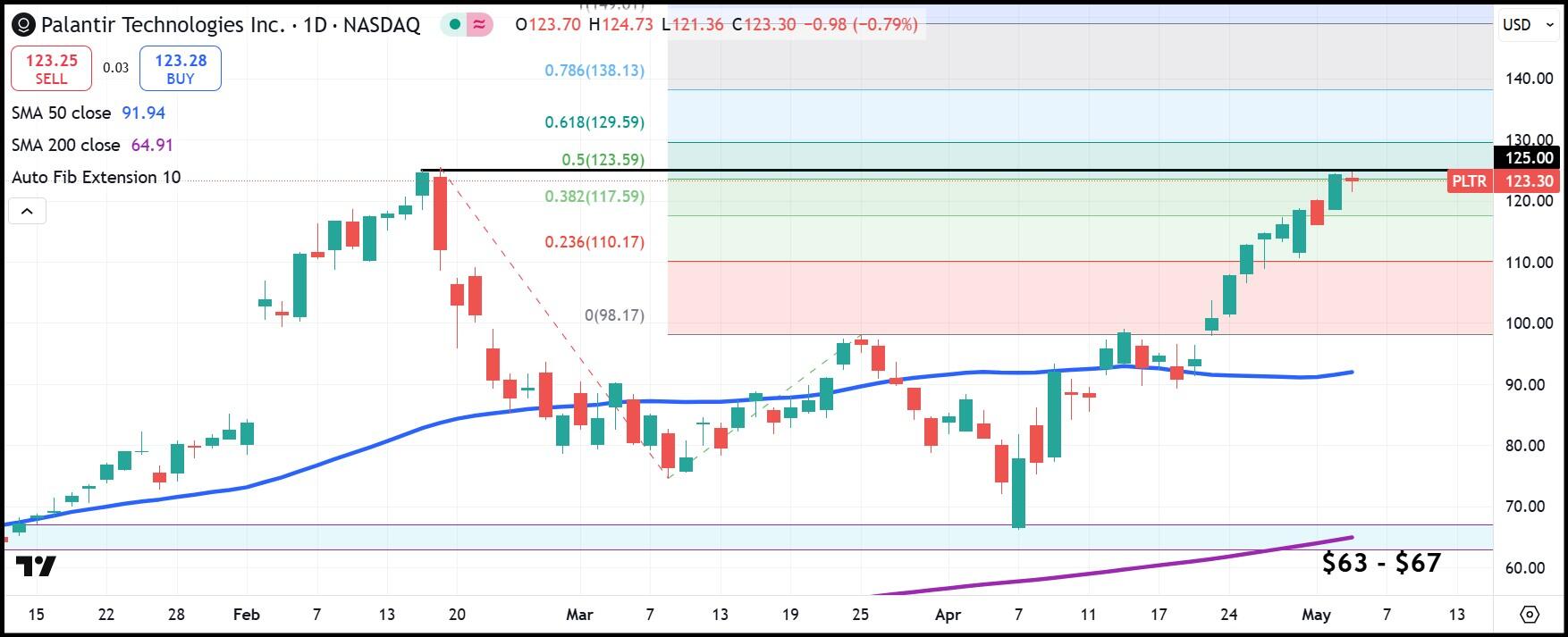
PLTR daily stock chart
Author

Clay Webster
FXStreet
Clay Webster grew up in the US outside Buffalo, New York and Lancaster, Pennsylvania. He began investing after college following the 2008 financial crisis.

















