|

NZD/USD trades flat below 0.6100 at the start of the week

  • NZD/USD trades with mild gains, just above its opening price of around 0.6095.
  • The USD recovered following the sell-off seen on Friday post NFPs.
  • Eyes on Chinese data on Tuesday.
NZD/USD trades flat below 0.6100 at the start of the week

The NZD/USD traded neutral on Monday, below the 0.6100 level. On the one hand, the USD recovered from rising yields after Friday’s losses, while the NZD trades strong ahead of key Trade Balance data from China on Tuesday.

Markets continue to asses jobs reports from the US released on Friday. Nonfarm Payrolls (NFP) cooled down, leading to a USD sell-off and a decline in US bond yields. It is intriguing why markets disregarded the rise in Average Hourly Earnings so quickly, which may contribute to inflationary pressures. The week’s highlight is the release of inflation data from the US on Thursday, with the headline figure expected to increase to 3.3% (YoY) from the previous 3% in June while the Core measure to decrease to 4.7% YoY from 4.8%.

As a reaction, the US bond yields are showing a mixed performance. The 10-year bond yield trades at 4.09%, seeing 0.79 % gains on the day, while the 2-year yield stands with mild payments at 4.77% and the 5-year yields at 4.17%, seeing a 0.70 % increase, respectively.

As for now, according to the CME FedWatch tool, the odds of a 25 basis point hike remain low for the following September meeting they top out near 30% for the November decision.

On the Kiwi’s side, New Zealand’s economic calendar won’t reveal any high-tier data this week. The highlight will be Chinese data to be reported on the early Asian session on Tuesday, which will impact the Asian block currency depending on its outcome.


NZD/USD levels to watch

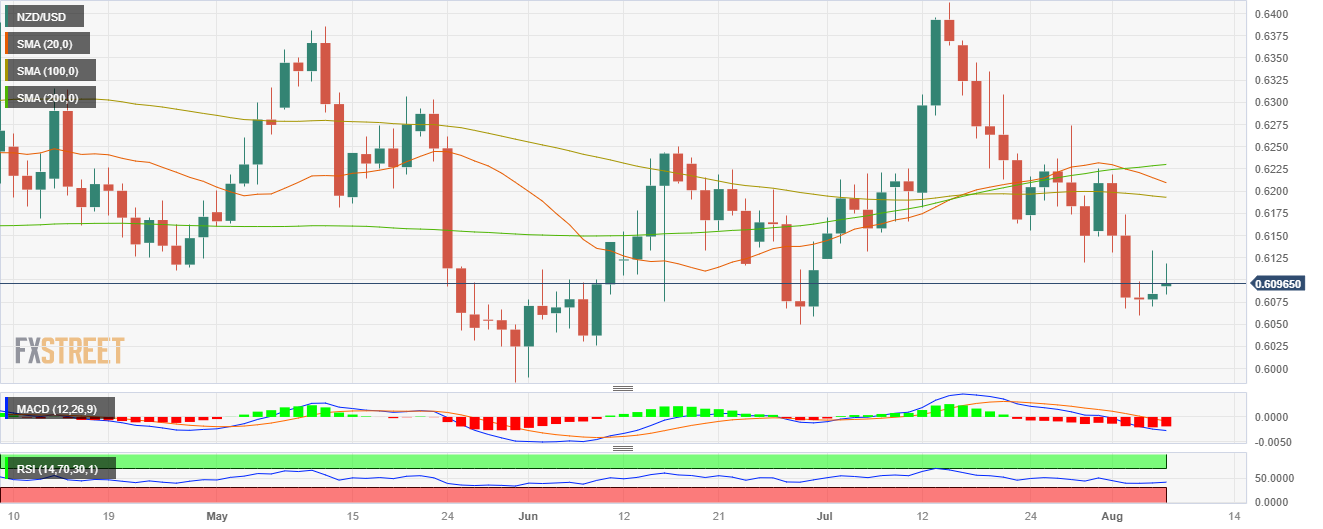
Upon analysing the daily chart, a neutral to bearish trend becomes evident for NZD/USD, with the bears gradually taking control. The Relative Strength Index (RSI) turned flat in negative territory, while the Moving Average Convergence (MACD) shows red bars. Additionally, the pair is below the 20,100 and 200-day Simple Moving Averages (SMAs), pointing towards the prevailing strength of the bears in the larger context and the buyers facing a challenging situation.

Support levels: 0.6080, 0.6060, 0.6050.

Resistance levels: 0.6100, 0.6130, 0.6150.

NZD/USD Daily chart
NZD/USD

Overview
Today last price0.6097
Today Daily Change0.0013
Today Daily Change %0.21
Today daily open0.6084
 
Trends
Daily SMA200.6215
Daily SMA500.6165
Daily SMA1000.6193
Daily SMA2000.6228
 
Levels
Previous Daily High0.6133
Previous Daily Low0.607
Previous Weekly High0.6226
Previous Weekly Low0.606
Previous Monthly High0.6413
Previous Monthly Low0.612
Daily Fibonacci 38.2%0.6109
Daily Fibonacci 61.8%0.6094
Daily Pivot Point S10.6058
Daily Pivot Point S20.6033
Daily Pivot Point S30.5995
Daily Pivot Point R10.6122
Daily Pivot Point R20.6159
Daily Pivot Point R30.6185

Author

Patricio Martín

Patricio is an economist from Argentina passionate about global finance and understanding the daily movements of the markets.


More from Patricio Martín
Share:

Editor's Picks

AUD/USD bears retain control near YTD low, 0.6650 tested

AUD/USD sits at fresh YTD lows near 0.6550 in Friday's Asian session and looks vulnerable to further downside. The US Dollar holds near April 2025 highs amid renewed US-Iran tensions and aggressive Fed rate-hike bets. Moreover, Thursday’s dismal Aussie jobs data, the RBA’s dovish tilt and PBOC's status-quo continue to weigh on the Aussie, validating the negative outlook for the currency pair.

USD/JPY drops below 159.50 after Japan’s National CPI

USD/JPY has turned south below mid-159.00s in the Asian session on Friday, as the Japanese Yen gains ground following the country's National CPI, which reaffirmed the December BoJ rate hike. Further, a broader risk-off market environment lifts the Yen's safe-haven appeal. However, hawkish Fed outlook and renewed US-Iran tensions keep the US Dollar supported, which could limit the pair's downside.


Gold: The $3,500 zone holds the downside… for now

Gold further extends its deep pullback, coming close to the key $3,500 mark per troy ounce as Friday’s European session draws to a close. Furthermore, the yellow metal has traded with losses since Monday, always tracking rising bets for extra tightening by the Fed and the lack of any progress from the Middle East conflict.

Bitcoin slips below $60,000 as selling pressure accelerates

Bitcoin price slips below $60,000 on Friday, reaching a level not seen since early July. Momentum indicators suggest firm selling pressure despite reaching oversold levels.

Week ahead – Flash PMIs and PCE inflation in focus ahead of Thanksgiving

US flash PMIs and PCE inflation data could shape Fed rate expectations. Eurozone and UK PMIs will offer an early look at business activity. Australia’s CPI data could influence expectations for the RBA’s next move.

Gold's 14-month low looks mild next to Silver's fall from $121 to $44
Gold has lost a third of its value since January as traders bet on more Federal Reserve rate increases. Silver has lost nearly two-thirds, because the buyers still holding Gold up have no equivalent in the Silver market. Gold is trading below $3,700 for the first time since September 2025, a little more than a third under the record near $5,600 it set in late January.