NZD/USD softens as US Dollar bulls return
- NZD/USD retreats as the Fed retains its "data-dependent" stance.
- USD firms while NZD slips, with light volumes capping volatility amid the US holiday.
- New Zealand GDP beats expectations; however, the economy remains in contraction territory.


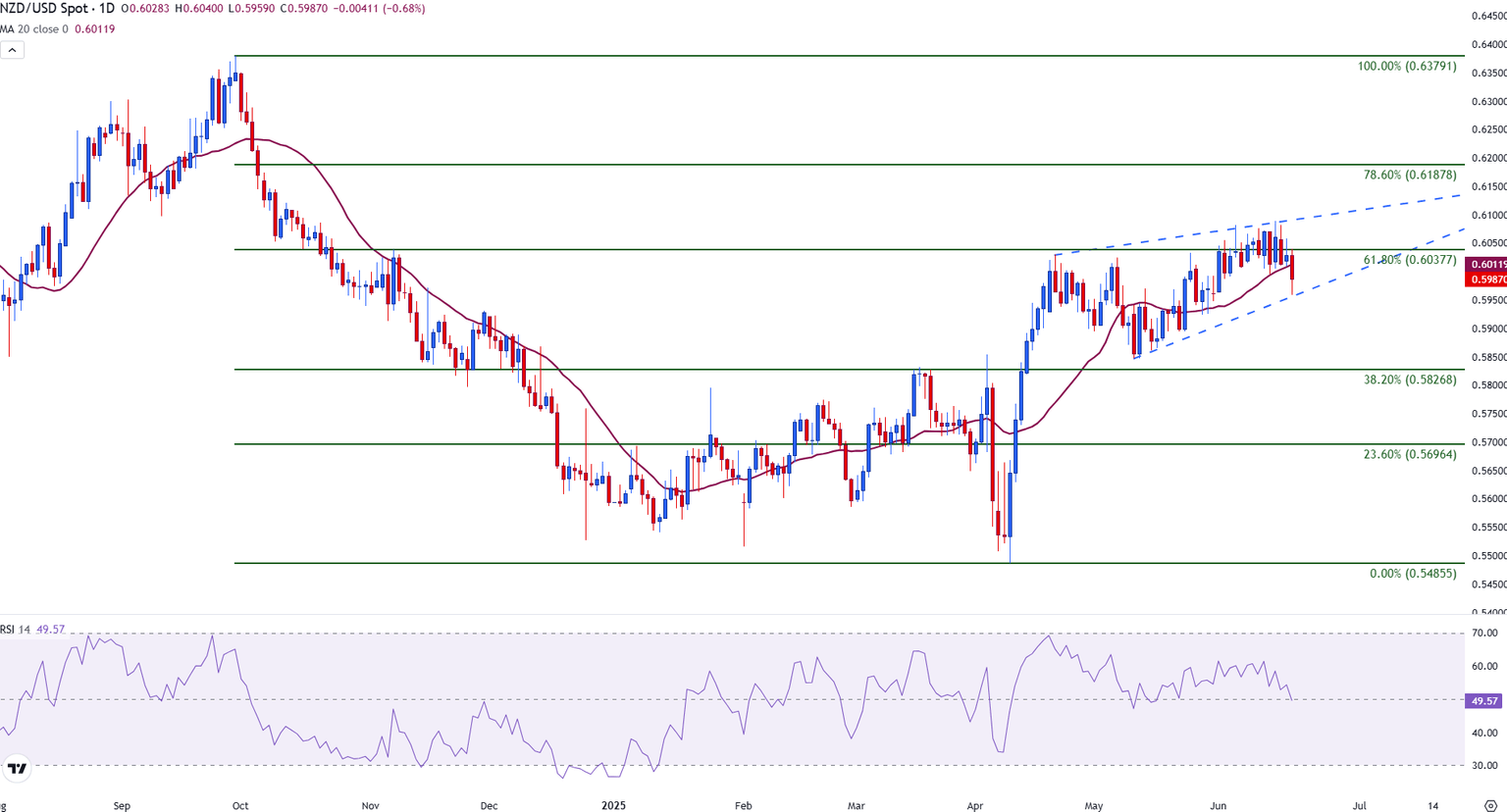
The New Zealand Dollar (NZD) remains under pressure on Thursday, with NZD/USD sliding toward 0.5980 as the US Dollar extends gains. The pair broke below the 20-day Simple Moving Average (SMA) at 0.6012 and the lower edge of a rising wedge pattern, a move that suggests bullish momentum has faded. Price action now reflects growing downside pressure as traders respond to contrasting economic signals from both economies.
The Federal Reserve’s (Fed) latest policy update delivered a more hawkish tone than markets had anticipated. While rates were left unchanged, the central bank raised its inflation forecast and signaled the likelihood of two rate cuts this year.
This shift, paired with Fed Chair Jerome Powell’s cautious remarks on inflation and geopolitical risks, has reinforced the US Dollar’s strength and left risk-sensitive currencies like the Kiwi struggling to find support.
Meanwhile, New Zealand’s recent economic data has done little to inspire confidence. Consumer inflation came in softer than expected, prompting markets to lower their expectations for further tightening by the Reserve Bank of New Zealand. Some participants are even beginning to price in the possibility of rate cuts if domestic growth continues to falter. Furthermore, the latest dairy auction revealed another decline in prices, which was a setback for one of the country’s key export sectors.
The outlook is further clouded by local political challenges. The government is facing criticism over housing affordability and public-sector pay disputes, developments that are weighing on sentiment at home. With few positive catalysts on the horizon, the New Zealand Dollar has been left exposed to external pressure and fading investor appetite for risk.
NZD/USD technical analysis signals the potential for a bearish reversal
On the technical front, NZD/USD has broken through key support levels, reinforcing the bearish bias. The drop below the 20-day SMA and the formation of a rising wedge confirm a reversal of the prior uptrend. The former support zone around 0.6012 now acts as initial resistance.
A recovery above this level would bring 0.6060 into focus, which aligns with the prior wedge top and recent swing high.
To the downside, the pair is testing the 23.6% Fibonacci retracement of the April–June rally, located around 0.5953. A close beneath this level could open the door to 0.5850, a region that acted as support during April’s consolidation. Below that, attention would shift to the deeper retracement zone near 0.5736, which aligns with the early April low.
Momentum indicators are also pointing lower. The Relative Strength Index (RSI) has slipped beneath the neutral 50 line and continues to track south, but it is not yet in oversold territory. A sustained move below 45 would indicate growing downside pressure.
NZD/USD daily chart
New Zealand Dollar FAQs
The New Zealand Dollar (NZD), also known as the Kiwi, is a well-known traded currency among investors. Its value is broadly determined by the health of the New Zealand economy and the country’s central bank policy. Still, there are some unique particularities that also can make NZD move. The performance of the Chinese economy tends to move the Kiwi because China is New Zealand’s biggest trading partner. Bad news for the Chinese economy likely means less New Zealand exports to the country, hitting the economy and thus its currency. Another factor moving NZD is dairy prices as the dairy industry is New Zealand’s main export. High dairy prices boost export income, contributing positively to the economy and thus to the NZD.
The Reserve Bank of New Zealand (RBNZ) aims to achieve and maintain an inflation rate between 1% and 3% over the medium term, with a focus to keep it near the 2% mid-point. To this end, the bank sets an appropriate level of interest rates. When inflation is too high, the RBNZ will increase interest rates to cool the economy, but the move will also make bond yields higher, increasing investors’ appeal to invest in the country and thus boosting NZD. On the contrary, lower interest rates tend to weaken NZD. The so-called rate differential, or how rates in New Zealand are or are expected to be compared to the ones set by the US Federal Reserve, can also play a key role in moving the NZD/USD pair.
Macroeconomic data releases in New Zealand are key to assess the state of the economy and can impact the New Zealand Dollar’s (NZD) valuation. A strong economy, based on high economic growth, low unemployment and high confidence is good for NZD. High economic growth attracts foreign investment and may encourage the Reserve Bank of New Zealand to increase interest rates, if this economic strength comes together with elevated inflation. Conversely, if economic data is weak, NZD is likely to depreciate.
The New Zealand Dollar (NZD) tends to strengthen during risk-on periods, or when investors perceive that broader market risks are low and are optimistic about growth. This tends to lead to a more favorable outlook for commodities and so-called ‘commodity currencies’ such as the Kiwi. Conversely, NZD tends to weaken at times of market turbulence or economic uncertainty as investors tend to sell higher-risk assets and flee to the more-stable safe havens.
Author
Tammy Da Costa, CFTe®
FXStreet
Tammy is an economist and market analyst with a deep passion for financial markets, particularly commodities and geopolitics.

















