NZD/USD rises on RBA’s hawkish posture, softening greenback on subdued trading conditions
- NZD/USD advances with support from RBA’s hawkish hold and weakness in the US dollar during the US holiday session.
- Uncertain economic outlook in the US amid mixed economic data and recession fears increases the likelihood of rate hikes.
- New Zealand’s QSBO improves in Q2 but highlights weakening demand and labor challenges.

NZD/USD advances in a subdued North American session as traders from the United States (US) remain on holiday in observance of Independence Day. However, the NZD/USD got lifted by the Reserve Bank of Australia’s (RBA) hawkish hold and the greenback’s soft tone. The NZD/USD exchanges hands at 0.6197 after hitting a daily low of 0.6140, up by 0.75%.
NZD/USD benefits from RBA’s hawkish hold, eyes US data and RBNZ next week’s decision
Global equities are trading upbeat on thin liquidity conditions as the US cash markets remain closed. The latest round of US economic data has painted an uncertain economic outlook after Durable Good Orders, Retails Sales, and Gross Domestic Product (GDP) for Q1 final reading justified the Federal Reserve’s (Fed) need for higher rates. Nevertheless, a soft read on the Fed’s preferred gauge for inflation revealed on Friday, alongside a contractionary June’s ISM Manufacturing PMI, increased the likelihood of a hard landing as recession fears increased.
Meanwhile, during the Asian session, the New Zealand Institute of Economic Research (NZIER) quarterly survey of business opinion (QSBO) improved in Q2 to -63.0% vs. -66.0 prior. The report highlighted demand is weakening while capacity utilization declined among builders and manufacturers. Regarding employment, firms revealed difficulties in finding labor, especially unskilled workers.
That, alongside the Reserve Bank of Australia’s (RBA) June monetary policy decision to keep rates unchanged but tilted hawkish, opened the door for additional tightening, and underpinned the New Zealand Dollar (NZD) against the US Dollar (USD).
The US Dollar Index (DXY), which tracks the buck’s value against a basket of peers, erased some of its Monday’s gains and is down 0.02%, at 102.941. In the short term of the curve, US Treasury bond yields are rising, while 20s and 30s print minuscule losses.
Upcoming events
The New Zealand economic docket is light throughout the week. Still, it will get some traction until next week’s Reserve Bank of New Zealand (RBNZ) monetary policy decision, which is expected to keep rates unchanged. On the US front, NZD/USD traders will get cues from the latest FOMC minutes, Fed speakers, and labor market data.
NZD/USD Price Analysis: Technical outlook
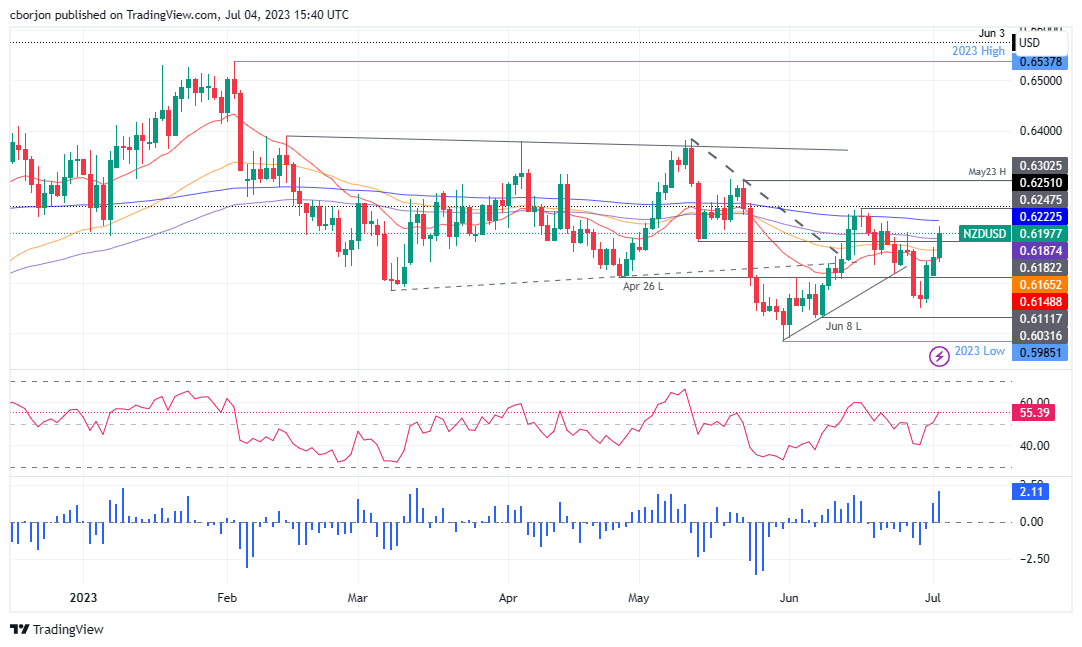
In the near term, the NZD/USD remains neutral to downward biased, as the 200-day Exponential Moving Average (EMA) at 0.6225 is putting a lid on the pair’s advance. In addition, a three advancing soldiers chart pattern suggests buyers gathered strong momentum, reinforced by the Relative Strength Index (RSI) getting to the bullish territory. If NZD/USD climbs past the 200-day EMA, that will expose the June 16 high of 0.6247, followed by the 0.6300 figure. Conversely, if NZD/USD drops below 0.6200, that could open the door for further downside, eyeing the 100-day EMA at 0.6187 and the 50-day EMA at 0.6165.
Author

Christian Borjon Valencia
FXStreet
Markets analyst, news editor, and trading instructor with over 14 years of experience across FX, commodities, US equity indices, and global macro markets.
















