NZD/USD rebounds from four-month low as Powell’s Jackson Hole remarks sink US Dollar
- NZD/USD is up nearly 0.85% on Friday after briefly touching 0.5800, its lowest level since April 11.
- Powell balanced tariff-driven inflation risks with labor market weakness, signaling monetary policy recalibration.
- Markets price in a 90% probability of a September rate cut, up from 70% earlier in the day.

The New Zealand Dollar (NZD) strengthens against the US Dollar (USD) on Friday, with NZD/USD rebounding from its lowest level since April 11 as traders reacted to Federal Reserve (Fed) Chair Jerome Powell’s remarks at the Jackson Hole Economic Symposium. At the time of writing, the pair is trading near 0.5860, recovering sharply from an intraday low of 0.5800.
Powell struck a cautious balance in his keynote, noting that while tariff-driven inflation pressures are possible, they are unlikely to become entrenched given the growing downside risks to the labor market. He added that the slowdown in job growth has not created a large margin of slack, which the Fed wants to avoid, signaling that policymakers remain attentive to risks on both sides of the mandate.
From a broader perspective, Powell also unveiled an updated monetary policy framework, stripping references to the “shortfalls” language on employment and reinforcing the Fed’s flexibility in addressing evolving risks.
The remarks reinforced expectations that the Fed is preparing to recalibrate policy, with markets sharply increasing bets on a September rate cut. According to the CME FedWatch Tool, traders now price in a 90% probability of a 25 basis-point cut, up from around 70% earlier in the day. This repricing sent US Treasury yields lower and weighed heavily on the US Dollar, allowing the Kiwi to stage a strong rebound.
Risk sentiment also improved as Powell avoided sounding overly hawkish, triggering gains in equities and higher-beta currencies. For the New Zealand Dollar, the move comes after a week of heavy selling pressure tied to the Reserve Bank of New Zealand’s (RBNZ) dovish pivot and concerns over slowing global growth.
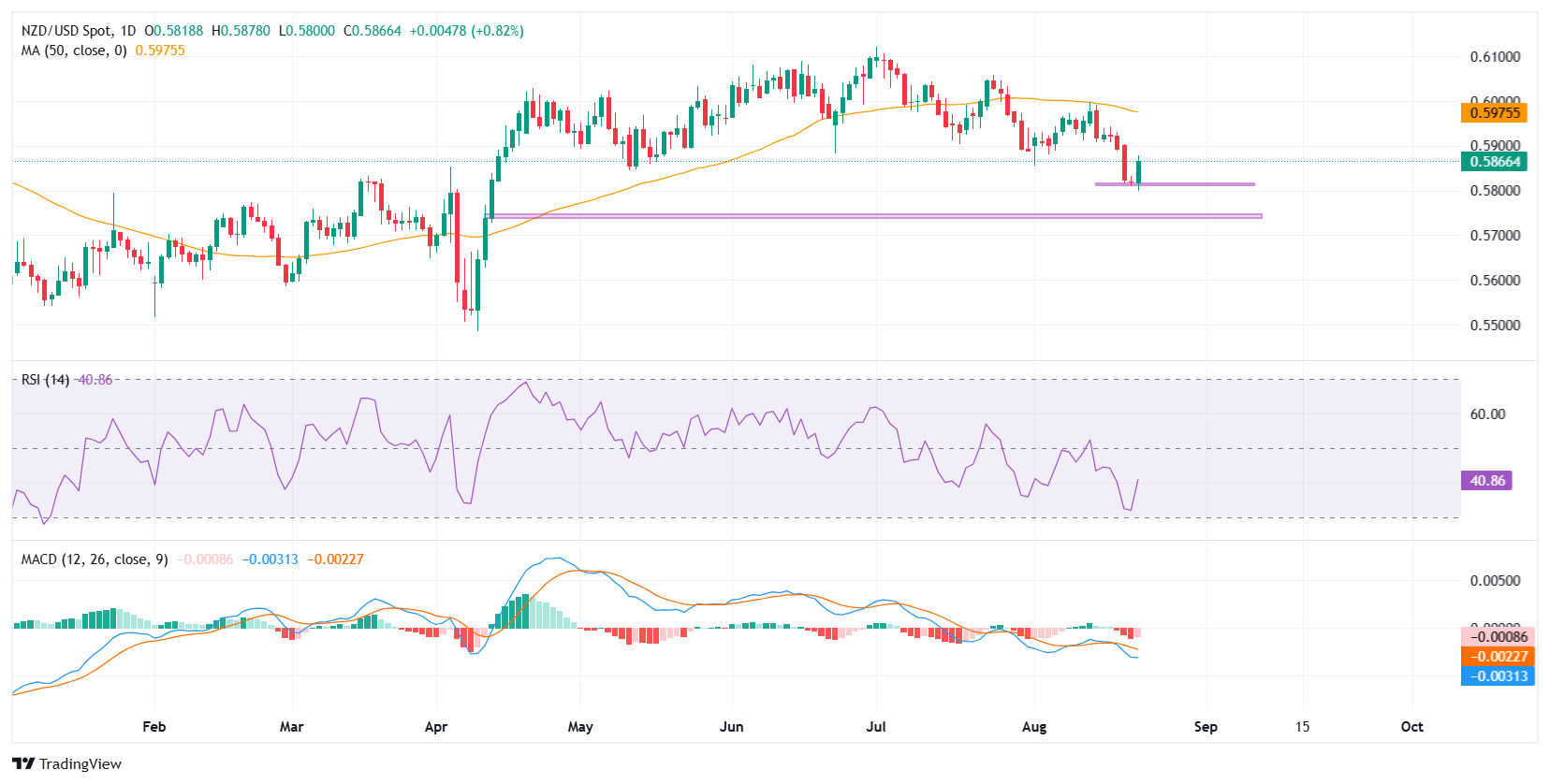
From a technical perspective, NZD/USD is attempting to recover after hitting a four-month low earlier in the session. The pair now faces initial resistance at the 0.5900 psychological level, followed by the 50-day Simple Moving Average (SMA) near 0.5975. On the downside, immediate support is located at 0.5800, with a break below exposing the April 11 trough at 0.5729.
New Zealand Dollar Price Today
The table below shows the percentage change of New Zealand Dollar (NZD) against listed major currencies today. New Zealand Dollar was the strongest against the US Dollar.
| USD | EUR | GBP | JPY | CAD | AUD | NZD | CHF | |
|---|---|---|---|---|---|---|---|---|
| USD | -1.00% | -0.95% | -1.09% | -0.55% | -1.03% | -0.82% | -0.90% | |
| EUR | 1.00% | 0.08% | -0.12% | 0.47% | -0.08% | 0.19% | 0.11% | |
| GBP | 0.95% | -0.08% | -0.22% | 0.39% | -0.16% | 0.14% | 0.04% | |
| JPY | 1.09% | 0.12% | 0.22% | 0.55% | 0.08% | 0.23% | 0.16% | |
| CAD | 0.55% | -0.47% | -0.39% | -0.55% | -0.54% | -0.26% | -0.35% | |
| AUD | 1.03% | 0.08% | 0.16% | -0.08% | 0.54% | 0.29% | 0.20% | |
| NZD | 0.82% | -0.19% | -0.14% | -0.23% | 0.26% | -0.29% | -0.09% | |
| CHF | 0.90% | -0.11% | -0.04% | -0.16% | 0.35% | -0.20% | 0.09% |
The heat map shows percentage changes of major currencies against each other. The base currency is picked from the left column, while the quote currency is picked from the top row. For example, if you pick the New Zealand Dollar from the left column and move along the horizontal line to the US Dollar, the percentage change displayed in the box will represent NZD (base)/USD (quote).
Author

Vishal Chaturvedi
FXStreet
I am a macro-focused research analyst with over four years of experience covering forex and commodities market. I enjoy breaking down complex economic trends and turning them into clear, actionable insights that help traders stay ahead of the curve.