|

NZD/USD Price Forecasts: Kiwi loses momentum after rejection at 0.5800

  • NZD/USD treads water below 0.5800 with technical indicators turning lower.
  • FX markets move within tight ranges, awaiting US employment figures.
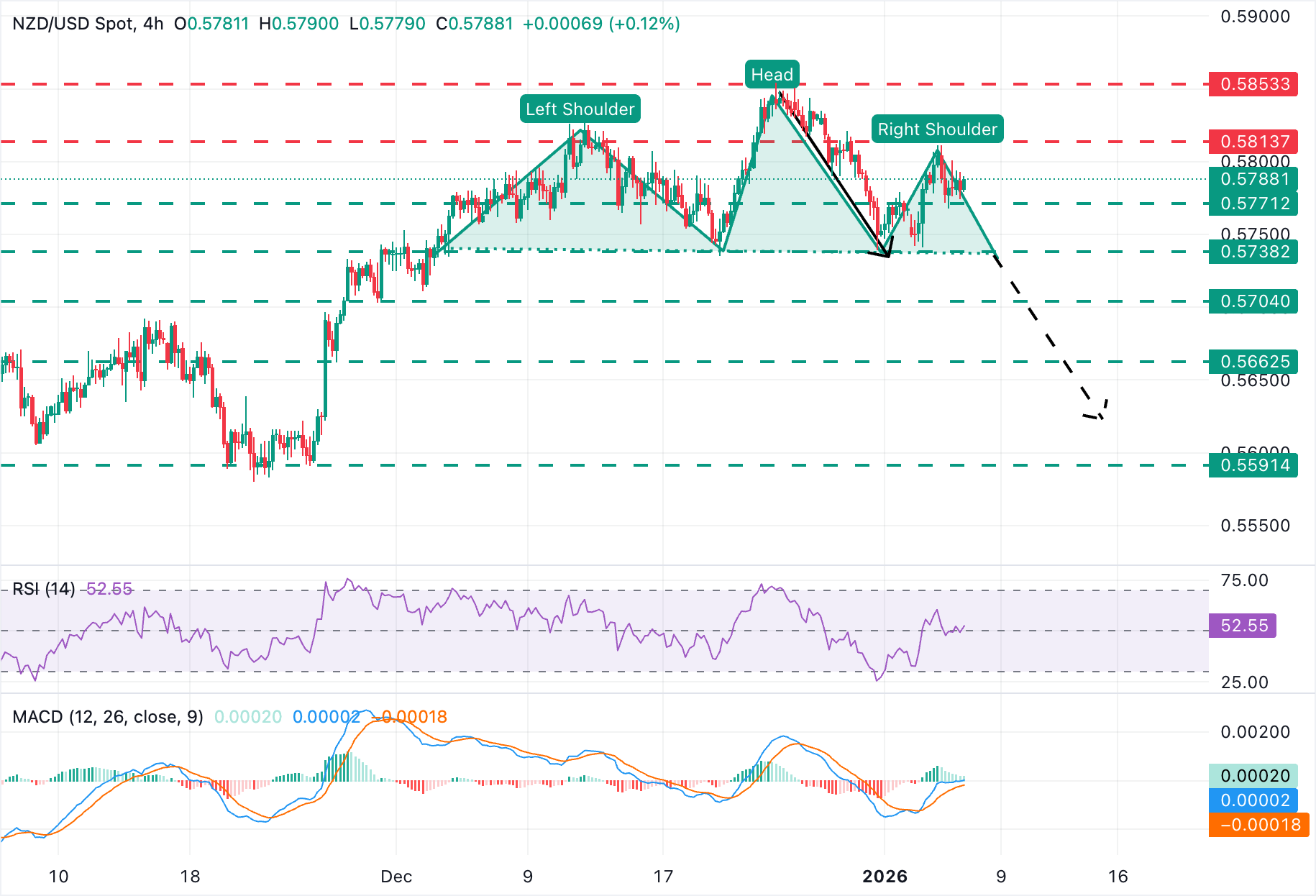
  • Kiwi's rejection at 0.5800 has printed the left shoulder of a potential H&S pattern.

The New Zealand Dollar is moving without a clear bias against the US Dollar, trading within a tight range around 0.5780 on Wednesday. Technical indicators, however, are turning lower after failing to break above the 0.5800 line on Tuesday.

Risk sentiment remains subdued, with investors looking from the sidelines ahead of the release of key US employment and services sector activity figures, which are expected to provide further insight into the US Federal Reserve’s (Fed) rate path.

Technical Analysis: A bearish Head & Shoulders pattern in progress
,

In the 4-hour chart, NZD/USD trades at 0.5785, little changed on a daily basis. The Moving Average Convergence Divergence (MACD) holds slightly above the zero line after turning positive, suggesting only modest bullish impetus, while the Relative Strength Index (RSI) is flattening around the 50 level, showing a lack of direction.

The rejection at 0.5800 keeps the 0.5735 area on the bears' focus. This is the neckline of a bearish H&S pattern. A breach of that level would confirm a trend shift, adding pressure towards the November 28 lows, near 0.5700, and the intra-day support, at 0.5662. The H&S's measured target is at 0.5625.

On the upside, immediate resistance aligns at 0.5814 (Tuesday's high), followed by the December 23 high, at 0.5853.

(The technical analysis of this story was written with the help of an AI tool)

Author

Guillermo Alcala

Graduated in Communication Sciences at the Universidad del Pais Vasco and Universiteit van Amsterdam, Guillermo has been working as financial news editor and copywriter in diverse Forex-related firms, like FXStreet and Kantox.


More from Guillermo Alcala
Share:

Editor's Picks

AUD/USD regains mild traction, falters near 0.7150

AUD/USD gathers some steam and manages to flirt with the 0.7150 level on Thursday. However, the pair has retraced some of Wednesday’s significant pullback due to renewed selling pressure on the Greenback and a slight improvement in risk sentiment following hopes of a deal in the Middle East. Wrapping up the Australian docket, the RBA’s Hauser will speak early on Friday.

USD/JPY trades below 160.00 intervention threshold; bullish bias intact

The USD/JPY pair attracts some sellers during the Asian session amid fears that authorities will step in again to prop up the Japanese Yen. Furthermore, the Israel-Lebanon truce prompts some profit-taking around the US Dollar and exerts downward pressure on the currency pair.

Gold puts its 200-day SMA to the test near $4,420

Gold keeps the bullish stance in place in the latter part of Thursday’s session, although a convincing break above the key $4,500 mark per troy ounce still remains elusive. The precious metal’s advance comes amid the resurgence of some selling interest around the Greenback, improving risk sentiment, and declining US Treasury yields across the board.

XRP plummets as ETF outflows, geopolitical tensions reinforce bearish outlook
Ripple (XRP) edges lower, trading around $1.15 at the time of writing on Thursday, its lowest price since February 6. The cross-border money remittance token is extending the sell-off for the fifth consecutive day, reflecting persistent headwinds from ongoing geopolitical tensions and investor uncertainty.
Nonfarm payrolls: Testing the limits of Fed policy patience

The upcoming nonfarm payrolls report for May will provide the final update on the US labor market before Kevin Warsh attends his first policy meeting as the new Fed Chair later this month.

Recession on paper: What really moves the Canadian Loonie now?

Statistics Canada handed the headline writers a gift and the analysts a headache. Real GDP shrank 0.1% on an annualized basis in the first quarter, and with the fourth quarter of 2025 revised down to a 1.0% contraction, that is two negative quarters in a row, the textbook definition of a technical recession and Canada's first since the pandemic.














