NZD/USD Price Forecast: Falls to near 0.6050 within the descending channel
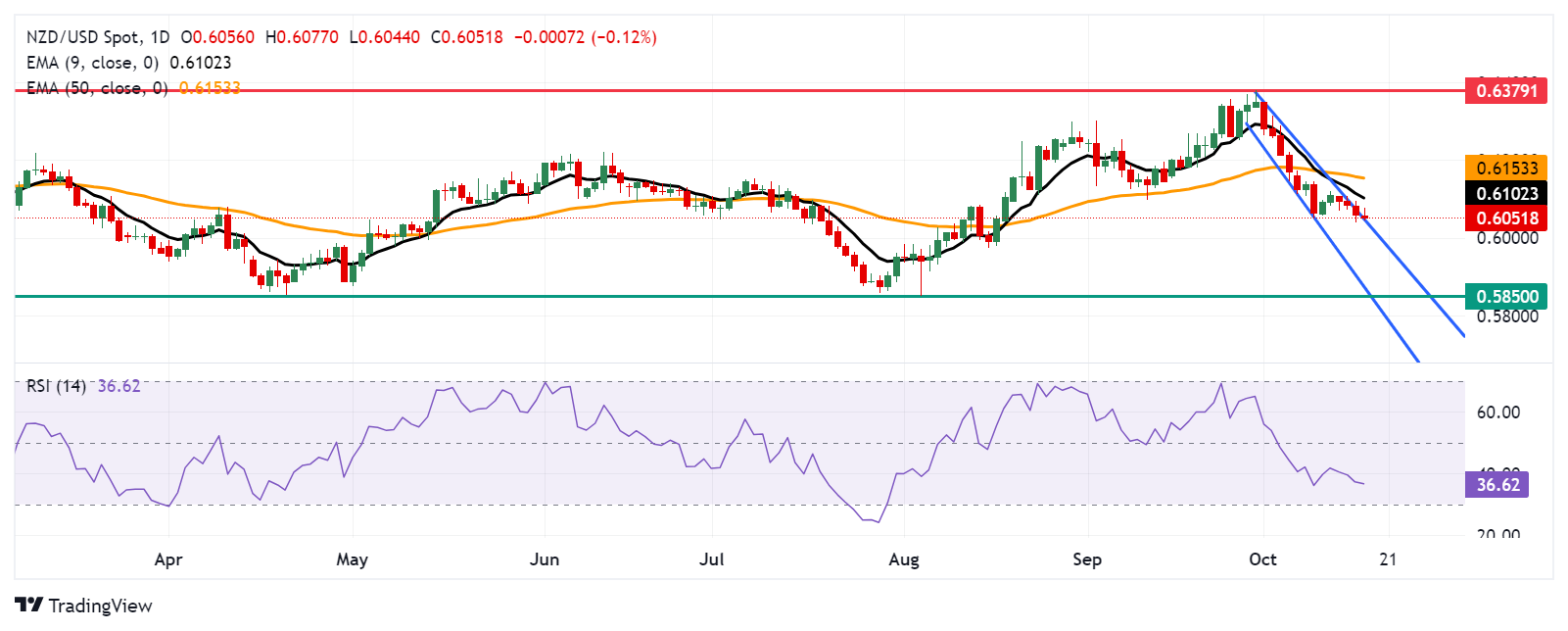
- NZD/USD attempts to remain within the descending channel pattern.
- If the 14-day RSI breaks below the 30 level, it would indicate an oversold territory and possibility of a short-term upward correction.
- The immediate resistance appears at the nine-day EMA at 0.6101 level, followed by the 50-day EMA at 0.6153 level.

The NZD/USD continues its losing streak for the fourth consecutive day, hovering around 0.6050 during Thursday's European trading session. The analysis of the daily chart shows that the pair attempts to remain within the descending channel pattern, signaling a continuation of the bearish trend.
The 14-day Relative Strength Index (RSI) approaches the 30 level, reinforcing the current bearish sentiment. A drop below this threshold would indicate that the NZD/USD pair is oversold, potentially leading to a short-term upward correction. Furthermore, the nine-day Exponential Moving Average (EMA) remains below the 50-day EMA, highlighting weakness in the short-term price trend for the pair.
In terms of support, if the NZD/USD pair successfully re-enters the descending channel, it may test the area around the lower boundary at the 0.5880 level, followed by the "pullback support" near the 0.5850 level.
On the upside, the immediate resistance is at the nine-day Exponential Moving Average (EMA) around the level of 0.6102, followed by the 50-day EMA at 0.6153 level. A break above these levels could shift the outlook to bullish, potentially allowing the NZD/USD pair to target the 16-month high of 0.6379, which was last reached on September 30.
NZD/USD: Daily Chart
New Zealand Dollar PRICE Today
The table below shows the percentage change of New Zealand Dollar (NZD) against listed major currencies today. New Zealand Dollar was the weakest against the Australian Dollar.
| USD | EUR | GBP | JPY | CAD | AUD | NZD | CHF | |
|---|---|---|---|---|---|---|---|---|
| USD | 0.10% | 0.04% | 0.06% | 0.23% | -0.15% | 0.07% | -0.03% | |
| EUR | -0.10% | -0.07% | 0.00% | 0.14% | -0.25% | 0.00% | -0.12% | |
| GBP | -0.04% | 0.07% | 0.04% | 0.19% | -0.19% | 0.05% | -0.04% | |
| JPY | -0.06% | 0.00% | -0.04% | 0.17% | -0.22% | -0.02% | -0.07% | |
| CAD | -0.23% | -0.14% | -0.19% | -0.17% | -0.37% | -0.14% | -0.23% | |
| AUD | 0.15% | 0.25% | 0.19% | 0.22% | 0.37% | 0.23% | 0.14% | |
| NZD | -0.07% | -0.01% | -0.05% | 0.02% | 0.14% | -0.23% | -0.09% | |
| CHF | 0.03% | 0.12% | 0.04% | 0.07% | 0.23% | -0.14% | 0.09% |
The heat map shows percentage changes of major currencies against each other. The base currency is picked from the left column, while the quote currency is picked from the top row. For example, if you pick the New Zealand Dollar from the left column and move along the horizontal line to the US Dollar, the percentage change displayed in the box will represent NZD (base)/USD (quote).
Author

Akhtar Faruqui
FXStreet
Akhtar Faruqui is a Forex Analyst based in New Delhi, India. With a keen eye for market trends and a passion for dissecting complex financial dynamics, he is dedicated to delivering accurate and insightful Forex news and analysis.