|

NZD/USD Price Analysis: Pair struggles at 20-day SMA as selling pressure builds

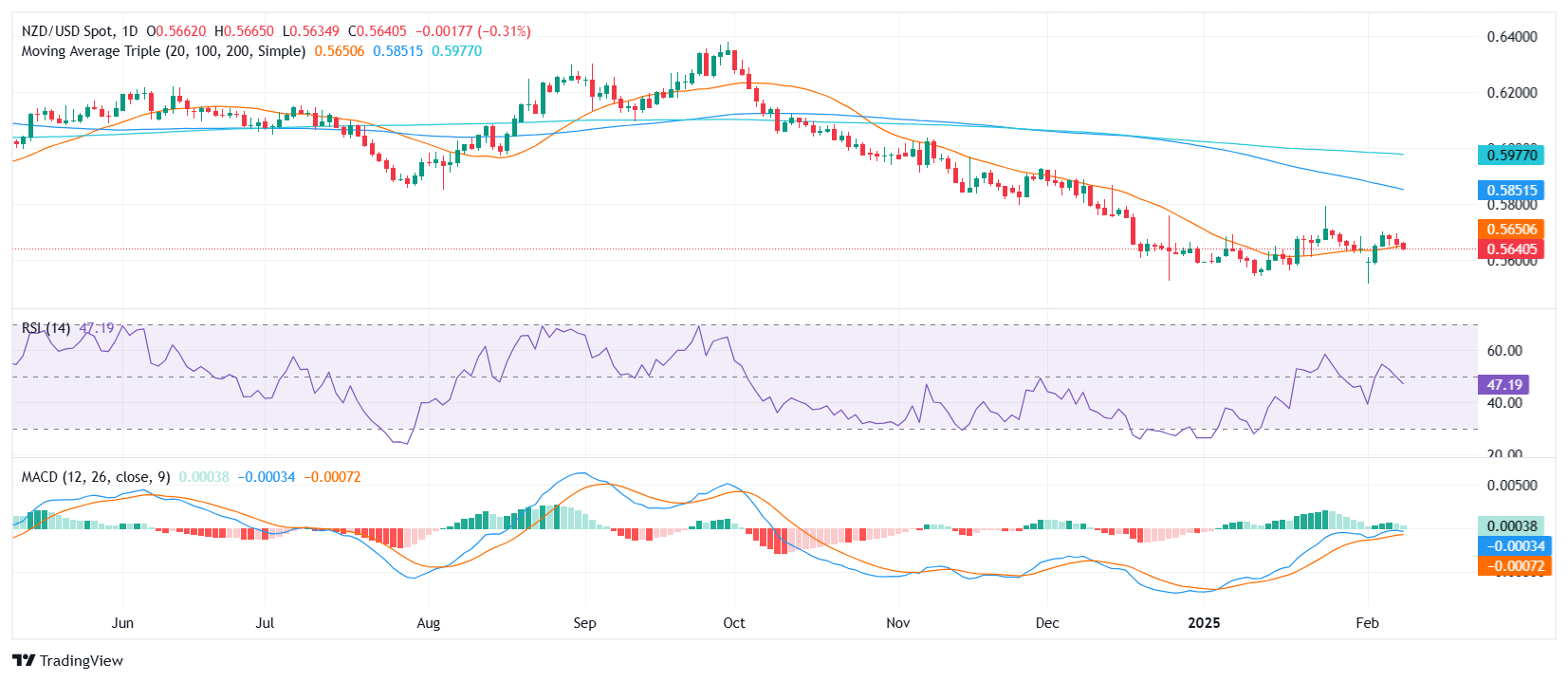
  • NZD/USD dips 0.30% on Monday, trading near 0.5640 amid renewed downside pressure.
  • The pair is testing support at the 20-day SMA, a key threshold for short-term direction.
  • RSI declines in negative territory, while MACD histogram shows weakening bullish momentum.

The NZD/USD pair saw a mild decline on Monday, slipping to 0.5640 as selling pressure persisted. Despite previous attempts to hold above the 20-day Simple Moving Average (SMA), the pair remains vulnerable, with a decisive breakdown of this level likely to accelerate downside risks.

Technical indicators highlight fading bullish momentum. The Relative Strength Index (RSI) has declined sharply to 47, dipping back into negative territory, which suggests a weakening recovery attempt. Meanwhile, the Moving Average Convergence Divergence (MACD) histogram prints decreasing green bars, reinforcing a slowdown in buying interest.

With the 20-day SMA around 0.5650 acting as a pivotal level, a confirmed break below this mark could push NZD/USD toward the next support at 0.5610. On the flip side, a bounce above 0.5675 would help stabilize sentiment and keep buyers engaged in the short term.

NZD/USD daily chart
Author

Patricio Martín

Patricio is an economist from Argentina passionate about global finance and understanding the daily movements of the markets.


More from Patricio Martín
Share:

Editor's Picks

GBP/USD advances above 1.3500 as easing Fed hike bets down USD

GBP/USD extends the advance above 1.3500 in the European trading hours on Friday. The US Dollar drops against the British Pound as cooler-than-expected US consumer and producer inflation data have limited the Fed's room for further interest rate hikes. Traders will keep an eye on the US July Retail Sales report and the Consumer Sentiment data later this Friday.


EUR/USD climbs above 1.1550 as US Dollar slips ahead of data

EUR/USD gains traction in the European session on Friday and trades in positive territory above 1.1550. The pair capitalizes on renewed US Dollar weakness, as doubts over a September Fed rate hike offset lingering Middle East concerns. The US Retail Sales and UoM Consumer Sentiment data are in focus later in the day. Meanwhile, the data from the Eurozone showed that the Gross Domestic Product (GDP) expanded at an annual rate of 1% in the second quarter, as expected.

Gold sticks to losses but holds above $4,300 as reduced Fed hike bets weigh on USD

Gold recovers slightly from the $4,300 neighborhood heading into the European session, though it remains in negative territory for the second straight day. Moreover, a mixed fundamental backdrop warrants some caution before positioning for an extension of the retracement slide from $4,450, or the highest since June 5, set the previous day.

Bitcoin SV hits three-month high, eyeing 200-day EMA breakout

Bitcoin SV is up nearly 2% extending a steady upward trend over the last two weeks. Retail strength builds in BSV amid multiple vulnerabilities found in the Bitcoin ecosystem. Bitcoin SV’s technical outlook is bullish as the price tests an upside breakout above the 200-day Exponential Moving Average at $15.39.

Dollar dominance is cracking and the Fort Knox Gold question won’t go away

Imagine somebody repeatedly claiming to have $100,000 in the bank but refusing to produce a statement or even balance the checkbook. The money might be there, but without verification, skepticism would be reasonable.

Why is Crude Oil priced for a reopening the ships haven't made?
Fourteen vessels crossed the Strait of Hormuz on Tuesday. Before the war, the count ran near 120 a day. In the sessions since the waterway was publicly declared open, Brent has drifted back to $87 and West Texas Intermediate (WTI) to $81, both a little lower again on Wednesday, with daily momentum on each unwound from the top of its range in late July to the low twenties now.















