|

NZD/USD Price Analysis: Pair extends gains and settled around 0.5705, momentum builds

  • NZD/USD advances on Friday, holding above the key 0.5700 level.
  • The pair maintains its uptrend, supported by bullish technical indicators.
  • Focus remains on whether momentum can push the pair toward the next resistance level at 0.5750.

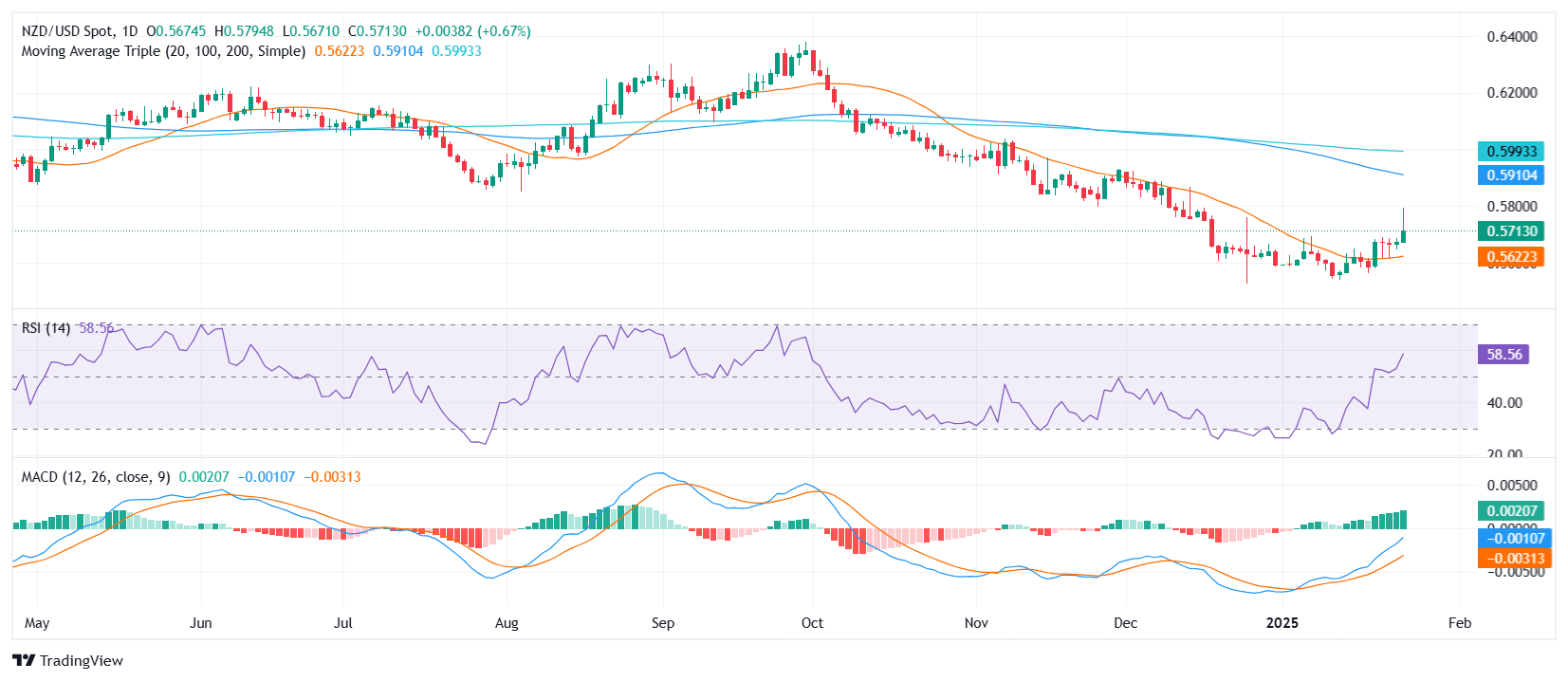
The NZD/USD pair continued its upward trajectory on Friday, rising by 0.44% to settle at 0.5705 and mantains its footing above its 20-day Simple Moving Average (SMA). This marks a steady continuation of the bullish momentum observed since mid-January, which was initiated by a breakout above the 0.5600 level. While minor pullbacks earlier in the week reflected potential profit-taking, the pair has maintained its position above 0.5700, signaling strong buying interest. On the negative side, the pair failed to sustain its intraday push near 0.5800.

Technical indicators align with the pair’s positive outlook. The Relative Strength Index (RSI) has climbed sharply to 63, firmly in positive territory, suggesting healthy upward momentum and room for further gains. Meanwhile, the Moving Average Convergence Divergence (MACD) histogram shows flat green bars, indicating sustained buying pressure despite a temporary pause in acceleration.

Immediate resistance is now seen at 0.5750, a level that could act as a gateway for the pair to aim higher. On the downside, support is found at 0.5670, followed by a more robust floor around 0.5640. As long as the pair stays above these support levels, the bullish trajectory remains intact, with potential for further appreciation in the near term.

NZD/USD daily chart
Author

Patricio Martín

Patricio is an economist from Argentina passionate about global finance and understanding the daily movements of the markets.


More from Patricio Martín
Share:

Markets move fast. We move first.

Orange Juice Newsletter brings you expert driven insights - not headlines. Every day on your inbox.

By subscribing you agree to our Terms and conditions.

Editor's Picks

EUR/USD eases to near 1.1650, eyes US PCE for fresh impetus

EUR/USD turns south to test 1.1650 in European trading on Friday, facing rejection once again near seven-week highs. The pair, however, continues to draw support from persistent US Dollar selling bias, despite a cautious market mood. Traders now await the US September PCE inflation and UoM Consumer Sentiment data. 

GBP/USD holds gains near 1.3350 ahead of US data

GBP/USD sticks to a positive bias near 1.3350 in the European session on Friday. Traders prefer to wait on the sidelines ahead of the key US inflation and sentiment data due later in the day. In the meantime, broad-based US Dollar weakness helps the pair stay afloat. 

Gold remains below $4,250 barrier as traders await US PCE data for directional impetus

Gold gains some positive traction on Friday, though it remains confined in the weekly range. Dovish Fed expectations continue to undermine the USD and lend support to the commodity. Bulls, however, might opt to wait for the US PCE Price Index before placing aggressive bets.

Pi Network: Bearish streak nears critical support trendline

Pi Network edges lower on Friday for the third consecutive day, approaching a local support trendline. The on-chain data suggests an increase in supply pressure as Centralized Exchanges experience a surge in inflows. Technically, the pullback in PI risks further losses, as the Moving Average Convergence Divergence indicator is flashing a sell signal. 

Canada Unemployment Rate expected to edge higher in November ahead of BoC rate decision

Statistics Canada will release its Labour Force Survey on Friday, and markets are bracing for a weak print. The Unemployment Rate is expected to tick higher to 7% in November, while the Employment Change is forecast to come in flat after a nice gain in October.

Pi Network Price Forecast: Bearish streak nears critical support trendline

Pi Network (PI) edges lower on Friday for the third consecutive day, approaching a local support trendline. The on-chain data suggests an increase in supply pressure as Centralized Exchanges (CEXs) experience a surge in inflows.















