|

NZD/USD Price Analysis: Attempting to break out of top of range

  • NZD/USD is testing the ceiling of its range and is poised to break higher. 
  • A move above the August 20 high would probably confirm a bullish breakout. 
  • Such a move could well see the pair reach the 0.6400s. 

NZD/USD is testing the ceiling of its sideways range. A break above the August 20 high would probably confirm an upside breakout with substantial gains on the horizon. 

NZD/USD 4-hour Chart 
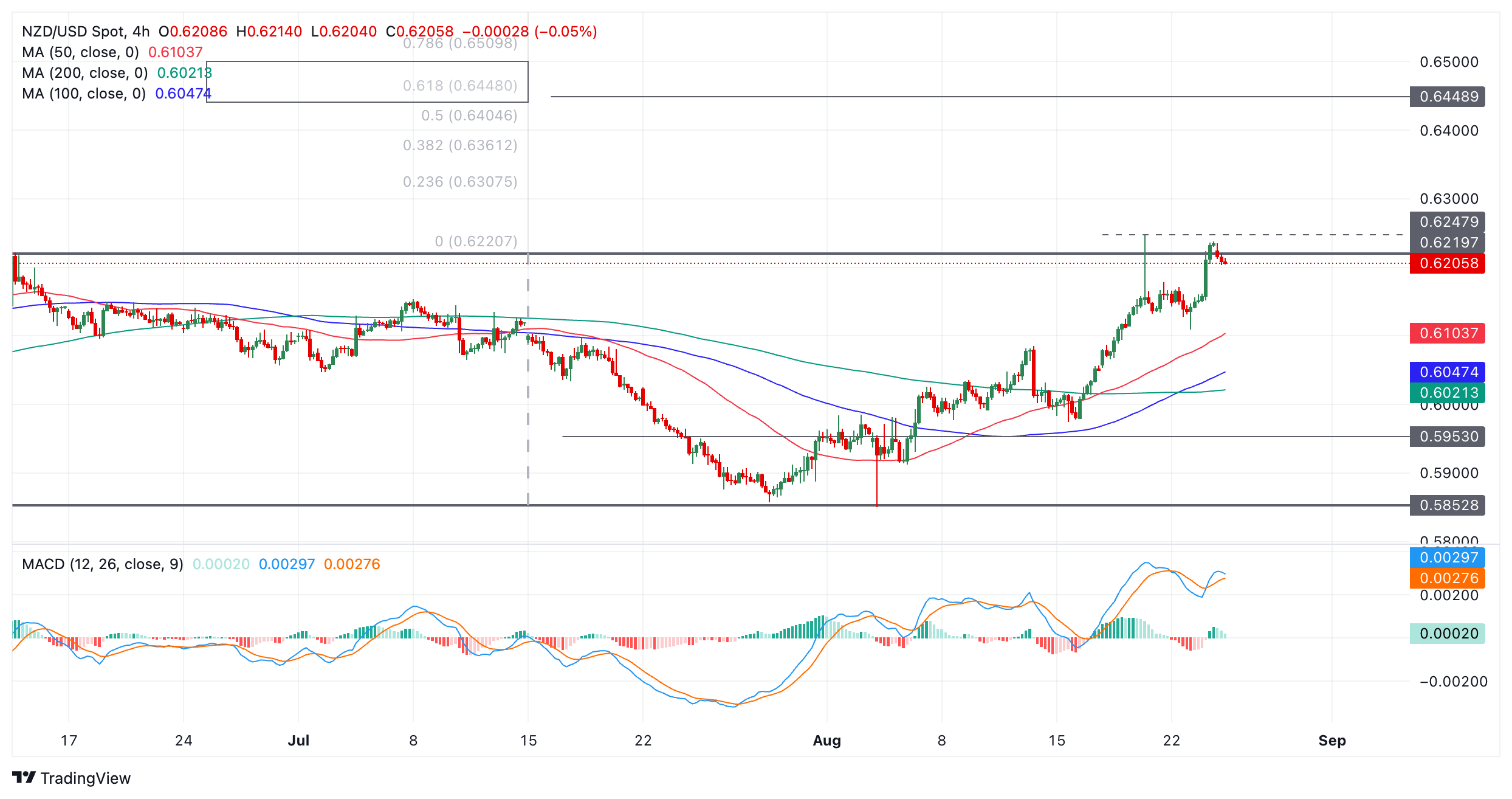
The pair temporarily breached the ceiling of its range on August 20 when it rose up to a high of 0.6248 before rapidly falling back down and forming a bearish Gravestone Doji candlestick in the process. This was followed by only a short period of weakness down to the 0.6109 August 22 swing low, however, before the pair recovered and broke back out of the range again on August 23. 

Since then, NZD/USD has pulled back down slightly a break above the 0.6248 August 20 highs, achieving a higher high would probably signal a decisive breakout. Such a breakout would activate the upside target, calculated as the 0.618 ratio of the height of the range extrapolated higher. This gives an upside target of 0.6448 (bold rectangle). Another, more conservative target lies at 0.6409 (December 2023 high). 

Such a move would probably also change the short-term trend from sideways to bullish.

A break below the 0.6109 swing low, however, would reconfirm the sideways trend as intact and likely to extend, with a probable down move towards the range lows in the 0.5850s.

Author

Joaquin Monfort

Joaquin Monfort is a financial writer and analyst with over 10 years experience writing about financial markets and alt data. He holds a degree in Anthropology from London University and a Diploma in Technical analysis.


More from Joaquin Monfort
Share:

Markets move fast. We move first.

Orange Juice Newsletter brings you expert driven insights - not headlines. Every day on your inbox.

By subscribing you agree to our Terms and conditions.

Editor's Picks

EUR/USD eases toward 1.1700 as USD finds fresh demand

EUR/USD eases toward the 1.1700 mark in Europe trading on Friday. The pair faces headwinds from a renewed uptick in the US Dollar as investors look past softer US inflation data. However, the EUR/USD downside appears capped by expectations of the Fed-ECB monetary policy divergence. 

GBP/USD steadies below 1.3400 as traders digest BoE policy update and US inflation data

The GBP/USD pair stalls the previous day's pullback from the vicinity of mid-1.3400s and a nearly two-month high, though it struggles to attract meaningful buyers during the Asian session on Friday. Spot prices currently trade around the 1.3380-1.3385 region, up only 0.05% for the day, amid mixed cues.

Gold stays weak below $4,350 as USD bulls shrug off softer US CPI

Gold holds the previous day's late pullback from the vicinity of the record high and stays in the red below $4,350 in the European session on Friday. The US CPI report released on Thursday pointed to cooling inflationary pressures, but the US Dollar seems resilient amid a fresh bout of short-covering.

Bitcoin, Ethereum and Ripple correction slide as BoJ rate decision weighs on sentiment

Bitcoin, Ethereum, and Ripple are extending their correction phases after losing nearly 3%, 8%, and 10%, respectively, through Friday. The pullback phase is further strengthened as the upcoming Bank of Japan’s rate decision on Friday weighs on risk sentiment, with BTC breaking key support, ETH deepening weekly losses, and XRP sliding to multi-month lows.

Bank of England cuts rates in heavily divided decision

The Bank of England has cut rates to 3.75%, but the decision was more hawkish than expected, leaving market rates higher and sterling slightly stronger. It's a close call whether the Bank cuts again in February or March.

Ethereum Price Forecast: EF outlines ways to solve growing state issues

Ethereum price today: $2,920. The EF noted that Ethereum's growing state could lead to centralization and weaken censorship resistance. The Stateless Consensus team outlined state expiry, state archive and partial statelessness as potential solutions to the growing state load.