|

NZD/USD ascends as greenback retreats on risk-appetite, sliding US yields

  • NZD/USD hovers around the 0.6000 mark, benefiting from a softer Greenback as US Treasury bond yields experience a decline.
  • US inflation data reveals a 3.9% YoY rise in PCE, easing pressures on the Fed to increase rates beyond the current 5.25%-5.50% range.
  • Upcoming RBNZ decision and potential US government shutdown add elements of anticipation and uncertainty to the market’s future movements.

The New Zealand Dollar (NZD) climbs against the US Dollar (USD), sponsored by an improvement in market sentiment and a Greenback that is falling as US Treasury bond yields slide. The NZD/USD remains trading at around the 0.6000 mark, at the time of writing, gains 0.76%.

New Zealand Dollar gains ground, rising 0.76% against a weakening US Dollar, US inflation data eases Fed rate hike pressures

Wall Street is trading in a better mood, as the US Department of Labor revealed the US Federal Reserve’s preferred gauge for inflation, the Personal Consumption Expenditures (PCE), which rose by 3.9% YoY, below July’s 4%, while headline inflation was 3.5% YoY as expected, a tick up from the prior’s month 3.4%.

The data eases off pressure on the Fed to increase rates to a higher level past the current 5.25%-5.50% range. Although most policymakers remain hawkish, others remain more cautious and fear overtightening monetary policy. From those, San Francisco, Boston, and Chicago Fed Presidents Mary Daly, Susan Collins, and Austan Goolsbee commented that patience is required while they remain undecided in regard to the next FOMC decision.

Additional data from the University of Michigan (UoM) showed that Consumer Sentiment for September's final reading deteriorated, while inflation expectations ticked up to 3.2% from 3.1% for one year. Americans see inflation at 2.8% on a five-year horizon, up from 2.7%.

In the meantime, next week’s economic docket will feature the Reserve Bank of New Zealand (RBNZ) decision, in which the central bank is projected to hold rates unchanged. On the US front, if a possible US government shutdown is dodged, the S&P and ISM PMIs would be released on Monday, and a tranche of Fed speakers.

NZD/USD Price Analysis: Technical outlook

Despite rallying, the NZD/USD is downward biased despite reaching a 7-week high, and although it is trading above the 0.6000 figure, it needs a daily close above the latter to keep buyers hopeful of higher prices. Key resistance levels lie on the upside, like the June 29 daily low of 0.6050, followed by the 0.6100 mark. Conversely, if the pair ends below 0.6000, the first support would be the 50-day moving average (DMA) at 0.5986, followed by the psychological 0.5950 mark and the September 27 swing low of 0.5899.
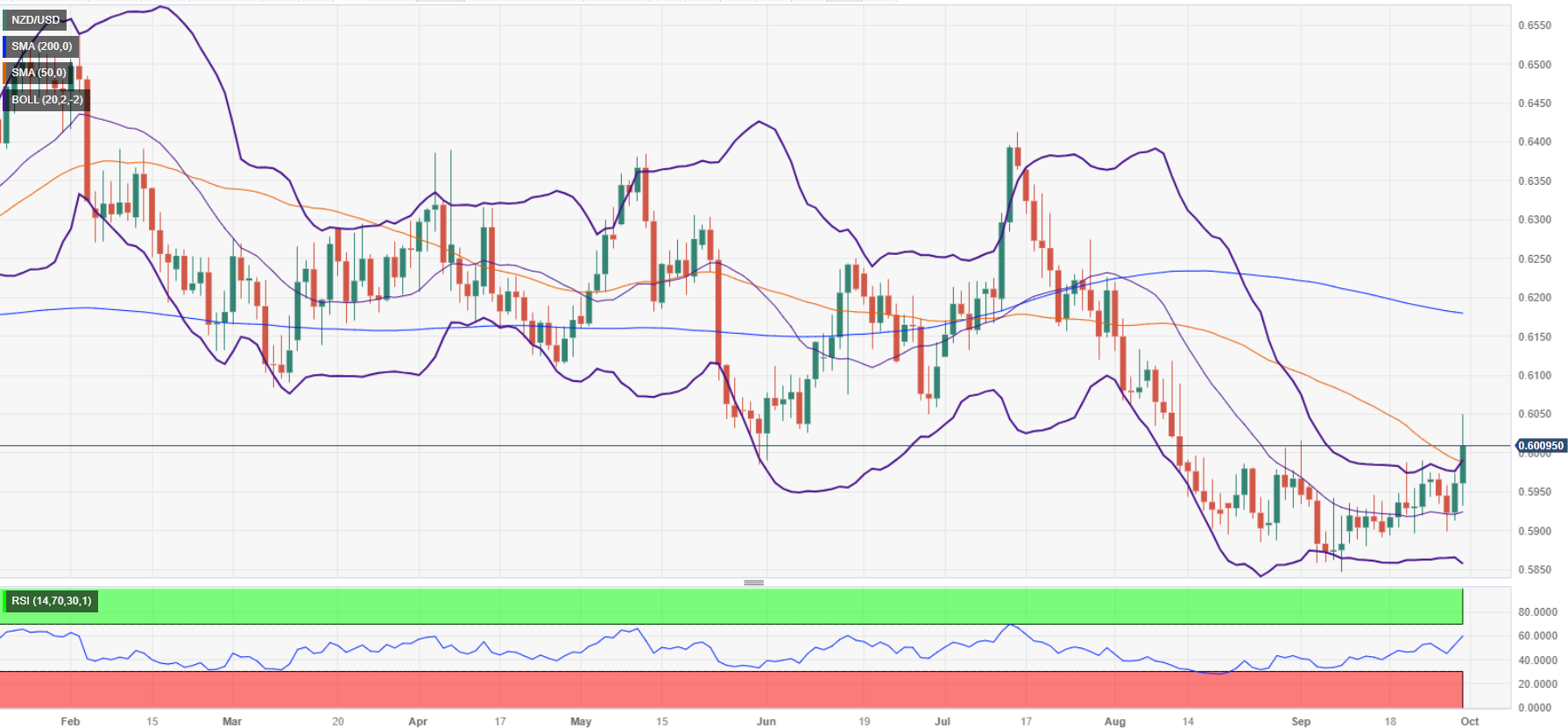
NZD/USD

Overview
Today last price0.601
Today Daily Change0.0049
Today Daily Change %0.82
Today daily open0.5961
 
Trends
Daily SMA200.5921
Daily SMA500.5992
Daily SMA1000.6081
Daily SMA2000.618
 
Levels
Previous Daily High0.5974
Previous Daily Low0.5913
Previous Weekly High0.599
Previous Weekly Low0.5894
Previous Monthly High0.6219
Previous Monthly Low0.5885
Daily Fibonacci 38.2%0.5951
Daily Fibonacci 61.8%0.5936
Daily Pivot Point S10.5925
Daily Pivot Point S20.5888
Daily Pivot Point S30.5864
Daily Pivot Point R10.5986
Daily Pivot Point R20.601
Daily Pivot Point R30.6047

Author

Christian Borjon Valencia

Markets analyst, news editor, and trading instructor with over 14 years of experience across FX, commodities, US equity indices, and global macro markets.


More from Christian Borjon Valencia
Share:

Editor's Picks

AUD/USD bulls regain control above 0.6950 amid USD retreat

AUD/USD regains traction and extends the previous day's bounce from the weekly low, aiming for 0.7000 in Asia on Friday. The overnight pullback in US bond yields keeps the US Dollar below an 18-month high, which in turn offers some support to the pair. Meanwhile, hawkish RBA expectations also keep the major underpinned.

USD/JPY holds gains near 158.00 after Japan's weak Household Spending data

USD/JPY clings to gains around 158.00 after data showed on Friday that Japan's Household Spending fell for the ninth straight month, undermining the Japanese Yen. Meanwhile, the US Dollar remains depressed as the overnight fall in US bond yields counters a hawkish Fed and geopolitical uncertainties, could cap any downside in the pair.

Gold remains range-bound below $4,200

Gold has given up some ground after an initial bullish attempt to reach weekly highs, returning to below the $4,200 mark per troy ounce on Friday. The US Dollar’s strong upside momentum, combined with rising US Treasury yields across the curve, seems to keep further gains in the yellow metal under scrutiny.

Has Bitcoin really escaped the macro forces it was built to fight?
Over 17 years ago, Satoshi Nakamoto designed Bitcoin (BTC) on the back of a global financial crisis as an alternative to the global monetary system outside the control of central banks, governments and traditional intermediaries. This raises a key question: has Bitcoin really become independent of the macroeconomic forces it was built to challenge?
The Euro is not the sick man of Europe. France's bond market is
EUR/USD remains under pressure, near the 17-month low of 1.1161 reached on Monday. The pair has lost more than 7% since its yearly peak, as concerns over France's public finances increasingly weigh on the single currency. But behind the weakness of the Euro (EUR), the problem does not necessarily lie with the European economy as a whole.
Has Bitcoin really escaped the macro forces it was built to fight?
Over 17 years ago, Satoshi Nakamoto designed Bitcoin (BTC) on the back of a global financial crisis as an alternative to the global monetary system outside the control of central banks, governments and traditional intermediaries. This raises a key question: has Bitcoin really become independent of the macroeconomic forces it was built to challenge?














