|

NZD/JPY price analysis: Cross retreats near daily lows ahead of Asian session

  • NZD/JPY trades near the 86.50 zone, under pressure despite a broader bullish outlook.
  • Momentum signals are mixed, with short-term averages supporting the upside but longer-term signals introducing caution.
  • Key support rests around 86.20, with resistance near 87.20 and 87.60.

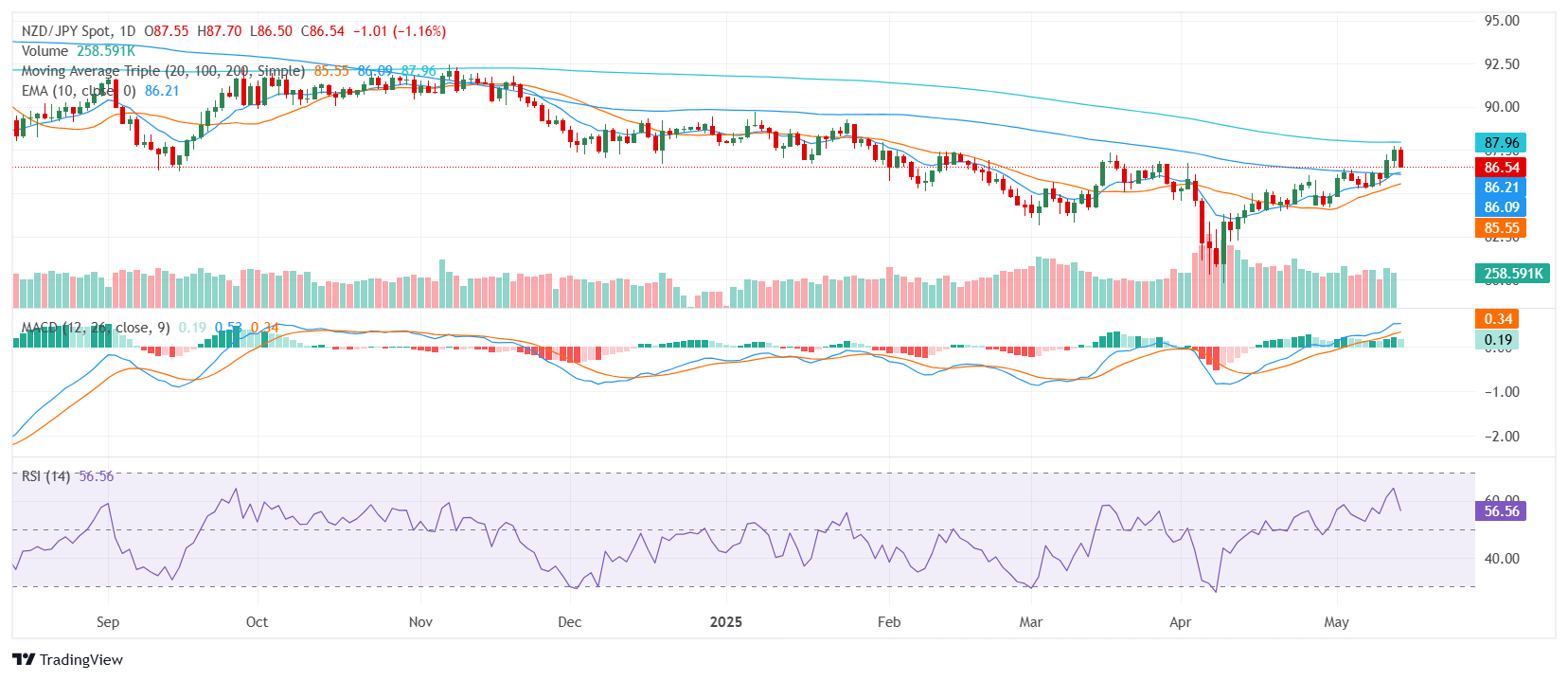
The NZD/JPY cross is trading near the 86.50 zone on Wednesday, down approximately 1% as it approaches the lower end of its daily range ahead of the Asian session. Despite maintaining a broader bullish signal, the cross has faced selling pressure, reflecting a mixed technical landscape as traders navigate recent volatility.

From a technical standpoint, the Relative Strength Index (RSI) hovers in the 50s, reflecting neutral momentum, while the Moving Average Convergence Divergence (MACD) indicates ongoing buy momentum, offering a more supportive tone for the cross. However, the Awesome Oscillator, sitting around 2, suggests a lack of clear directional strength, aligning with the broader mixed sentiment.

Adding to this cautious tone, the Stochastic %K (14, 3, 3) and Stochastic RSI Fast (3, 3, 14, 14) both remain in the 80s, signaling overbought conditions and hinting at potential near-term selling pressure. Despite this, the 20-day and 100-day Simple Moving Averages (SMAs) continue to support the buy side, as do the 10-period Exponential Moving Average (EMA) and 10-day SMA, both aligned in the 80s, reinforcing the overall positive outlook.

Immediate support is identified around 86.23, followed by deeper levels at 86.21 and 86.18. On the upside, resistance is expected near 87.21, with stronger barriers at 87.62 and 87.96, potentially capping gains in the short term.

Daily Chart
Author

Patricio Martín

Patricio is an economist from Argentina passionate about global finance and understanding the daily movements of the markets.


More from Patricio Martín
Share:

Editor's Picks

GBP/USD weakens below 1.3450 as US-Iran uncertainty boosts safe-haven US Dollar

The GBP/USD pair loses ground to near 1.3425 during the early Asian session on Tuesday. Uncertainty surrounding US-Iran talks drives traders toward a safe-haven currency such as the US Dollar against the British Pound. All eyes will be on the US July jobs data, which is due later on Friday.

EUR/USD flatlines above 1.1500 as traders turn cautious ahead of US NFP data

The EUR/USD pair holds steady around 1.1505 during the early European trading hours. Markets remain cautious ahead of the crucial US July jobs report, which is due later this week. Eurozone inflation ticked up in July, bolstering the case for a rate hike from the European Central Bank. The headline Eurozone inflation rose to 2.9% YoY in July from 2.8% in June, in line with expectations.

Gold consolidates above $4,050 amid Fed hike bets and Iran uncertainty

Gold seesaws between tepid gains and minor losses during the Asian session as traders seem hesitant and opt to wait for further developments surrounding the Middle East crisis. The US Dollar struggles to build on the previous day's solid bounce from the lowest level since Mid-June and acts as a tailwind for the bullion. However, the uncertainty over US-Iran peace talks helps limit the downside for the buck.

Ripple and Stellar steady as derivatives data points to easing downside pressure

Ripple and Stellar show mixed price action, with XRP holding above the key $1 support zone while XLM faces rejection at $0.173. Meanwhile, improving derivatives metrics alongside fading bearish momentum suggest that the downside pressure may be easing for both altcoins. Derivatives data shows mild bullish sentiment among traders.

NFP week: What awaits Bitcoin and Gold

This is an NFP week as markets brace for the release of a large influx of job market statistics. The data rollout begins with the JOLTS Job Openings report on Tuesday, continues with the ADP Employment report on Wednesday and Jobless claims on Thursday, and finishes with the Nonfarm Payrolls report on Friday.

9-3: Is the Federal Reserve’s vote tally Warsh's new forward guidance?
The rate did not move. Neither did the statement, and that’s the more interesting fact. Set the July 29 Federal Open Market Committee (FOMC) statement beside the one issued on June 17, and the two documents are identical apart from a single verb and a paragraph at the bottom naming three dissenters.