|

NZD/JPY Price Analysis: Bulls maintain dominance, overbought conditions may fuel a correction

  • The NZD/JPY rose by 0.52% during Thursday's session to 93.34.
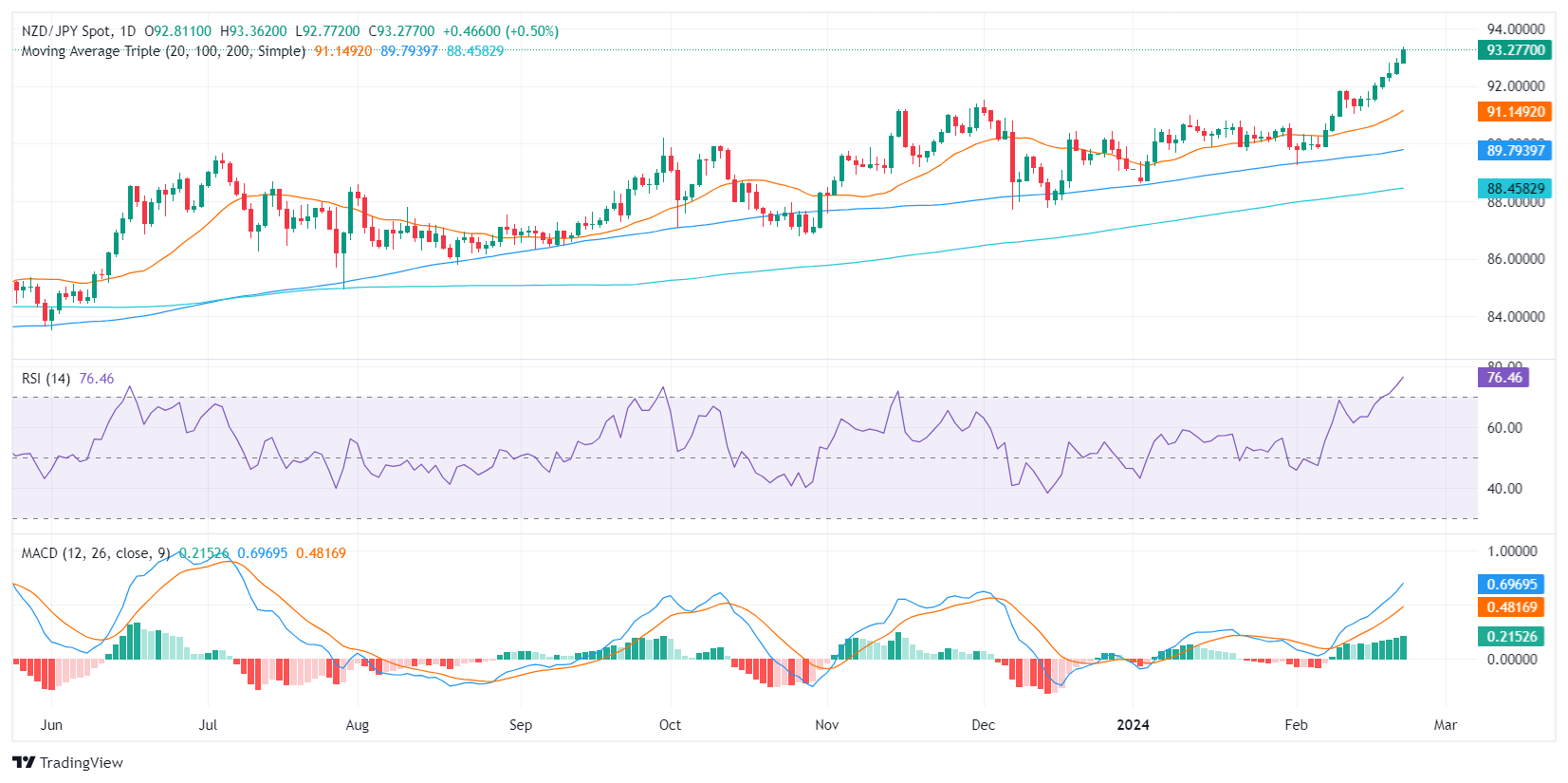
  • The daily RSI of the NZD/JPY signals overbought conditions, indicating a strong buying momentum with possibilities of a near correction.
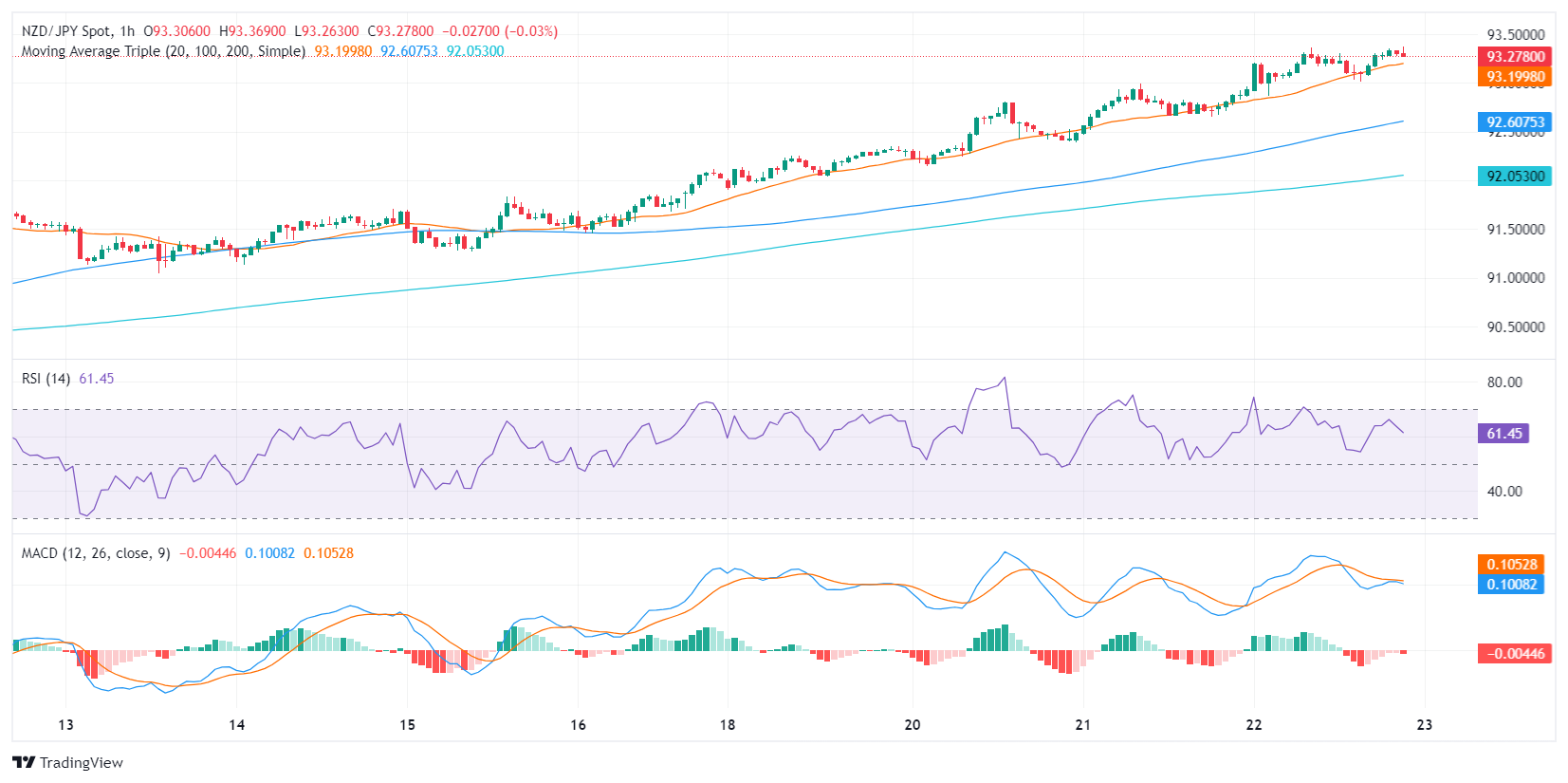
  • On the hourly chart, indicators are consolidating, making it a deviation from the overbought vibe of the daily chart.

In Thursday’s session, the NZD/JPY rose to 93.34, rallying by 0.52% reaching its highest level since 2015. It appears that buyers have predominantly influenced recent trends, causing the pair to enter an overbought territory with a Relative Strength Index (RSI) above 70 on the daily chart. While the persistent uptrend remains unbroken, caution might be advisable due to the over-extended buying movements which could use a healthy correction.

Meanwhile, the daily Moving Average Convergence Divergence (MACD) histogram continues to print green bars, indicating positive momentum in the short term. This underscores the powerful buying activity that has driven the pair into overbought territory.

In contrast, the hourly chart displays the RSI within a healthy 50-70 range, foreshadowing a potential short-term cooling off or consolidation period. Likewise, a slowdown in the robust buying momentum is suggested by the flat red hourly MACD histogram bars. However, the broader uptrend remains intact above the 200, 100, and 20-day SMAs on the daily chart.

NZD/JPY daily chart
NZD/JPY hourly chart
NZD/JPY

Overview
Today last price93.25
Today Daily Change0.44
Today Daily Change %0.47
Today daily open92.81
 
Trends
Daily SMA2091
Daily SMA5090.3
Daily SMA10089.75
Daily SMA20088.42
 
Levels
Previous Daily High92.99
Previous Daily Low92.39
Previous Weekly High92.12
Previous Weekly Low91.04
Previous Monthly High90.99
Previous Monthly Low88.64
Daily Fibonacci 38.2%92.76
Daily Fibonacci 61.8%92.62
Daily Pivot Point S192.47
Daily Pivot Point S292.13
Daily Pivot Point S391.87
Daily Pivot Point R193.07
Daily Pivot Point R293.33
Daily Pivot Point R393.67

Author

Patricio Martín

Patricio is an economist from Argentina passionate about global finance and understanding the daily movements of the markets.


More from Patricio Martín
Share:

Editor's Picks

AUD/USD remains below 0.7000 amid light trading

AUD/USD fills a modest bearish gap on Monday, but remains below 0.7000 in the Asian session amid holiday-thinned liquidity. The US Dollar attempts a bounce even as US bond yields pull back from multi-year highs, limiting the pair. Moreover, diminishing odds of another RBA rate hike in November cap the Aussie.

USD/JPY hovers above 158.00 amid Japan/ US holiday

USD/JPY extends its range-bound price action into a new week, trading above 158.00 as bulls remain on high alert amid speculation that authorities will step in to prop up the Japanese Yen. Meanwhile, softer US bond yields keep US Dollar bulls on the back foot and cap the pair's upside. However, geopolitical uncertainties could limit losses for the safe-haven buck amid thin liquidity due to a holiday in Japan and the US.

Gold  remains vulnerable below $4,200 on Fed hike bets

Gold is under mild selling pressure on Monday, trading at around $4,170. The US Dollar advances modestly in thin trading, supported by bets that the Federal Reserve will hike rates at least one more time before year-end.

Bitcoin struggles as ETF outflows, geopolitical uncertainty weigh

Bitcoin hovers around $83,600 on Monday after a 3.1% correction last week. US-listed spot ETFs recorded an outflow of $681.10 million last week, snapping the three-week inflow streak. Geopolitical uncertainty and mixed signals keep investors cautious.

The week ahead: A critical week as earnings and CPI test market

The Oil price is relatively stable this morning, and US and European stock markets are poised to open higher, as risk sentiment shrugs off an escalation in the Middle East and concerns about rising bond yields.

Has Bitcoin really escaped the macro forces it was built to fight?
Over 17 years ago, Satoshi Nakamoto designed Bitcoin (BTC) on the back of a global financial crisis as an alternative to the global monetary system outside the control of central banks, governments and traditional intermediaries. This raises a key question: has Bitcoin really become independent of the macroeconomic forces it was built to challenge?














