Nvidia results: What to expect and can they save the AI trade?
- Why Nvidia’s revenues can keep rolling in.
- Nvidia earnings: The macro event of the quarter.
- Can Nvidia’s results save the AI trade?
- Nvidia’s history of stock market weakness after earnings reports.
- Is the tech stock sell-off OpenAI’s fault?
- Why Nvidia could benefit from divergence in the AI trade.

This Wednesday, Nvidia will report results for last quarter. Analysts are expecting an extraordinary set of results. Revenues for last quarter are expected to surge to $55.19bn, 57% higher than a year ago. Net income is expected to come in at $30.85bn, a 55% increase compared to a year ago.
Analysts have upgraded their forecasts for Nvidia’s earnings in the past 4 weeks, and the good news may not stop there. Forecasts for next year also look strong. The company is expected to announce monster profits for the future, with its 1-quarter ahead forecast expected to show revenues rising further to $46.14bn in the first three months of 2026.
Why Nvidia’s revenues can keep rolling in
So, where are these earnings coming from and why are analysts confident that Nvidia can continue to generate huge revenues? Nvidia is a transformative company. Without it, there would be no Artificial Intelligence. Its chips and GPUs are the lynchpin of the AI revolution. It also has a bullet proof supply chain. Nvidia’s largest customers are Microsoft, Meta, Super Micro Computers, Amazon and Alphabet. Microsoft accounts for 18% of Nvidia’s revenues, while Meta makes up nearly 10%. Since Microsoft has pledged to spend $120bn on AI next year, and Meta has pledged to spend $100bn, a chunk of this money, some $90bn in 2026, could be heading to Nvidia, which gives analysts confidence that the revenues can keep rolling in.
Of course, when or if Microsoft and Meta stop spending as much on AI then Nvidia’s future revenue streams will be at risk. However, that is a worry for another day. While there are genuine concerns about the AI trade and how much money is being spent on AI infrastructure, the future could be transformed by this new technology, so there is a strong argument to be made that the hyperscalers should continue to invest.
Nvidia earnings: The macro event of the quarter
Nvidia results are not just any earnings report, they are treated like a macro event. This is because Nvidia is the world’s largest company, as measured by market capitalization, it is currently worth $4.53 trillion. How it performs will have an impact on US and global financial markets. Also, if its stock price falters, then it could threaten the entire AI trade.
Nvidia’s market capitalization growth has outpaced the overall S&P 500’s market capitalization growth, as the company has become more important to the overall US market
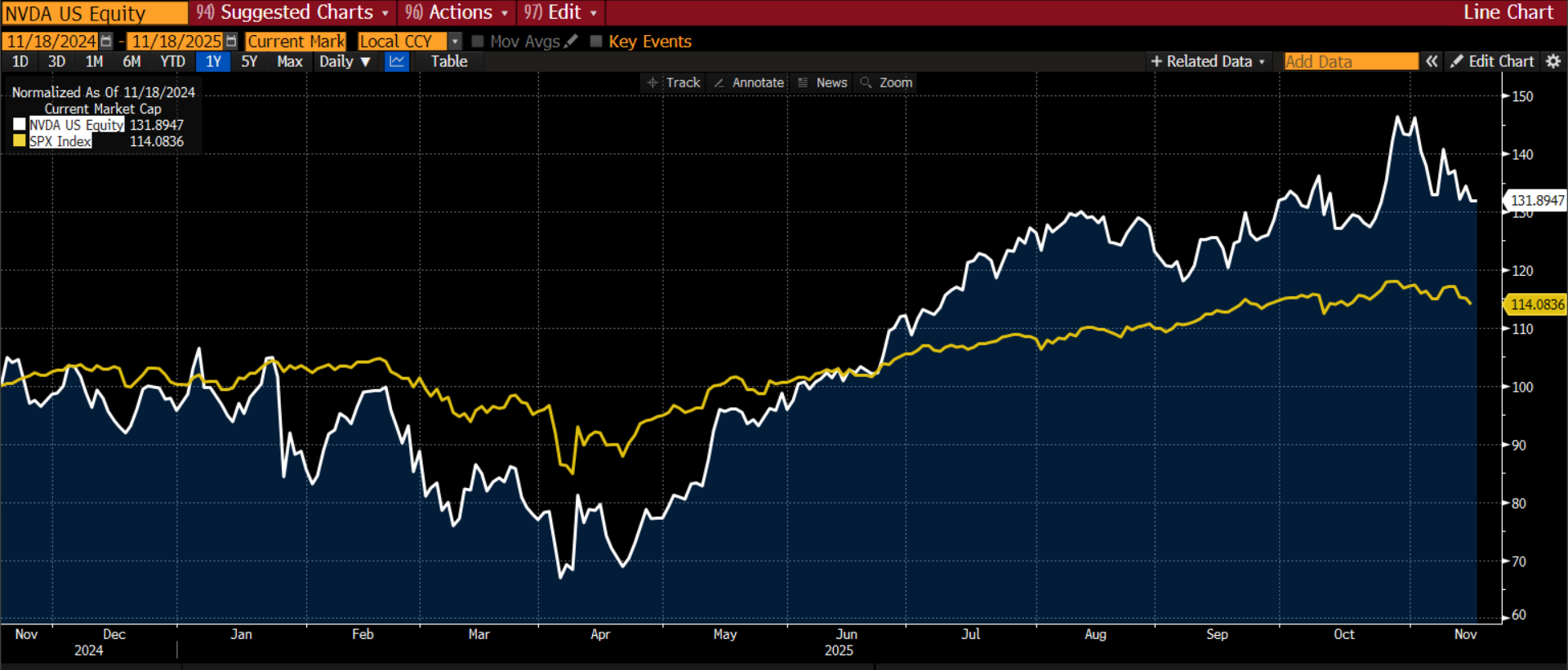
Source: XTB and Bloomberg
Can Nvidia’s results save the AI trade?
As lead up to Nvidia’s earnings report, the AI trade has faltered. Nvidia’s share price is down more 4% in the past 5 days, and it is testing its 50-day moving average. A move below this level, at $185.97, would suggest that short-term momentum is to the downside. Sentiment towards Nvidia has shifted since it was announced that Softbank had sold its $5 bn stake in the chip maker, Peter Thiel’s fund also sold its entire stake last quarter. This does not mean that there is something fundamentally wrong with Nvidia and its earnings report is expected to show that its fundamentals are incredibly healthy. Instead, large investors may be booking profits from highly lucrative holdings to invest in other, less well-known AI stocks.
The wider AI trade has also come under pressure. The iShares future AI and tech ETF is lower by more than 10% since peaking at the end of October. Also, the Magnificent 7 group of mega cap tech stocks has breached its 50-day sma and is back at its lowest level for a month.
Nvidia’s history of stock market weakness after earnings reports
One company’s results cannot save the AI trade, but it will be interesting to see how the market reacts to another monster earnings report from Nvidia. In three out of the last five quarterly earnings reports, the stock price has fallen, even though earnings surprised on the upside. Thus, Nvidia has a short-term history of stock price volatility to the downside around good earnings reports. Its Q2 earnings report saw the share price fall 0.79% on the day after results were announced. After its January earnings report, the stock price plunged some 8.4%, even though the company reported a 6% increase in earnings per share. Thus, the market has got into the habit of ‘buying the rumour and selling the fact’ when it comes to Nvidia’s earnings reports.
Overall, the company is expected to report a stunning set of results. Revenue growth is outstanding, and margins are expected to show that the company remains in robust health, even though sales to China remain compromised. This should be an earnings report that investors love, however, the recent history of Nvidia’s stock price performance after an earnings report is for the stock to trend lower. While it could do the same this time, we would note that Nvidia has already experienced a hefty sell-off in recent days, and we shall have to see if that will attract dip buyers.
Is the tech stock sell off OpenAI’s fault?
Nvidia’s share price has taken a hit as the AI trade has come under greater scrutiny, however, is this justified? There has undoubtedly been some questionable spending commitments in the AI space recently. For example, OpenAI has pledged $1 trillion in investment to boost its AI infrastructure and compute power. This has led to more scrutiny from investors as they now focus on tech stocks’ return on investment and free cash flow figures.
Why Nvidia could benefit from divergence in the AI trade
Although Nvidia has made some ‘circular’ investments in companies that will buy Nvidia-made chips, this has been a tiny fraction of the company’s overall balance sheet, however, Nvidia has been tarred with the same brush. We think that 2026 could see a divergence in the performance of AI stocks, with ‘safe and reasonable’ AI companies outperforming the riskier companies who have been spendthrift with capex. We believe that Nvidia will be considered part of the former group, and any share price weakness on the back of this earnings report could be used as an attractive buying opportunity for a company that is a reliable cash and revenue-generating machine.
Magnificent seven, divergence is already occurring with Google and Nvidia leading the way
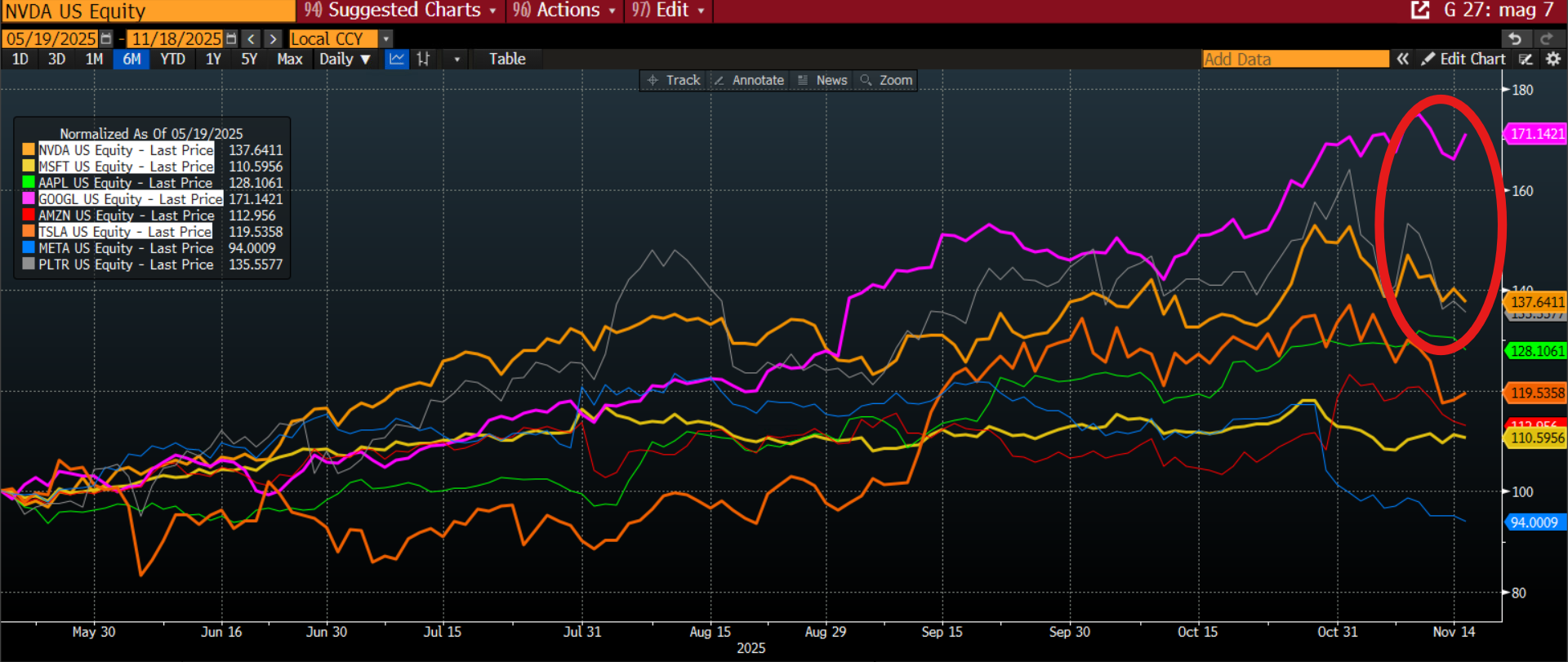
Source: XTB and Bloomberg
Author

Kathleen Brooks
XTB UK
Kathleen has nearly 15 years’ experience working with some of the leading retail trading and investment companies in the City of London.