British Pound Sterling wins the day and stays stuck in the same trap
- GBP/USD trades just below 1.3400, up a quarter of a percent, leaning on the 200-day EMA that has capped it all week.
- A war-driven Oil spike has markets fully pricing a Bank of England hike by year-end, with November odds now above even.
- Hawkish Federal Reserve minutes keep the Dollar bid and the ceiling firmly in place.
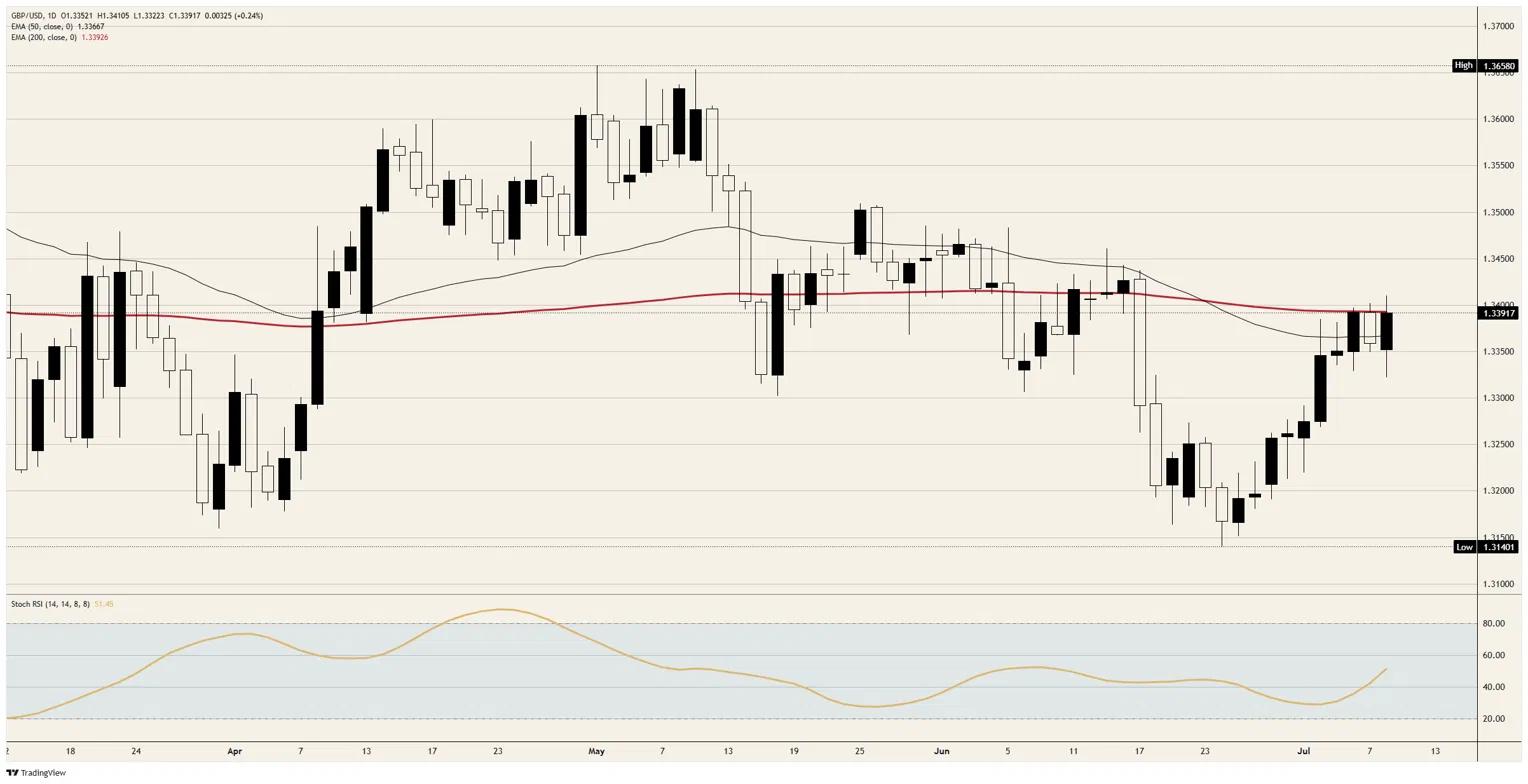
GBP/USD trades just below 1.3400 on Wednesday, up around a quarter of a percent and once again leaning on the 200-day Exponential Moving Average (EMA) that has repelled every advance since the pair clawed back from its mid-June washout. Cable has recovered roughly two big figures from the 1.3150 area in under two weeks, and the reward for the effort is a ceiling it cannot break and a floor it refuses to leave.
An imported inflation shock does the heavy lifting
The Pound's bid is not homegrown: Fresh US strikes on Iran sent Crude Oil surging more than 6% and dragged Bank of England (BoE) tightening expectations up with it. Markets now fully price a 25-basis-point hike by year-end, up from roughly three-quarters odds before President Trump declared the Versailles ceasefire over, and a November move trades better than even. The June hold at 3.75% already carried two dissenters voting for 4.00%, so the hawkish bloc only needs the energy shock to persist, and the Strait of Hormuz is supplying persistence daily.
The same shock cuts the other way through the real economy, which is why the trap holds instead of resolving higher. Services inflation at 3.7% sits exactly where the BoE cannot ignore it, while the services Purchasing Managers Index (PMI) is below the 50 line, payroll counts are shrinking, and pay growth is cooling toward 3.4%. A central bank hiking into a contracting services sector is not a currency's friend for long, and Sterling traders keep pricing both halves of that sentence at once.
Tuesday's Financial Stability Report added little heat, flagging leverage, stretched valuations and cyber risk while pronouncing the system resilient, and the Governor has already ruled out near-term cuts while conceding the 2% target now arrives later than forecast. The rates market heard all of it as permission to keep the hike priced, which is the only reason a currency attached to a contracting services sector is trading at a three-week high.
The Dollar side refuses to blink
Wednesday's Federal Open Market Committee (FOMC) minutes, released at 18:00 GMT, barely moved the pair, and the non-reaction is itself the finding. The account showed a committee split almost evenly, with many members seeing the funds rate above the current range by year-end and many others at or below it; the June dot grid printed nine hikes against eight holds and a single cut, while the new Chair keeps stripping forward guidance out of the communication entirely. A quiet split changes no pricing, but it guarantees the Dollar stays bid into every inflation print.
With the Bank Rate at 3.75% and the Federal Reserve (Fed) range at 3.50%-3.75%, there is no meaningful yield gap for Cable to trade, so the pair defaults to headlines and positioning. UK politics supplies just enough of the former: Andy Burnham remains the presumptive successor to Keir Starmer, with a handover possible by mid-July, yet he has still not named a Chancellor, with Ed Miliband floated for the role. Sterling is pricing a managed transition rather than a fight, which is one more reason nothing moves far.
A quiet calendar keeps the cage locked
Thursday offers a BoE deputy governor's speech at 09:30 GMT and US Initial Jobless Claims at 12:30 GMT, with 218K expected; neither is built to break a 200-day EMA. The heavier tests stack up from July 14, when US Consumer Price Index (CPI) data opens a run that includes UK growth, jobs and inflation prints before the Fed and the BoE both decide policy at the end of the month. Until one of those releases forces the issue, the consolidation is the trade, and the market knows it: Momentum sits mid-range and directionless while the pair oscillates in an ever-tighter pocket beneath the moving average.
Cable has spent the week grinding against the same fifty-pip pocket beneath the average, and compression this stubborn tends to resolve violently rather than politely. The awkward part for both camps is that the calendar between now and July 14 offers nothing with the horsepower to force the break, which leaves strait headlines and the Dollar's mood as the only wildcards with intraday teeth.
GBP/USD technical levels to watch
Resistance: The 200-day EMA just below 1.3400 is the wall, with 1.3450 behind it and the 1.3500 handle above that; the pair has not traded through that zone since sliding off the May peak near 1.3650.
Support: The 50-day EMA inside the 1.3350-1.3400 pocket props up intraday dips, ahead of 1.3300 and the June base at 1.3150.
Bias: Bullish only on a daily close above 1.3400; until the 200-day EMA gives way, rallies are for fading back into the 1.3350 pocket, and a loss of 1.3300 would flip the tape bearish toward the June base.
GBP/USD daily chart
Pound Sterling FAQs
The Pound Sterling (GBP) is the oldest currency in the world (886 AD) and the official currency of the United Kingdom. It is the fourth most traded unit for foreign exchange (FX) in the world, accounting for 12% of all transactions, averaging $630 billion a day, according to 2022 data. Its key trading pairs are GBP/USD, also known as ‘Cable’, which accounts for 11% of FX, GBP/JPY, or the ‘Dragon’ as it is known by traders (3%), and EUR/GBP (2%). The Pound Sterling is issued by the Bank of England (BoE).
The single most important factor influencing the value of the Pound Sterling is monetary policy decided by the Bank of England. The BoE bases its decisions on whether it has achieved its primary goal of “price stability” – a steady inflation rate of around 2%. Its primary tool for achieving this is the adjustment of interest rates. When inflation is too high, the BoE will try to rein it in by raising interest rates, making it more expensive for people and businesses to access credit. This is generally positive for GBP, as higher interest rates make the UK a more attractive place for global investors to park their money. When inflation falls too low it is a sign economic growth is slowing. In this scenario, the BoE will consider lowering interest rates to cheapen credit so businesses will borrow more to invest in growth-generating projects.
Data releases gauge the health of the economy and can impact the value of the Pound Sterling. Indicators such as GDP, Manufacturing and Services PMIs, and employment can all influence the direction of the GBP. A strong economy is good for Sterling. Not only does it attract more foreign investment but it may encourage the BoE to put up interest rates, which will directly strengthen GBP. Otherwise, if economic data is weak, the Pound Sterling is likely to fall.
Another significant data release for the Pound Sterling is the Trade Balance. This indicator measures the difference between what a country earns from its exports and what it spends on imports over a given period. If a country produces highly sought-after exports, its currency will benefit purely from the extra demand created from foreign buyers seeking to purchase these goods. Therefore, a positive net Trade Balance strengthens a currency and vice versa for a negative balance.
Author

Joshua Gibson
FXStreet
Joshua joins the FXStreet team as an Economics and Finance double major from Vancouver Island University with twelve years' experience as an independent trader focusing on technical analysis.