Nvidia rally continues on Thursday as Trump approves H200 buyers in China
- The US cleared ten Chinese firms to purchase Nvidia's H200 AI chip.
- President Trump held summit with Xi Jinping on Thursday in Beijing.
- No purchases have yet been made as China steers its firms away from relying on second-tier AI tech.
- Up 2% in the premarket, Nvidia stock could gain for seventh straight day on Thursday.

Nvidia (NVDA) stock is the early winner of the United States (US) President Donald Trump's summit with China on Thursday. Shares of the AI chipmaker rose more than 2% in Thursday's premarket. If the gains remain through the close, this will become NVDA's seventh consecutive day of gains.

President Trump's Commerce Department approved ten Chinese firms to import Nvidia's H200 AI chip, as well as a few other distributors in the Asian region.
US Retail Sales for April fell from 1.6% MoM in March to 0.5% MoM, but that was in line with the consensus. The Dow Jones Industrial Average (DJIA) futures rose 0.9% in the premarket on Thursday, while the NASDAQ Composite futures declined 0.2%, and S&P 500 futures gained 0.3% on the news.
Nvidia could boost China sales on Commerce Department clearance
Nvidia has been looking to regain market share in China after several rounds of trade barriers were imposed by the Biden and then Trump administrations over the past several years. Before the curbs were imposed by Washington, Nvidia held a 95% share of China's AI chip market. But in the intervening years, a number of Chinese players have begun producing competitive chips.
The H200 is a second-tier technology, building on the platform of the earlier H100 model by applying a heavier allowance for memory and bandwidth. But Washington continues to bar Chinese companies from legally purchasing Nvidia's newest suite of Blackwell chips.
The US started approving H200 chip sales on a case-by-case basis last autumn, but sales have been meager as Beijing has steered some Chinese firms toward domestic rivals.
The US Commerce Department's new clearance this week allows Alibaba (BABA), Tencent (TCEHY), ByteDance (BDNCE) and JD.com (JD) and others to purchase the H200, as well as distributors Foxconn and Lenovo. However, companies are only allowed to purchase up to 75,000 chips.
Nvidia stock chart
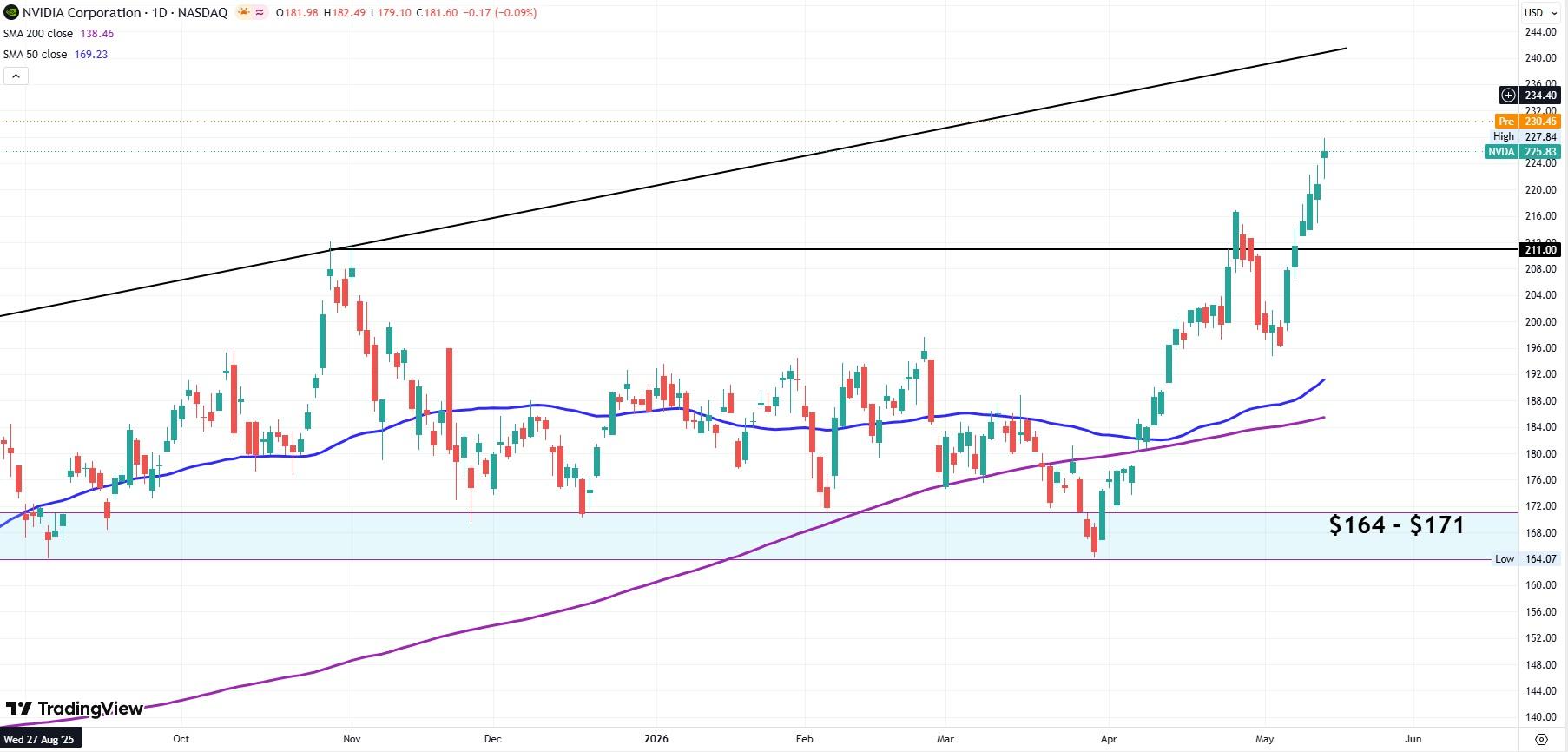
The new rally affecting NVDA's share price is the second leg of the rally that began with the rest of the NASDAQ at the start of April. The first leg reached a high of $216.83 on April 27 before initiating a pullback that found support around $195.
Monday of this week marked the first close above that April 27 high, and now Nvidia stock looks poised to test the top of the long-term trendline near $240. Support arises at the $216.83 previous high, the $211 resistance from October 2025, and the medium-term support between the 50-day and 200-day Simple Moving Averages between $185 and $191.
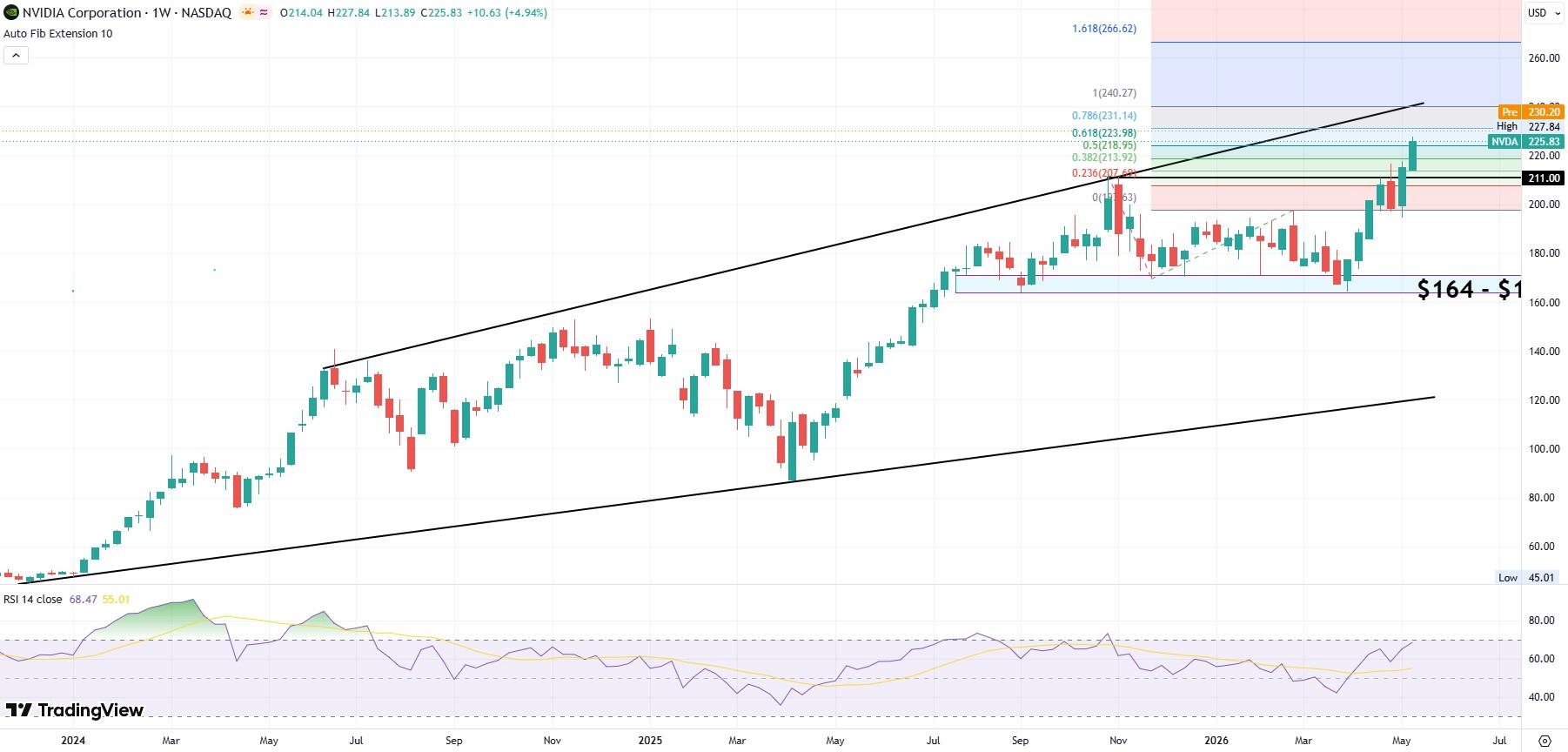
The topline of the long-term price channel, as seen below on the weekly chart, began in June 2024. The inverve Fibonacci Extension shows that the topline converges with the 100% level near that $240 price level, giving that area even more significance.
Since the Relative Strength Index (RSI) on the weekly chart provides us with a 68 reading, we're still not in overbought territory. Bulls should focus instead on the immediate momentum and the $240 target rather than focusing too hard on the RSI in the near term. But the rising RSI does mean that swing traders shouldn't consider NVDA for entry at this juncture.
Author

Clay Webster
FXStreet
Clay Webster grew up in the US outside Buffalo, New York and Lancaster, Pennsylvania. He began investing after college following the 2008 financial crisis.
















