NOC bullish cycle nearing completion with possible retest of highs


NOC remains in a strong long-term bullish structure, but the Elliott Wave cycle looks mature and may retest recent highs before a deeper corrective phase begins.
Northrop Grumman Corporation (NYSE: NOC) remains in a strong long-term bullish trend on the monthly chart. The stock has shown years of steady growth supported by a clear Elliott Wave structure. However, the current cycle now looks mature and may be close to completing. Before this cycle ends, price may retest or slightly break recent highs.
The Elliott Wave counts show that Northrop Grumman completed a major long-term Wave II correction in the past. This correction helped reset the market and prepared it for a powerful new bullish phase. After Wave II ended, the stock started a strong impulsive advance. It developed into a multi-year Wave III rally. After that, the market pulled back in Wave IV but stayed above key support. This confirmed that the main bullish trend was still intact.
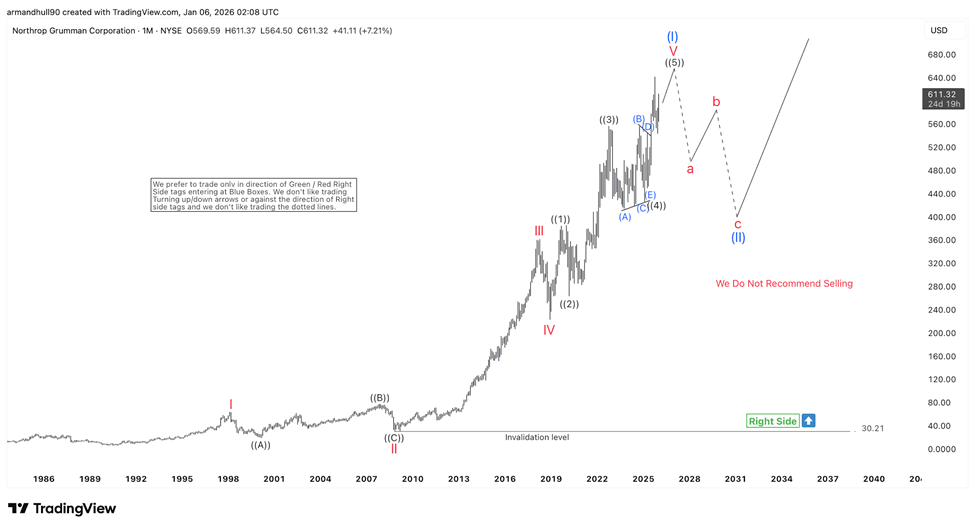
From Wave IV, the stock entered an even stronger phase. It developed a clear five-wave structure into V. Inside this move, we can see waves ((1)), ((2)), ((3)), ((4)), and ((5)). Wave ((3)) showed strong momentum, which is normal in Elliott Wave theory. Wave ((4)) formed a sideways corrective structure and held well. The final push higher completed Wave V of Wave (I), showing that the bullish cycle is now advanced.
Even though the cycle is near completion, the chart still suggests some upside. The price can retest or slightly break the recent highs before a bigger correction starts. After that, the stock is expected to enter Wave (II), which may unfold as an a-b-c decline. This correction should be seen as healthy and part of a larger bullish outlook, not a bearish reversal.
The long-term Right Side tag remains bullish. The invalidation level is far lower, which keeps the main trend positive for now.
Conclusion
Northrop Grumman remains bullish, but the current Elliott Wave cycle is getting close to completion. A retest of highs may still happen before a larger corrective Wave (II) develops.
Author
Elliott Wave Forecast Team
ElliottWave-Forecast.com