|

NIO Stock Price and Forecast: Shares crash after selloff on renewed COVID-19 fears and lack of stimulus

  • NYSE:NIO drops alongside broader markets as the electric vehicle sector continues to get pummeled.
  • Low chance of a stimulus package before November 3rd triggers volatile stocks selloff.
  • With another wave of COVID-19 in Europe, NIO’s expansion to the continent may be delayed.

NYSE:NIO has finally slowed down its torrid pace from earlier this year as shares tumbled on Monday to the tune of 4.23% amidst a broader market selloff as the global economy braces itself for another wave of COVID-19. The NASDAQ shed 189 basis points, while the Dow Jones was the biggest loser on the day, dropping over 650 basis points as the fading hopes of a stimulus package from the American government sent investors packing. In times of uncertainty, it is common for volatile stocks to be sold off first as investors seek stability until the markets settle.

NIO was not the only electric vehicle company to struggle as Tesla (NASDAQ:TSLA), Workhorse (NASDAQ:WKHS), Hyliion (NYSE:HYLN), Nikola (NASDAQ:NKLA), and Xpeng (NYSE:XPEV) all fell significantly as investors shed some profits from each company’s run-up from earlier this year. Part of NIO’s outlook in 2021 includes expanding into Europe, although a spike in coronavirus cases may slow that down if the status worsens. 

NIO stock news
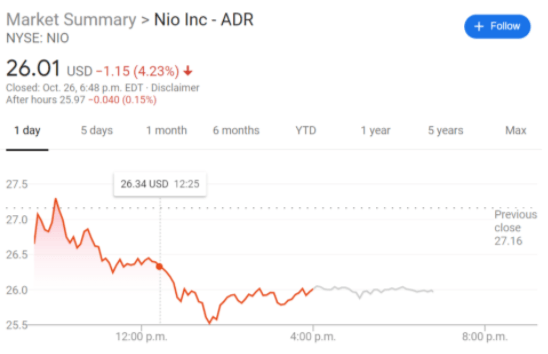
NIO stock price chart

As the chances of government stimulus continue to shrink ahead of the November 3rd federal election, investors can expect to see continued volatility in the markets, especially sectors like EV-automakers. While NIO should still see a positive end to the year with its quarterly earnings call presumably at some point in mid-November, as well as NIO Day in January, NIO investors may have to put up with some more short-term pain until things begin to stabilize. 

Premium

You have reached your limit of 3 free articles for this month.

Start your subscription and get access to all our original articles.

Subscribe to PremiumSign In

Author

More from Stocks Reporter
Share:

Markets move fast. We move first.

Orange Juice Newsletter brings you expert driven insights - not headlines. Every day on your inbox.

By subscribing you agree to our Terms and conditions.

Editor's Picks

EUR/USD bounces toward 1.1750 as US Dollar loses strength

EUR/USD returned to the 1.1750 price zone in the American session on Friday, despite falling Wall Street, which indicates risk aversion. Trading conditions remain thin following the New Year holiday and ahead of the weekend, with the focus shifting to US employment and European data scheduled for next week.

GBP/USD nears 1.3500, holds within familiar levels

After testing 1.3400 on the last day of 2025, GBP/USD managed to stage a rebound. Nevertheless, the pair finds it difficult to gather momentum and trades with modest intraday gains at around 1.3490 as market participants remain in holiday mood.

Gold trims intraday gains, approaches $4,300

Gold retreated sharply from the $4,400  area and trades flat for the day in the $4,320 price zone. Choppy trading conditions exacerbated the intraday decline, although XAU/USD bearish case is out of the picture, considering growing expectations for a dovish Fed and persistent geopolitical tensions.

Cardano gains early New Year momentum, bulls target falling wedge breakout

Cardano kicks off the New Year on a positive note and is extending gains, trading above $0.36 at the time of writing on Friday. Improving on-chain and derivatives data point to growing bullish interest, while the technical outlook keeps an upside breakout in focus.

Economic outlook 2026-2027 in advanced countries: Solidity test

After a year marked by global economic resilience and ending on a note of optimism, 2026 looks promising and could be a year of solid economic performance. In our baseline scenario, we expect most of the supportive factors at work in 2025 to continue to play a role in 2026.

Crypto market outlook for 2026

Year 2025 was volatile, as crypto often is.  Among positive catalysts were favourable regulatory changes in the U.S., rise of Digital Asset Treasuries (DAT), adoption of AI and tokenization of Real-World-Assets (RWA).